History, Faith, the Tilma, and the Man Chosen by Heaven
Few events in Christian history unite documented history, living devotion, and unexplained physical evidence as powerfully as the apparitions of Our Lady of Guadalupe in 1531. At the center of this event stands Saint Juan Diego Cuauhtlatoatzin, an Indigenous man whose obedience reshaped the spiritual destiny of the Americas.
This article presents a complete, historically accurate, and theologically grounded account of the Guadalupe event—addressing Juan Diego’s identity, the apparitions, the tilma’s mysteries, attempts to destroy it, and why it took nearly five centuries for the Church to formally recognize the man Heaven chose.
1. Who Was Juan Diego?
Identity, Tribe, and Historical Context
Juan Diego Cuauhtlatoatzin was born in 1474 in Cuautitlán, in the Valley of Mexico, about 14 miles north of present-day Mexico City.
Tribal and Cultural Identity
- Juan Diego was Indigenous Nahua.
- He is widely associated with the Chichimeca peoples (a broad classification used by the Aztecs for northern Nahua-speaking groups).
- His cultural formation is best described as Toltec-influenced Nahua, not Aztec.
Important clarification:
The term Toltec refers less to a strict ethnicity and more to a cultural and intellectual tradition known for philosophy, art, moral refinement, and theological reflection. Many Nahua peoples—including Juan Diego’s—identified themselves as inheritors of Toltec wisdom.
Juan Diego’s people were subjugated by the Aztec Empire before the Spanish conquest and later suffered further upheaval under colonial rule.
2. Conversion and Early Christian Life
Juan Diego was baptized around 1524, shortly after the arrival of Franciscan missionaries. By the time of the apparitions, he was:
- A widower
- Poor and uneducated by European standards
- Known for humility, consistency in prayer, and faithfulness
Every week, he walked long distances to attend Mass and receive instruction—an act that already marked him as spiritually disciplined.
3. Tepeyac Hill: Where Heaven Chose to Appear
Tepeyac Hill lies in what is now northern Mexico City, once just outside the Aztec capital of Tenochtitlán.
Before Christianity, Tepeyac had associations with a mother-figure veneration. However, the Guadalupan apparition did not affirm or revive pagan worship. Instead:
- Mary identified herself as “the Mother of the True God through whom all things live”
- She redirected spiritual longing toward the Creator, not toward pre-Christian deities
The location became a place of healing, reconciliation, and new identity, not syncretism.
4. The Apparitions (December 9–12, 1531)
Between December 9 and December 12, 1531, the Virgin Mary appeared to Juan Diego multiple times.
Key historically attested elements:
- She spoke Nahuatl, his native language
- She appeared as a mestiza-looking woman, visually bridging cultures
- She requested a church be built so she could:
- Offer love
- Provide compassion
- Hear prayers
- Protect all who sought her Son
The bishop, Fray Juan de Zumárraga, requested a sign.
5. The Sign: Roses and the Tilma
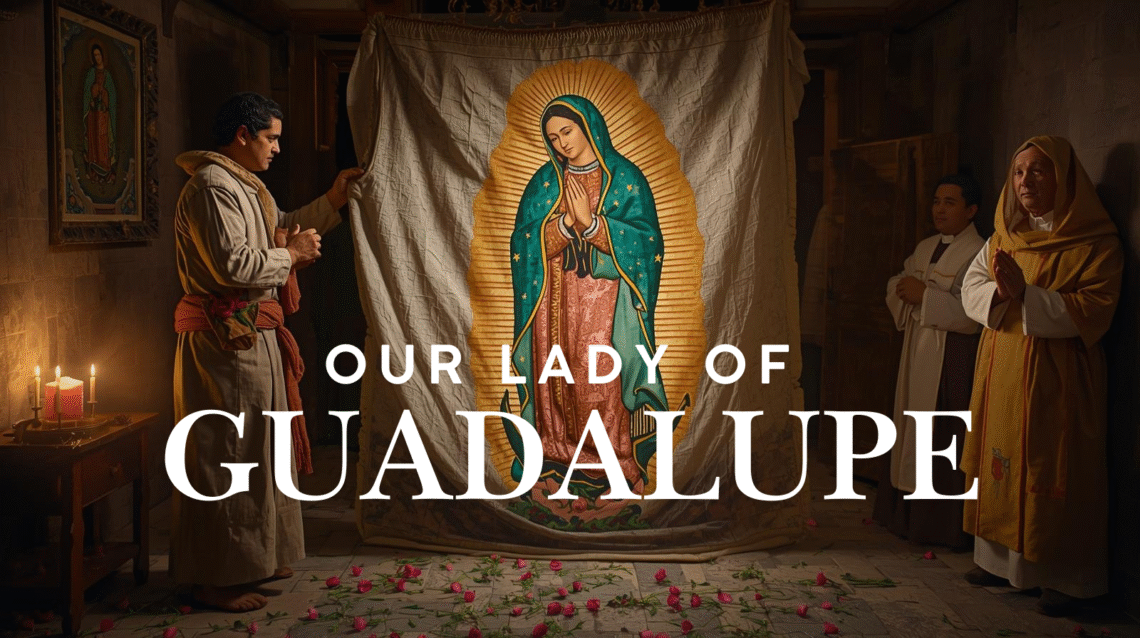
On December 12, Juan Diego gathered Castilian roses—flowers native to Spain but unknown in Mexico—blooming miraculously in winter on barren ground.
He carried them in his tilma, a cloak made of ayate, woven from cactus fiber.
When Juan Diego opened the tilma before the bishop:
- The roses fell to the floor
- An image of the Virgin Mary appeared instantly on the fabric
No artist was present. No preparation occurred. The image appeared fully formed.
6. The Tilma: Scientific Findings and Mysteries
The tilma remains on public display today at the Basilica of Our Lady of Guadalupe.
Material Reality
- Ayate fabric normally decomposes in 20–30 years
- The tilma is nearly 500 years old
Scientific Observations
- No Known Pigments
Multiple studies (including infrared and chemical analysis) have failed to identify traditional pigments. - No Brushstrokes or Primer Layer
No preparatory layer exists between image and fabric. - Microscopic Detail in the Eyes
Enlargements reveal tiny human figures reflected in the eyes, consistent with optical laws (Purkinje-Sanson effect), discovered centuries later. - Stable Temperature
The tilma maintains a temperature close to that of a living human body (~98°F).
Important distinction:
Science does not claim to explain the image. It confirms only that no known artistic method accounts for it.
7. Attempts to Destroy the Tilma
The image has survived multiple destructive events:
- 1791 – Nitric acid spilled nearby; the image remained intact
- 1921 – A bomb exploded beneath the tilma; altar destroyed, image unharmed
- Centuries of smoke, pollution, and human contact caused no degradation
Each event increased devotion rather than diminishing belief.
8. Where Is Our Lady of Guadalupe Today?
The original tilma is displayed in the Basilica of Our Lady of Guadalupe in Mexico City.
It is:
- Protected behind bulletproof glass
- Visible to millions of pilgrims annually
- Still the focus of active devotion, prayer, and study
9. Juan Diego’s Later Life and Death
After the apparitions:
- Juan Diego lived near the chapel at Tepeyac
- He dedicated his life to prayer and service
- He humbly shared the story of the Virgin
He died in 1548, around 74 years old.
Burial Location
- Tradition holds his remains are associated with the Guadalupe shrine
- Exact archaeological confirmation is limited due to historical burial practices
10. Why Juan Diego Is a Saint
Juan Diego was canonized not for public miracles, but for:
- Heroic humility
- Radical obedience
- Faithfulness under rejection
- Endurance amid cultural erasure
He embodies sanctity rooted in hidden faith, not authority.
11. Why Canonization Took Nearly 500 Years
Juan Diego was canonized in 2002 by Pope Saint John Paul II.
Reasons for delay include:
- Colonial dismissal of Indigenous testimony
- Racial and cultural bias within historical scholarship
- Preference for European documentation over oral tradition
Modern scholarship—including the Nican Mopohua (16th-century Nahuatl text)—confirmed the historical consistency of the accounts.
His canonization was an act of spiritual and historical justice.
12. The Impact of Guadalupe on History
Following the apparitions:
- Human sacrifice declined rapidly
- Millions converted peacefully
- Indigenous dignity was affirmed
- Christianity took root without cultural annihilation
Our Lady of Guadalupe did not appear to conquerors.
She appeared to the poor.
She did not threaten judgment.
She offered motherhood.
“Am I not here, I who am your Mother?”
Reflection
The story of Our Lady of Guadalupe is not frozen in the past. It continues to speak—to the marginalized, the forgotten, the weary.
Juan Diego did not seek recognition.
He carried obedience.
And through that obedience, Heaven gave the world a Mother.