
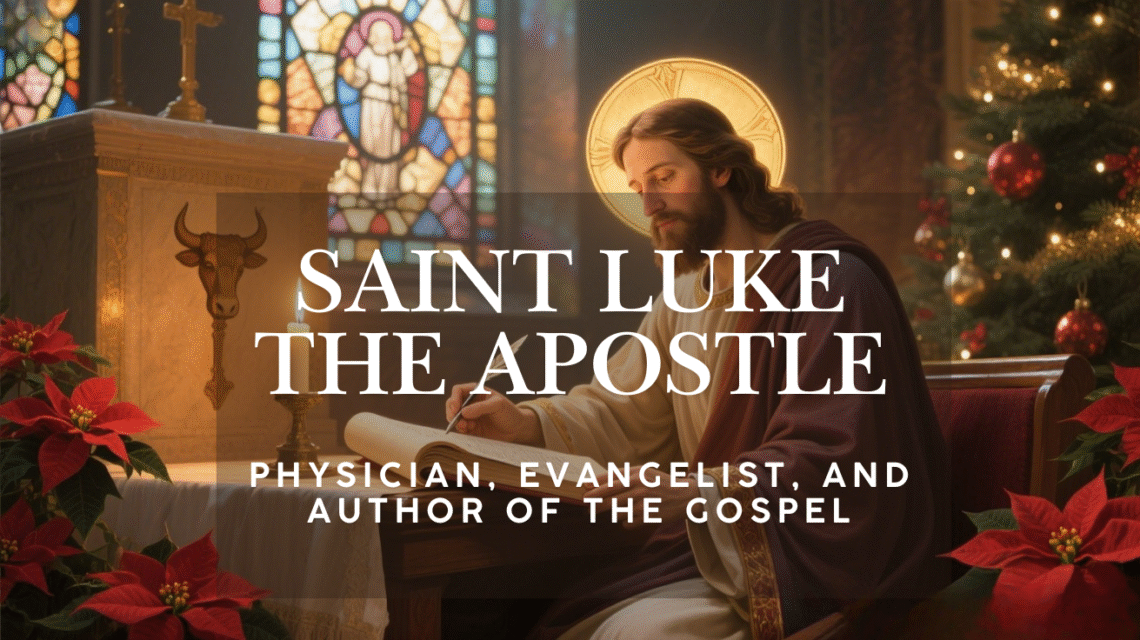
There are saints whose lives thunder across history with dramatic conversions and public martyrdoms. And then there are saints like Saint Luke the Apostle, whose holiness unfolds through attention, compassion, and the discipline of seeing clearly.
Luke did not walk with Jesus during His earthly ministry. He did not witness the Crucifixion with his own eyes. Yet, through Luke’s pen, the Church received some of the most intimate, tender, and human moments of the Gospel — moments no one else preserved with such care.
Luke was a physician by training, a man of science and observation, likely born in Antioch in Syria, a major center of learning in the ancient world. He was a Gentile, not Jewish, making him the only non-Jewish author of the New Testament. This alone gives his witness a unique place in the story of salvation: Luke stands at the threshold where the Gospel opens fully to the world.
When Luke encountered the early Christian community, he encountered Christ — not through spectacle, but through lives changed. His conversion did not erase his profession; it refined it. Luke learned to diagnose more than the body. He learned to attend to the wounds of the soul.
The Companion of Saint Paul
Luke’s life becomes clearer when we follow his path alongside Saint Paul. In the Acts of the Apostles, the narrative subtly shifts from “they” to “we,” signaling Luke’s personal presence in Paul’s missionary journeys. He traveled through Asia Minor, Macedonia, Greece, and eventually to Rome. He endured imprisonments, dangers, and uncertainty — not as a preacher in the spotlight, but as a faithful companion.
Paul refers to Luke simply and profoundly as “the beloved physician.” That title tells us much. Luke remained with Paul when others left. He stayed when it was costly. He observed, recorded, and served.
It is believed Luke was with Paul during his final imprisonment in Rome. While Paul faced martyrdom, Luke bore witness — once again — through fidelity rather than spectacle.
The Gospel of Mercy
Luke’s Gospel reveals what his heart learned. He writes with special attention to those often overlooked: women, the poor, the sick, the sinner, the foreigner. Only Luke records the Annunciation with such tenderness, Mary’s Magnificat, the Good Samaritan, the Prodigal Son, the healing of the ten lepers, and Christ’s mercy toward the repentant thief.
This is not accidental. Luke noticed who others passed by.
Tradition also holds that Luke was an early iconographer, even painting images of the Blessed Virgin Mary. Whether literal or symbolic, the tradition reflects something true: Luke helped the Church see Mary — not as distant, but as mother; not as abstract, but as obedient, courageous, and prayerful.
Relics and Final Years
After Paul’s death, tradition suggests Luke continued preaching, possibly in Greece. He is believed to have died in Boeotia around the age of 84, though accounts differ as to whether he died peacefully or by martyrdom.
Luke’s relics have been venerated for centuries. Portions were transferred to Constantinople in the 4th century and later to Padua, Italy, where they rest today in the Basilica of Saint Justina. His relics became sources of prayer and healing — a fitting continuation of the physician’s vocation.
The Relics of Saint Luke and Their Meaning
The Church does not venerate relics as objects of superstition, but as tangible witnesses to lives transformed by Christ. The relics of Saint Luke are especially meaningful because they reflect both his vocation and his quiet fidelity.
According to long-held tradition, the relics of Saint Luke were preserved and honored from the earliest centuries of Christianity. In the 4th century, his remains were transferred to Constantinople, a sign of the esteem in which he was held by the early Church. Centuries later, significant relics were moved to Padua, Italy, where they rest today in the Basilica of Saint Justina — a place of pilgrimage, prayer, and healing.
Luke’s relics are often associated with colors of deep symbolism in sacred art and liturgy. Green is traditionally connected to him, representing healing, renewal, and hope — fitting for a physician who attended both body and soul. Gold and warm earth tones are also linked to Luke, reflecting wisdom, illumination, and the dignity of truth carefully recorded. In iconography, these colors quietly proclaim his role as one who brought clarity, restoration, and light to the Church.
The presence of Luke’s relics reminds the faithful that holiness leaves a trace. His hands, which once traveled dangerous roads alongside Saint Paul, now rest as a testimony that faithfulness endures beyond a lifetime. For those who come seeking healing, understanding, or guidance in vocation, Luke’s relics speak without words: that careful attention, mercy, and truth lived consistently are never lost.
What We Know — and What We Don’t
Luke never names himself directly in his Gospel. He does not center himself. Instead, he speaks through careful investigation, testimony, and reverence for truth. He tells us that he examined accounts closely, consulted witnesses, and wrote so that readers “may know the certainty” of what they had been taught.
What we don’t know is just as telling. We do not know what Luke looked like. We do not know the full details of his conversion. We do not know the exact circumstances of his death.
But we know his fruit.
Luke gave the Church clarity without coldness, detail without distraction, and truth without cruelty. He showed that faith does not oppose reason — it completes it.
Why the Church Turns to Saint Luke
People turn to Saint Luke when they seek healing, clarity, and guidance in discernment. Physicians, artists, writers, and caregivers claim him as a patron — those whose work requires attentiveness to both suffering and dignity.
Miracles attributed to Luke are often quiet: recoveries, insights, peace where confusion once reigned. His intercession is sought not for spectacle, but for restoration — of body, mind, and soul.
Luke reminds us that holiness can be practiced through listening, studying, traveling beside the suffering, and telling the truth with love.
A Prayer to Saint Luke the Apostle
Saint Luke, beloved physician and faithful witness,
you who sought truth with diligence
and recorded mercy with reverence,
intercede for us.
Teach us to see clearly —
to notice the wounded,
to honor the overlooked,
to speak truth with compassion.
Pray for those who suffer in body and spirit,
for those who seek understanding,
and for those entrusted with the care of others.
Guide our minds, steady our hearts,
and help us remain faithful
even when our work is quiet and unseen.
Saint Luke the Apostle,
companion of the saints and servant of the Gospel,
pray for us.


One comment on “Saint Luke the Apostle: The Physician Who Learned to See”