
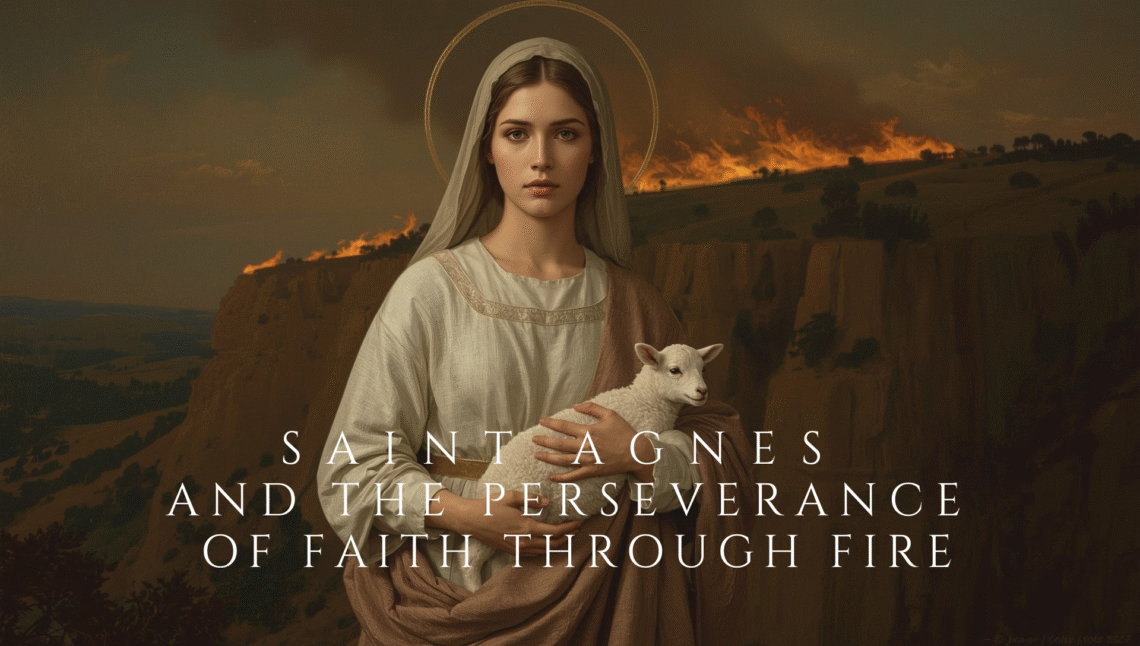
There are moments in life when what confronts a person cannot be lifted, avoided, or escaped. These moments are marked by fire—by trial and circumstances that burn away illusions of control and force the soul to confront what it truly trusts. Fire does not test physical endurance or outward capability; it reveals what a person is anchored to when outcomes are uncertain and relief does not come. Throughout Scripture and the lives of the saints, fire is not presented as punishment alone, but as refinement—permitted by God not to destroy, but to expose what is eternal from what is temporary.
Today, on the feast of Saint Agnes, the Church remembers a young woman who endured such fire—not because she was spared suffering, but because her faith was fixed on God rather than outcome. Her witness speaks to anyone who has discovered that perseverance is not rooted in strength of body, but in conviction of soul, trust in God’s purpose, and fidelity that remains even when the path forward is unclear.
Saint Agnes did not endure because she believed the trial would pass quickly. She endured because she trusted that obedience to God would not be wasted, even if it cost her everything. Her perseverance was not rooted in survival, but in fidelity. Not in resistance, but in surrender to a purpose she could not yet fully see.
Fire refines. It does not ask permission. It exposes what is temporary and what is eternal. Agnes remained faithful not because the fire diminished, but because her trust in God did not.
Scripture offers a similar vision in the valley of dry bones. Before breath is given, the bones must first come together. Order precedes life. Waiting precedes restoration. The image is not sentimental; it is severe. The bones are not weary—they are lifeless. Yet God does not abandon them. He speaks.
This matters because fire often leaves the soul feeling spent rather than empowered. After trials, many do not feel renewed; they feel dry, uncertain, and silent. Saint Agnes stands as a witness that faith does not require emotional vitality to remain true. She did not wait for relief in order to trust God. She trusted God even when no relief came.
Dry bones are not evidence of failure. They are proof that life once existed—and can exist again by God’s command alone.
God allowed His Son to endure fire—physical, emotional, and spiritual—not because suffering was absent from the Father’s heart, but because redemption lay beyond it. The Cross was not endured by strength. It was endured by obedience, love, and trust.
Jesus did not escape the fire. He passed through it.
The saints follow this same path, not because they seek suffering, but because they trust that God does not waste what He permits. Saint Agnes did not know the end in human terms. She did not see rescue as the world defines it. Yet she believed that fidelity would not end in loss.
This is the faith that carries the soul through fire: the certainty that God would not allow a person to endure what they were not created to survive.
A Prayer on the Feast of Saint Agnes
Saint Agnes,
you who remained faithful as fire surrounded you,
intercede for those who walk through trials that do not relent.
Pray for souls enduring stress, hardship, and refining fire,
that faith may remain fixed
even when relief does not come.
Ask the Lord to sustain perseverance,
to strengthen trust where answers are delayed,
and to breathe life again
where souls feel dry and spent.
May we believe, as you did,
that God does not permit fire
without also preparing resurrection.
Amen.