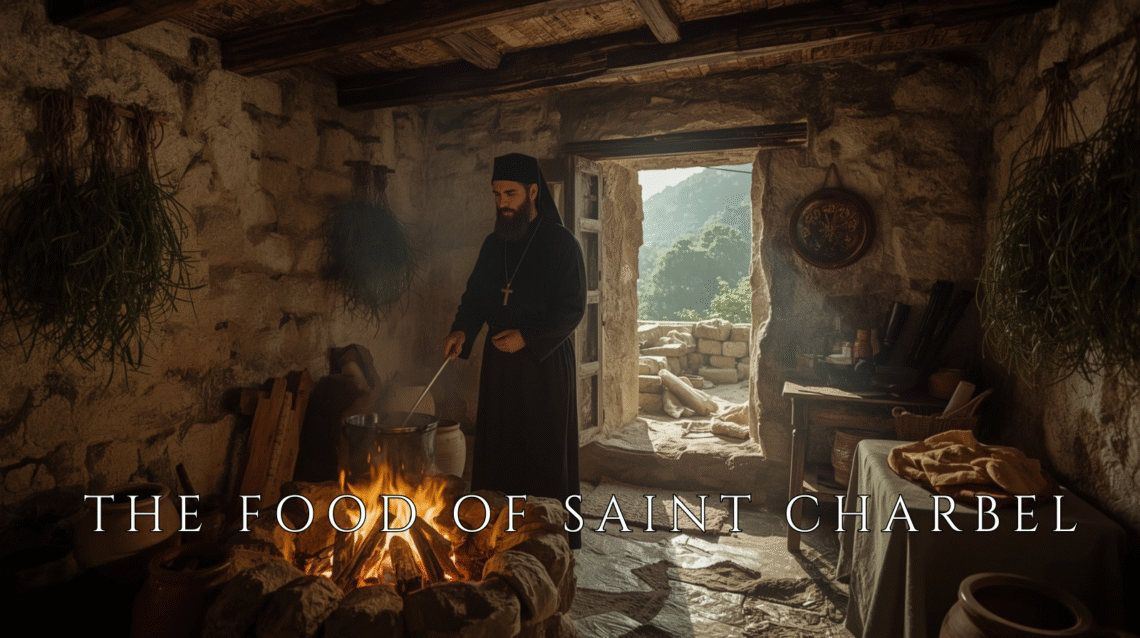
In a time when food is often treated as entertainment, identity, or even escape, the life of Saint Charbel Makhlouf offers a striking and almost unsettling contrast. Long before his name became known across the world for extraordinary healings and unexplainable miracles, Saint Charbel lived a life of radical simplicity — one shaped not by abundance, but by restraint. His daily meals were humble, repetitive, and intentionally unremarkable, reflecting a monastic discipline that viewed food not as pleasure, but as sustenance granted by God. There was no pursuit of flavor, no attachment to comfort, and no excess beyond what was necessary to continue in prayer and labor. Understanding what Saint Charbel ate — and why he ate this way — allows us to glimpse the deeper spiritual foundation beneath his holiness. These simple ingredients were not chosen for their symbolism or supposed mystical properties, but because they supported a life of fasting, silence, and surrender. In exploring this historically consistent monastic food, we are not uncovering a miracle recipe, but rather a quiet testimony to how simplicity can strengthen the body, steady the mind, and open the heart more fully to God.
This is not a “miracle recipe.”
There is no sacred measurement.
No promised outcome.
What follows is historically consistent monastic food — the kind Saint Charbel lived on — paired with the why behind it.
🍲 The Humble Meal (Inspired by Monastic Tradition)
1. Lentils or Peas
Why they mattered:
- High in protein and fiber
- Sustaining without heaviness
- Affordable, accessible, grounding
Spiritually:
Lentils and peas feed without indulgence. They satisfy hunger without awakening craving.
They teach enough.
“Daily bread” doesn’t mean abundance.
It means sufficiency.
2. Bread (Often Plain, Sometimes Dry)
Why it mattered:
- Staple of survival
- Easy to preserve
- No luxury
Spiritually:
Bread reminds us that Christ chose the simplest food to reveal Himself.
Saint Charbel ate bread the way he prayed — without embellishment.
3. Olive Oil (Used Sparingly)
Why it mattered:
- Sustenance
- Natural nourishment
- Symbol of anointing and healing
Spiritually:
Olive oil appears throughout Scripture as a sign of God’s presence.
For Saint Charbel, it was both physical nourishment and silent theology.
4. Boiled Vegetables
Why they mattered:
- Seasonal
- Local
- Easily digested
No sauces.
No layering of flavor.
Just creation as it is.
5. Herbal Infusions (Occasional)
Not a “Saint Charbel tea,” but herbs common to Lebanese monasteries:
- Wild thyme (za’atar)
- Sage
- Chamomile
Used gently.
With prayer.
Never as the source of healing.
🕯️ The deeper lesson
Saint Charbel healed not through what he consumed —
but through what he refused to cling to.
No attachment to taste.
No dependence on pleasure.
No comfort sought outside of God.
And this is why his life still speaks so loudly today.
In a world that is overfed yet undernourished,
Saint Charbel reminds us that the soul also needs restraint.
His miracle was not what he ate.
His miracle was what he surrendered.