The desert monk whose spiritual battle became the blueprint for Christian warfare.
Long before medieval exorcisms and Hollywood horror films, early Christians told stories of real spiritual battles fought in the silence of the desert. Among these accounts, none is more gripping than the story of Saint Anthony the Great — the father of monasticism and the man who confronted demonic forces with nothing but prayer, courage, and unwavering faith. His encounters with the demonic were so intense that ancient writers described physical attacks, terrifying visions, and a night when he was beaten nearly to death. Yet what makes Anthony’s story unforgettable is not the violence he endured, but the fearless, almost shocking response he gave afterward. This article explores the legendary battle between Saint Anthony and the demons, the meaning behind it, and why his story continues to inspire Christians facing their own spiritual struggles.
The Call to the Desert
Anthony was a young man from a wealthy Egyptian family when he heard the Gospel reading:
“Go, sell what you have, give to the poor, and follow Me.”
He took it literally.
He gave away everything.
He left the city.
He entered the desert — a place of silence, solitude, and spiritual testing.
But Anthony wasn’t alone.
The desert, in early Christian imagination, was the battleground where demons roamed freely.
And they noticed him.
The First Assault
At first, the attacks were subtle:
- whispers of doubt
- temptations
- illusions
- fear
- loneliness
Anthony resisted them with prayer.
But the demons grew angry.
They wanted him gone.
So they escalated.
The Night the Demons Attacked
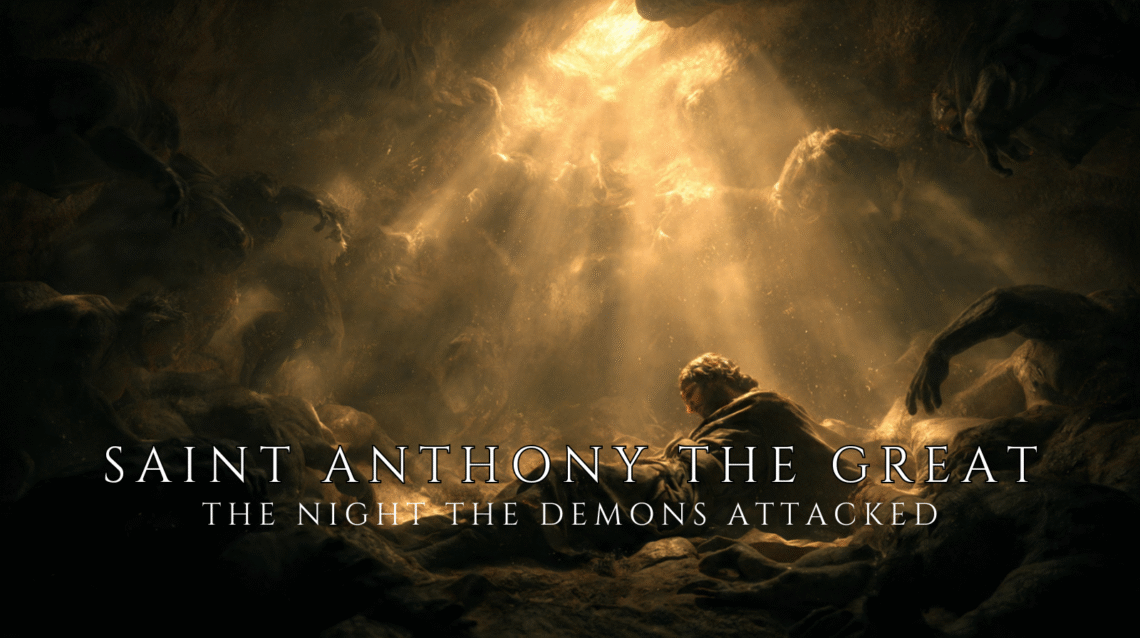
One night, as Anthony prayed in an abandoned tomb, the demons came in force.
Ancient accounts describe:
- monstrous shapes
- animal‑like forms
- shadows with claws
- creatures that snarled and shrieked
They beat him so violently that his body collapsed.
A friend found him unconscious, carried him to safety, and thought he would die.
But Anthony woke up — bruised, broken, barely able to move — and said something that stunned everyone:
“Take me back.”
He wanted to return to the tomb.
He wanted to face them again.
Round Two — Anthony’s Defiance
Back in the tomb, Anthony lay on the ground, unable to stand.
The demons returned.
This time, they came with even more terrifying illusions:
- roaring beasts
- serpents
- giants
- swarms of creatures
- voices mocking him
But Anthony didn’t flinch.
He shouted into the darkness:
“Here I am!
I am not afraid of you!
If you had any power, one of you would have been enough!”
The demons raged.
But they could not break him.
The Light Breaks Through
Suddenly, the tomb filled with a brilliant light.
The demons vanished.
Anthony felt his strength return.
And he cried out:
“Where were You, Lord?”
A voice answered:
“I was here, Anthony.
But I waited to see your courage.
Now I will always help you.”
This moment became one of the most iconic scenes in Christian literature — the moment when a humble monk became a spiritual giant.
Why This Story Matters
Anthony’s battle is not about monsters in the dark.
It’s about:
- perseverance
- spiritual resilience
- refusing to give in to fear
- confronting inner darkness
- trusting God in the silence
- courage in the face of overwhelming pressure
Anthony teaches us that spiritual warfare is real —
but so is divine strength.
He became the father of monks, the model of spiritual discipline, and the symbol of victory over evil.