High in the rugged mountains of northern Ethiopia stands one of the most astonishing achievements in Christian history: the rock‑hewn churches of Lalibela, a sacred complex carved entirely from living volcanic stone. These structures are not built in the traditional sense—there are no bricks, no scaffolds, no timber beams. Instead, the earth itself was carved downward, revealing cathedrals, chapels, tunnels, and courtyards that seem to rise from the mountain like a revelation.
For travelers, historians, and pilgrims alike, Lalibela is a place where faith and geology collide. The moment you descend into the narrow trenches—cool, shadowed, and echoing with ancient footsteps—you understand why this site is considered one of the greatest architectural and spiritual wonders on earth.
A City Carved, Not Constructed
The story begins in the late 12th century with King Gebre Meskel Lalibela, a ruler of the Zagwe dynasty who dreamed of creating a “New Jerusalem” for Ethiopian Christians. Political turmoil and dangerous travel routes made pilgrimages to the Holy Land nearly impossible, so Lalibela envisioned a sacred city that would bring Jerusalem to his people.
What followed defies imagination.
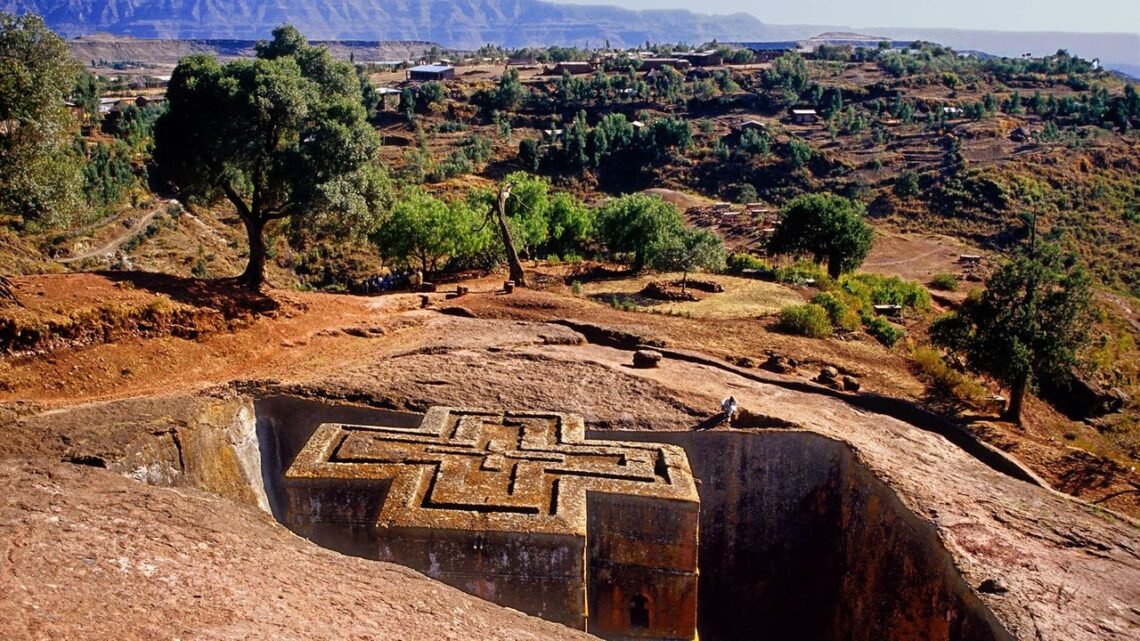
Instead of building upward, workers carved downward, excavating entire churches from a single block of volcanic tuff. Every wall, column, window, arch, and altar was shaped from the same continuous stone. The roofs were not placed—they were revealed. The floors were not laid—they were uncovered.
The result is a network of eleven monolithic churches, each connected by tunnels, trenches, and symbolic pathways representing biblical journeys.
Descending Into the Earth
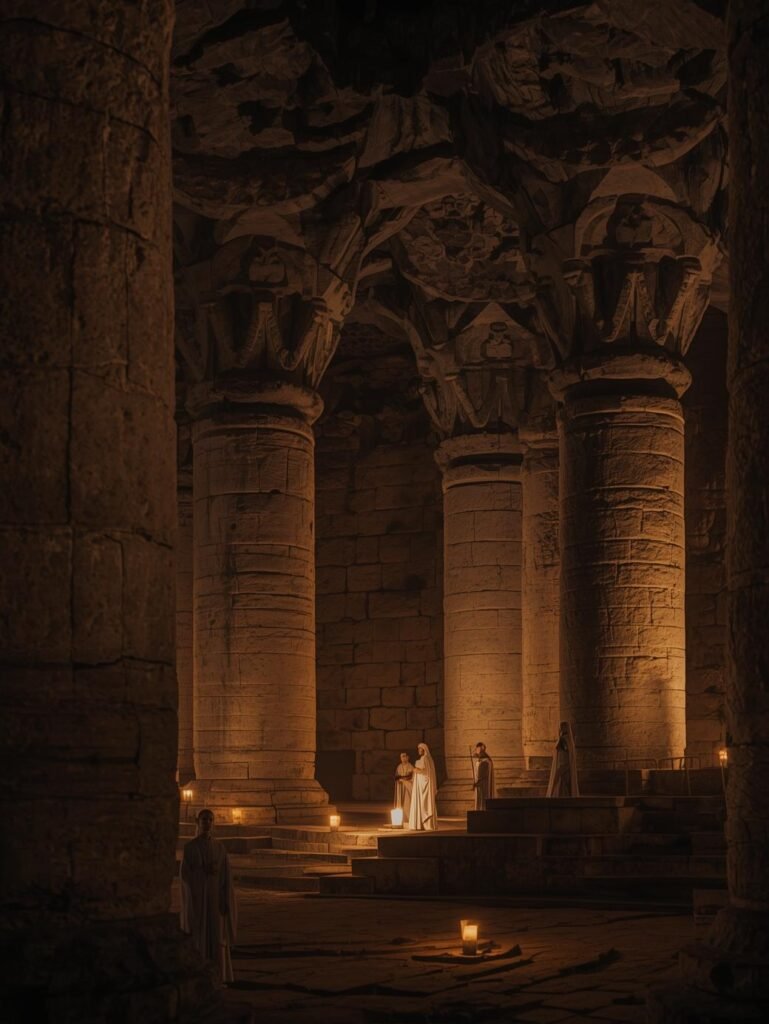
To enter Lalibela’s churches, you don’t walk through a door—you descend into the earth itself.
The trenches are narrow and steep, sometimes only wide enough for one person at a time. The air cools instantly. The light shifts from bright gold to muted blue. The world above disappears.
Then, suddenly, you emerge into a sunken courtyard where a church stands freed from the rock, its walls rising from the pit like a stone ark.
The most iconic of these is Biete Giyorgis (The Church of St. George)—a perfect cross-shaped structure carved 40 feet deep into the ground. Its symmetry is so precise that modern architects still struggle to explain how medieval craftsmen achieved it with hand tools.
Visitors often describe the moment they first see it as “a shock of silence.”
A Sacred Mirror of Jerusalem
Lalibela’s layout is not random. It is a deliberate spiritual map.
- A river named Jordan flows through the site.
- Churches are grouped into “Northern” and “Southern” clusters, mirroring biblical divisions.
- Pilgrims walk the carved pathways as if retracing the life of Christ.
This is not a museum.
It is a living, breathing place of worship where priests chant ancient liturgies and pilgrims sleep in the courtyards wrapped in white shawls.
Hardly Known Fact:
1) The Builders Left No Records
One of the greatest mysteries of Lalibela is this:
No written records exist describing how the churches were built.
No blueprints.
No construction notes.
No royal decrees.
Just the finished structures—silent, perfect, and impossible.
This absence has fueled centuries of speculation:
- Some believe tens of thousands of workers labored for decades.
- Others claim angels assisted at night, doubling the progress.
- Some archaeologists think earlier cave shrines were expanded into full monoliths.
But the truth remains locked in the stone.
2) The Roofs Once Shimmered With Gold
Early travelers’ accounts describe the churches’ roofs as being coated with a golden plaster, now long eroded by centuries of rain. This suggests the complex once gleamed in the sun like a heavenly city—an image almost impossible to imagine today.
Secret Tunnels Still Unexplored
Beneath the visible pathways lies a network of hidden tunnels, some of which remain uncharted. These passages allowed priests to move unseen during times of conflict and served as symbolic “pilgrimage routes” representing the soul’s journey through darkness into light.
3) The Churches Are Slowly Sinking
Because they are carved into volcanic tuff, the structures gradually erode and sink.
UNESCO and local craftsmen work constantly to stabilize them, meaning Lalibela is not a frozen relic—it is a living monument that continues to change.
What It Feels Like to Stand in Lalibela
If you were there right now, you would hear:
- The echo of chanting bouncing off stone walls
- The soft shuffle of pilgrims’ bare feet
- The wind sweeping across the high plateau
- The distant ring of ancient bells
You would feel:
- Cool stone beneath your fingertips
- The weight of centuries pressing gently around you
- A sense of awe that is almost physical
And you would understand why so many call Lalibela:
“A church not built by human hands, but revealed by God.”