What Really Happened — and Why It Matters
Each year on February 10, the Church celebrates the feast of Saint Scholastica, a woman whose life of quiet prayer left a lasting mark on Christian spirituality.
Saint Scholastica is best known as the twin sister of Saint Benedict, the father of Western monasticism. While Benedict organized communities, wrote a Rule, and shaped religious life through structure and obedience, Scholastica lived a more hidden vocation — one centered on prayer, humility, and love.
Their story is not about disobedience or conflict. It is about how God listens.
The Annual Meeting
According to Saint Gregory the Great, who recorded their lives in Dialogues, Benedict and Scholastica met once a year at a small house near the monastery.
They spent the day:
- speaking about God
- sharing spiritual counsel
- praying together
As evening approached, Benedict prepared to return to his monastery, faithful to the rule that monks should not remain outside overnight.
Scholastica, sensing this would be their last meeting, gently asked him to stay longer.
Benedict refused — not out of coldness, but obedience.
The Silent Prayer
At this moment, something extraordinary happened.
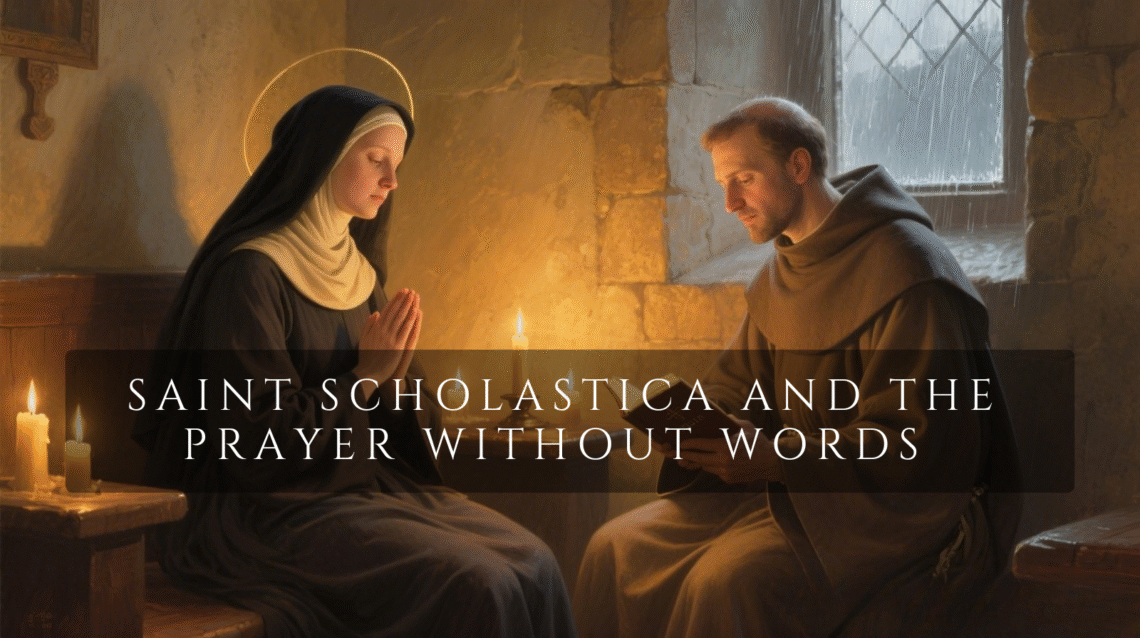
Saint Scholastica did not argue.
She did not insist.
She did not speak another word.
Instead, she:
- lowered her head
- folded her hands
- prayed silently
Saint Gregory does not record any spoken prayer. No words are given. No formula is preserved.
This is important.
Scholastica’s prayer was not a demand — it was trust.
Immediately after her silent prayer, a sudden storm arose. Rain and thunder poured down so fiercely that Benedict could not leave.
Seeing this, Benedict exclaimed:
“God forgive you, sister — what have you done?”
Scholastica replied calmly:
“I asked you, and you would not listen.
So I asked God, and He heard me.”
What Was the Prayer?
Many people ask: What prayer did Saint Scholastica pray?
The honest answer is: we do not know.
The Church has never claimed that God “gave” Scholastica a special prayer, nor that she spoke particular words.
What we know is this:
- Her prayer was silent
- It came from love
- It aligned perfectly with God’s will
Saint Gregory concludes the story with a profound observation:
She obtained more because she loved more.
This does not mean Scholastica overruled obedience.
It means love fulfilled obedience.
The Meaning of the Storm
The storm was not punishment.
It was not manipulation.
It was not theatrical.
It was a sign that God honors prayer rooted in charity.
Benedict obeyed the rule.
Scholastica obeyed love.
And God showed that both belong together.
The Final Vision
Three days later, after Scholastica’s death, Benedict was praying when he saw her soul ascend to heaven in the form of a dove.
Only then did he realize:
- this had been their final meeting
- her prayer had already prepared him
- love had spoken before words ever could
Why This Story Matters Today
Saint Scholastica teaches us that:
- Not all prayer needs words
- God listens to the heart before the voice
- Silence can be more powerful than speech
- Love is never opposed to holiness
Her life reminds us that prayer is not about persuasion —
it is about union.
Sometimes, the prayer God answers most quickly
is the one spoken only by the soul.