
Some figures in Scripture speak rarely, yet when they do, history bends. Archangel Gabriel is one of them.
Gabriel does not appear often in the Bible, but every time he does, the world is changed. He is not sent for ordinary moments. He is sent when God is about to act decisively — when heaven interrupts earth with truth that cannot be delayed.
Gabriel’s name itself reveals his mission. In Hebrew tradition, Gavri’el means “God is my strength.” He does not speak on his own authority. He stands as one who carries the weight of God’s word intact, unaltered, and uncompromised.
Gabriel in the Old Testament: Interpreter of God’s Timing
Gabriel first appears in the Book of Daniel during a moment of confusion and fear. Daniel has received visions he cannot understand — visions of kingdoms, suffering, and the unfolding of history.
Gabriel is sent not to comfort Daniel emotionally, but to give understanding. He explains what has been revealed and situates suffering within God’s larger design. From the beginning, Gabriel’s role is clear: he does not soften truth, but he makes it intelligible.
This establishes a pattern that continues throughout Scripture — Gabriel is the angel who brings clarity when the message is overwhelming.
Gabriel in the New Testament: When Eternity Enters Time
Centuries later, Gabriel appears again — this time not in visions, but in real, human moments.
He is sent to Zechariah, announcing the birth of John the Baptist. When Zechariah doubts, Gabriel does not negotiate. He identifies himself plainly:
“I am Gabriel, who stand in the presence of God.”
This is not a threat. It is a statement of authority. Gabriel reminds Zechariah that the message does not originate in imagination or desire, but in God Himself.
Soon after, Gabriel is sent again — to the Virgin Mary.
In the Annunciation, Gabriel delivers the most consequential message ever spoken to a human being. He does not coerce. He does not rush. He speaks, then waits. The Incarnation hinges not on his power, but on Mary’s consent.
This moment reveals something essential about Gabriel: he carries God’s word perfectly, yet respects human freedom completely.
Who Gabriel Is — and Who He Is Not
Gabriel is not a saint. He is not a human soul glorified in heaven. He is a pure spiritual being, created by God as an angelic messenger. For this reason, Gabriel does not have bodily relics.
This absence is not a loss. It is a reminder.
Angels do not point to themselves. They point beyond themselves — to God’s action, God’s will, and God’s timing. Gabriel leaves no relics behind because his purpose is fulfilled in the message, not the messenger.
Symbols Associated With Archangel Gabriel
Though Gabriel has no relics, the Church has long recognized symbolic attributes that help the faithful understand his role.
Gabriel is often associated with:
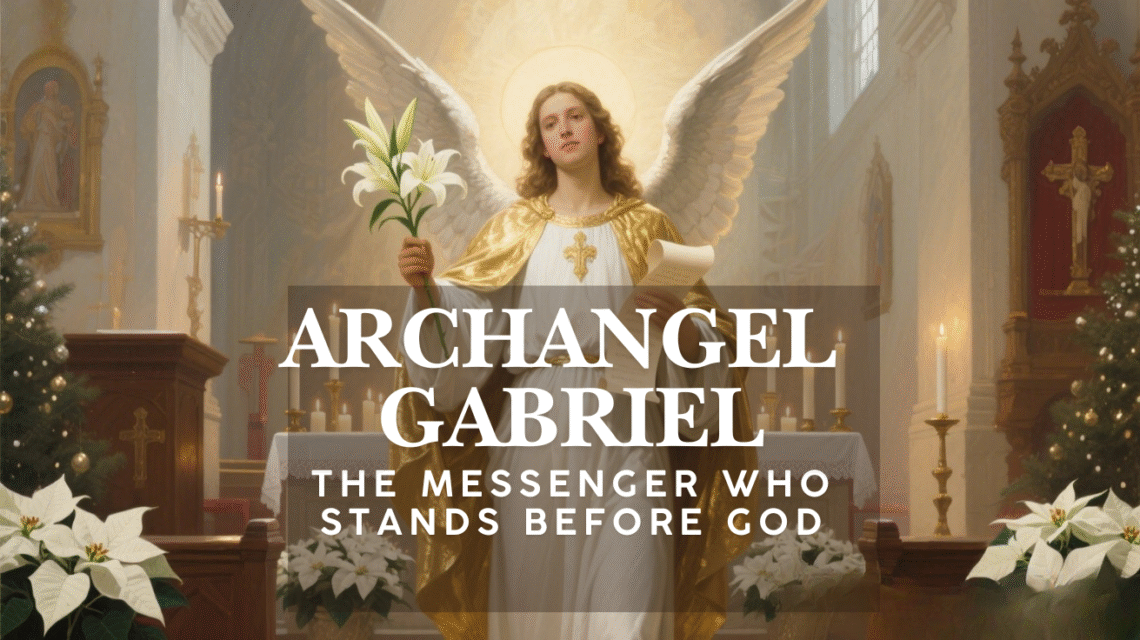
- White, symbolizing purity and divine truth
- Gold, representing God’s authority and glory
- The lily, signifying holiness and the Annunciation
- A scroll or trumpet, representing proclamation and revelation
These symbols appear consistently in sacred art, not as decoration, but as theology made visible.
Gabriel’s Feast and the Church’s Devotion
The Church honors Archangel Gabriel alongside Michael and Raphael on September 29, recognizing the distinct missions entrusted to each.
People turn to Gabriel when seeking clarity, courage to speak truth, discernment in vocation, and openness to God’s call. He is especially invoked by communicators, writers, teachers, and those facing moments that require a faithful response rather than certainty.
Gabriel’s presence in Scripture reminds us that God’s word often arrives before understanding — and that obedience sometimes precedes explanation.
Why Gabriel Still Matters
In a world saturated with noise, Gabriel stands as a witness to meaningful speech. He does not argue. He announces. He does not embellish. He delivers what has been entrusted to him.
His story assures us that when God speaks, He also sends the grace to receive what is said.
Gabriel teaches us that saying “yes” to God does not require full knowledge of the outcome — only trust in the One who speaks.
A Prayer to Archangel Gabriel
Archangel Gabriel,
messenger of God’s truth
and bearer of divine light,
stand with us.
Help us listen when God speaks,
receive His word with humility,
and respond with courage.
When clarity is needed,
bring understanding.
When obedience feels costly,
strengthen our resolve.
Teach us to speak truth without fear
and to say “yes” to God
even when the path ahead is unknown.
Archangel Gabriel,
faithful servant who stands before God,
pray for us.