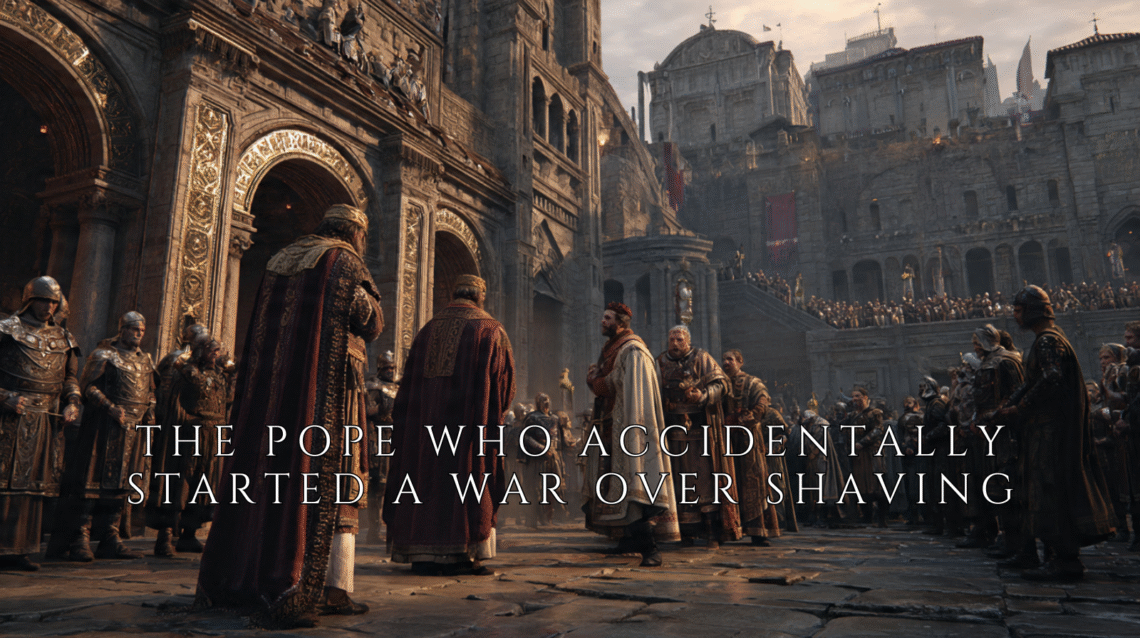
How a dispute about priestly grooming spiraled into excommunications, rebellions, and a political crisis.
History is full of conflicts sparked by land, power, and politics — but one of the strangest disputes in medieval Europe began with something far more trivial: facial hair. In the 11th century, a papal reform movement collided with imperial authority, and what started as a simple rule about clergy shaving escalated into a full‑blown political crisis. Excommunications were issued, armies were raised, and the Holy Roman Emperor himself was dragged into a humiliating showdown. This bizarre chapter, often called “The Beard War,” reveals how even the smallest religious reforms could ignite massive upheaval in a world where Church and state were tightly intertwined. This article explores the unbelievable true story of how a shaving rule helped spark one of the most dramatic power struggles of the Middle Ages.
The Strange Beginning: A Rule About Beards
In the 11th century, the Church was undergoing major reforms.
Pope Gregory VII — a fiery, uncompromising reformer — wanted to purify the clergy and enforce strict discipline.
Among his many rules was one that seems harmless today:
Priests must shave their beards.
To Gregory, this wasn’t about fashion.
It was about:
- uniformity
- discipline
- rejecting worldly vanity
- distinguishing clergy from laymen
But not everyone agreed.
Especially not the German clergy.
The German Clergy Revolts
In the Holy Roman Empire, many priests wore long beards as a sign of:
- wisdom
- masculinity
- tradition
- cultural identity
They saw Gregory’s shaving rule as: - insulting
- unnecessary
- foreign
- authoritarian
Some priests refused outright.
Others mocked the rule publicly.
A few even preached sermons defending beards as “God‑given.”
Word reached Rome.
Gregory was not amused.
The Emperor Gets Involved
The German clergy appealed to their ruler, Emperor Henry IV, asking him to protect them from what they saw as papal overreach.
Henry, already frustrated with Gregory over other reforms, seized the opportunity.
He declared that:
- the pope had no right to dictate grooming
- the clergy could keep their beards
- Rome was interfering in imperial affairs
This was the spark that lit the fire.
The Conflict Escalates
Gregory VII responded with the nuclear option:
He excommunicated Henry IV.
Not for the beards alone —
but the shaving dispute became the symbol of a much larger power struggle.
The excommunication triggered:
- rebellions among German nobles
- political chaos
- threats of civil war
- a crisis of legitimacy for Henry
All because the emperor defended beards.
The Humiliation at Canossa
Desperate to regain authority, Henry IV traveled across the Alps in winter to beg forgiveness.
He stood barefoot in the snow outside the castle of Canossa for three days, wearing a simple wool garment, waiting for the pope to lift the excommunication.
Gregory finally relented.
The beard dispute was technically resolved —
but the damage was done.
The conflict between pope and emperor would continue for decades.
And it all began with a rule about shaving.
Why This Story Still Matters
The Beard War wasn’t really about beards.
It was about:
- who held authority
- how far papal power extended
- the independence of clergy
- the tension between Church and state
- the fragility of medieval politics
But the fact that it started with a grooming rule makes it unforgettable.
It’s a reminder that even the smallest issues can explode when pride, power, and politics collide.