The brilliant scholar whose inventions were so advanced, people thought he made a pact with the devil.
Long before the Renaissance, long before modern science, and centuries before electricity, one pope stunned Europe with inventions so advanced that people believed he must have used sorcery. Pope Sylvester II — born Gerbert of Aurillac — was a mathematician, astronomer, engineer, and scholar whose brilliance pushed the limits of medieval knowledge. He built mechanical devices, introduced Arabic numerals to Europe, and created machines so unusual for the time that legends quickly formed around him. Some claimed he had a talking brass head that answered questions. Others whispered he had a demon trapped in a box. This article explores the astonishing life of Pope Sylvester II, the truth behind the “Magician Pope,” and why his legacy still fascinates historians today.
A Genius Born in the Wrong Century
Gerbert of Aurillac was born around 946 in France — a time when Europe was intellectually stagnant.
But Gerbert was different.
He had:
- a brilliant mathematical mind
- a hunger for knowledge
- a fascination with astronomy
- a gift for engineering
He traveled to Spain, where he encountered advanced Islamic scholarship — mathematics, mechanics, and scientific instruments unknown in Christian Europe.
He absorbed everything.
And he brought it home.
The Inventions That Shocked Medieval Europe
Gerbert built devices that seemed impossible for the time:
1. A Mechanical Clock Before Clocks Existed
He designed early time‑keeping mechanisms using gears and weights — centuries before mechanical clocks became common.
2. A Proto‑Computer (The Abacus Reborn)
Gerbert redesigned the abacus using Arabic numerals, making calculations faster and more accurate.
To medieval scholars, it looked like magic.
3. A Talking Brass Head
According to legend, Gerbert built a mechanical brass head that could answer yes‑or‑no questions.
Some say it worked like an early algorithm.
Others say it was a myth born from fear of his intelligence.
But the story spread like wildfire.
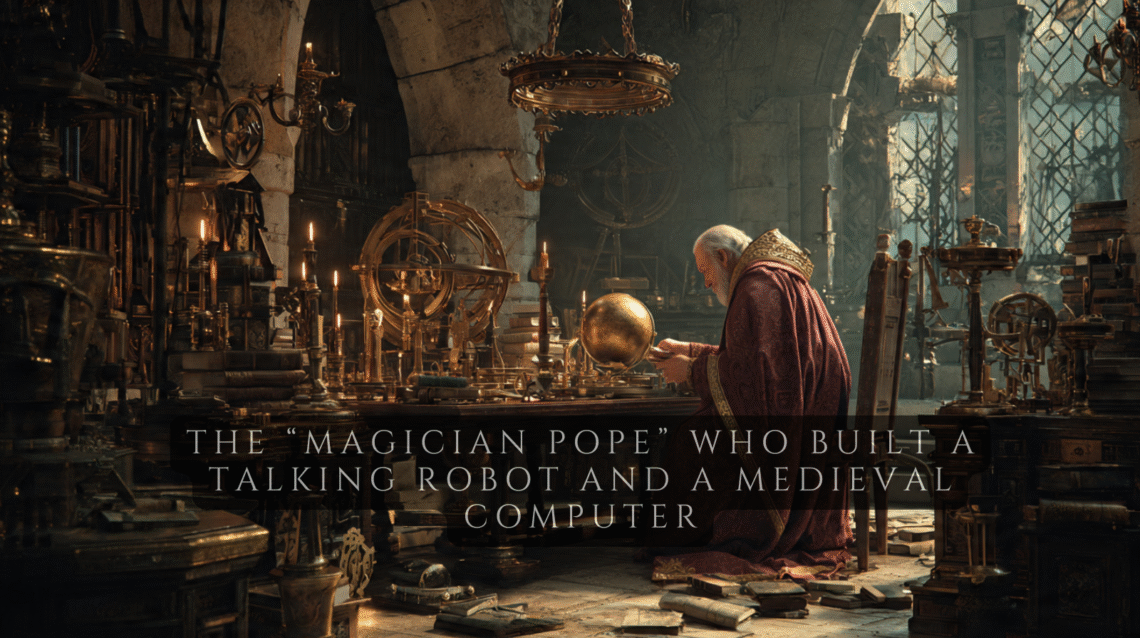
4. An Astronomical Sphere
He built a rotating celestial globe that mapped the stars with astonishing accuracy.
People whispered:
“He commands the heavens.”
5. A Pipe Organ Powered by Steam
Gerbert engineered a steam‑driven organ — a marvel of physics and mechanics.
To the medieval mind, this was sorcery.
The Rumors Begin
Gerbert’s brilliance terrified people who didn’t understand it.
Rumors spread:
- “He studied forbidden magic.”
- “He learned sorcery from the Moors.”
- “He made a pact with the devil.”
- “His brass head tells him the future.”
His enemies used these stories to undermine him.
But his supporters saw him as a visionary.
The Rise to the Papacy
Gerbert’s intelligence caught the attention of kings and emperors.
He became:
- a renowned teacher
- a respected scholar
- a trusted advisor
- Archbishop of Reims
- Archbishop of Ravenna
And finally, in the year 999, he was elected Pope Sylvester II.
His election sparked even more rumors:
“A sorcerer sits on the throne of Peter.”
But Sylvester II ignored the gossip and focused on reform, education, and restoring order to the Church.
The Prophecy of His Death
According to legend, Sylvester II’s brass head warned him:
“You will die when you say Mass in Jerusalem.”
He avoided the Holy Land for years.
But one day, he celebrated Mass in the Roman church of Santa Croce in Gerusalemme —
“Holy Cross in Jerusalem.”
He suddenly fell ill.
Realizing the prophecy had come true, he asked forgiveness for any sins and died shortly after.
The legend only grew.
Why His Story Still Matters
Pope Sylvester II represents:
- the clash between science and superstition
- the fear of knowledge in a dark age
- the brilliance of early medieval scholars
- the danger of being too far ahead of your time
He was not a magician.
He was not a sorcerer.
He was a genius — centuries before the world was ready for him.