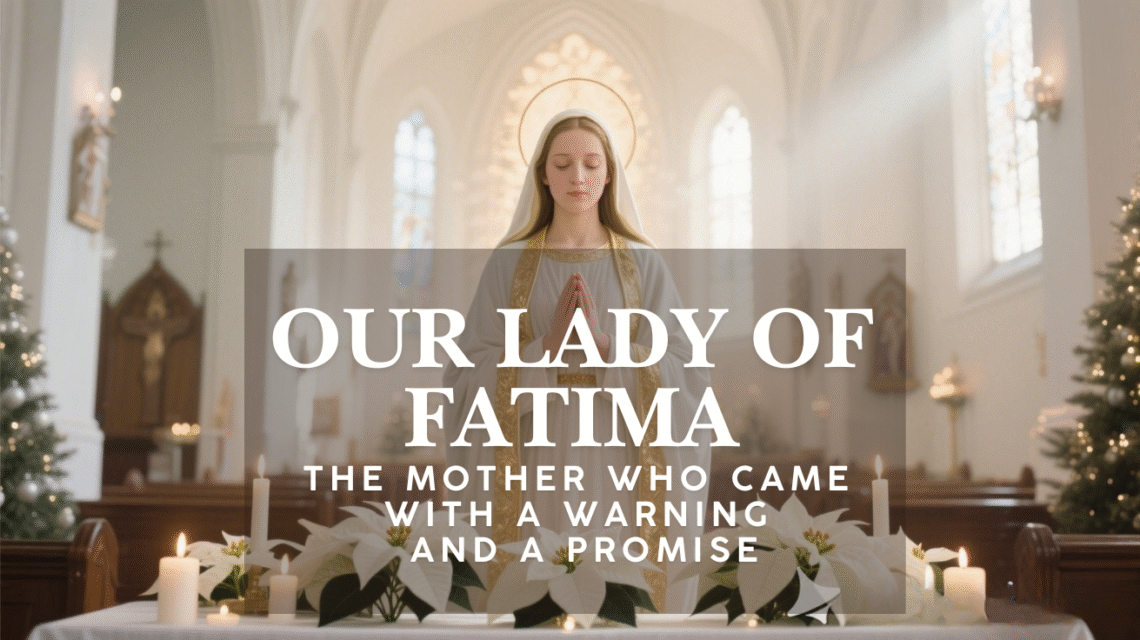
In 1917, while the world was unraveling under the weight of war, God did not send a theologian, a ruler, or a general. He sent a Mother.
Our Lady of Fatima appeared not in a cathedral or a great city, but in the fields of Cova da Iria, near the small village of Fatima, Portugal. She came quietly, repeatedly, and with unmistakable urgency — not to the powerful, but to three shepherd children: Lucia dos Santos and her cousins Francisco and Jacinta Marto.
They were poor, uneducated, and unknown to the world. Yet heaven trusted them with a message meant for the entire Church.
The World She Entered
The year was 1917. World War I raged across Europe. Millions were dead. Nations were collapsing. Faith was weakening, and atheism was rising aggressively, particularly in Russia. Into this moment, Mary did not come to offer comfort alone — she came to call for conversion, prayer, and reparation.
From May to October, on the 13th day of each month, the children returned to the same place. And each time, the Lady came.
She asked them to pray the Rosary daily.
She asked for sacrifice offered for sinners.
She warned that without repentance, suffering would increase.
She spoke not as a distant queen, but as a mother who sees the fire ahead and refuses to stay silent.
The Three Secrets
Much has been written — and misunderstood — about the Secrets of Fatima. In truth, they were not riddles meant to terrify, but truths meant to awaken.
The first was a vision of hell — not as spectacle, but as reality — shown to impress upon humanity the seriousness of sin and the urgency of prayer.
The second concerned the spread of errors, especially those that would deny God and persecute the Church, alongside a promise: “In the end, my Immaculate Heart will triumph.”
The third secret, revealed publicly decades later, described persecution, suffering, and martyrdom within the Church — a reminder that fidelity has a cost, and that history would test believers severely.
What is often missed is this: every warning was paired with hope. Mary never spoke without pointing toward mercy.
The Miracle of the Sun
On October 13, 1917, tens of thousands gathered — believers, skeptics, journalists, and mockers alike. Rain soaked the fields. The children announced the Lady would perform a miracle.
Then the sun appeared to dance, spin, and plunge toward the earth before returning to its place. Clothes soaked by rain were suddenly dry. Fear gave way to awe.
This event, known as the Miracle of the Sun, was witnessed by believers and nonbelievers alike and reported in secular newspapers. It remains one of the most widely attested public miracles in Church history.
Mary had kept her promise.
The Children and the Cost of Yes
Francisco and Jacinta would die young, offering their suffering in union with Christ, exactly as Mary had foretold. Lucia would live long, bearing the weight of the message and the responsibility of obedience.
Their lives remind us that proximity to heaven does not remove suffering — it gives it meaning.
Relics of Fatima and Their Meaning
The Church preserves the relics of Saint Jacinta and Saint Francisco Marto, canonized in 2017, as witnesses to holiness formed in obedience and sacrifice. Their relics are venerated at the Sanctuary of Our Lady of Fatima, alongside objects associated with the apparitions.
Relics connected to Fatima are often associated with white, symbolizing purity and light; gold, representing divine glory and authority; and blue, traditionally linked to Mary’s fidelity and heavenly origin. These colors echo the atmosphere of the apparitions themselves — luminous, serious, and filled with peace.
The shrine at Fatima is not merely a destination; it is a call to interior pilgrimage — to prayer, repentance, and trust.
The Absence of Relics and the Presence of a Message
Unlike the saints whose relics the Church preserves with reverence, Our Lady of Fatima left no bodily relics behind. The Blessed Virgin Mary was assumed body and soul into Heaven, and for this reason, the Church does not possess relics of her earthly remains. This absence is not a loss, but a quiet affirmation of her unique place in salvation history.
At Fatima, the Church instead preserves the relics of the children who received her message — Saints Francisco and Jacinta Marto — along with items associated with the apparitions themselves. These sacred remnants do not point to Mary as an object, but to her role as a messenger who leads souls toward conversion, prayer, and trust in God.
In this way, Fatima remains centered not on what was left behind, but on what was entrusted to the world: a call to prayer, repentance, and hope — a message meant to be lived rather than possessed.
Lesser-Known Truths About Fatima
What many do not realize is that before Mary appeared, an angel visited the children multiple times, teaching them prayers of reparation and Eucharistic devotion. Fatima did not begin with spectacle — it began with formation.
Another often overlooked fact: Mary never asked for fear. She asked for consistency. Daily prayer. Simple sacrifices. Faithfulness in ordinary life.
And perhaps most quietly powerful of all — Fatima is not about predicting catastrophe. It is about preventing it through conversion.
Mary came because prayer still matters. Because choices still matter. Because heaven intervenes when humanity stands at a crossroads.
Why the World Still Turns to Our Lady of Fatima
People turn to Our Lady of Fatima when the world feels unstable, when evil appears bold, and when faith feels costly. She is invoked for peace, for the conversion of hearts, and for perseverance in dark times.
Her message has not expired. It matures with time.
Fatima reminds us that history is not random — it is moral. And prayer is never passive.
A Prayer to Our Lady of Fatima
Our Lady of Fatima,
Mother who came with both warning and hope,
teach us to pray with sincerity
and to live with courage.
Lead us to repentance without despair,
to sacrifice without fear,
and to trust without conditions.
Intercede for a world wounded by pride and division.
Protect the Church in times of trial.
Form our hearts to love your Son above all things.
May your Immaculate Heart triumph in us first,
so that peace may take root in the world.
Our Lady of Fatima,
pray for us.