In December of 1531, on a small hill called Tepeyac, just outside present-day Mexico City, Heaven touched the earth in a way that would forever alter the course of faith in the Americas.
The Virgin Mary appeared not to a scholar or nobleman, but to a humble Indigenous man named Juan Diego Cuauhtlatoatzin, a member of the Chichimeca people, newly converted to Christianity. Speaking to him in his native Nahuatl, she addressed him tenderly as “my little son” and asked that a church be built in her honor on that very hill.
The Tilma That Should Not Exist
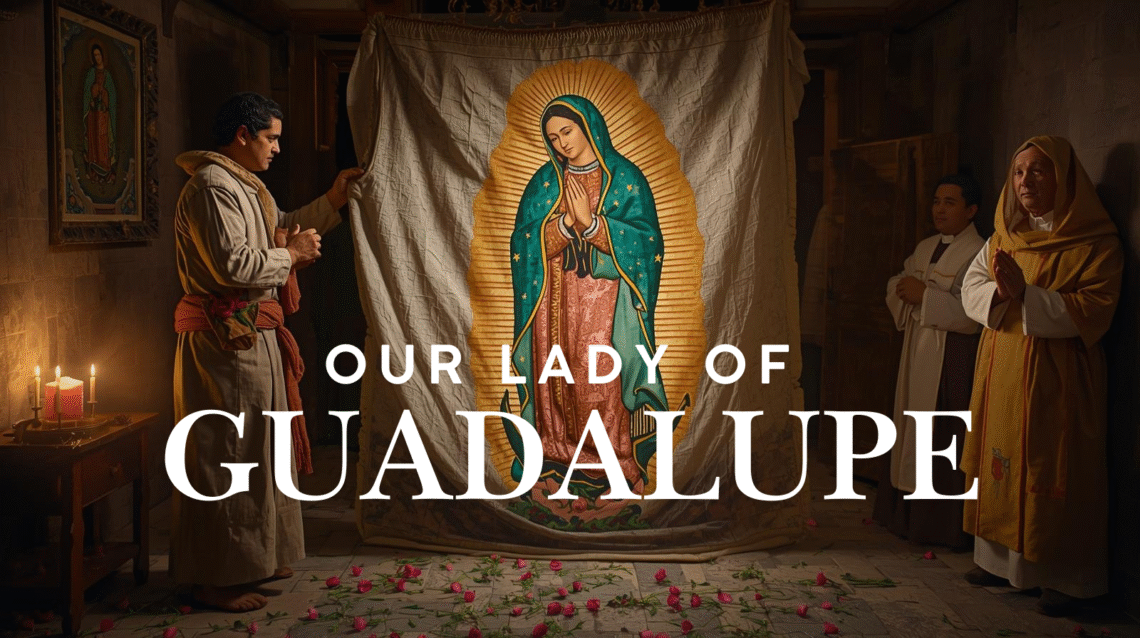
Juan Diego carried roses — Castilian roses, impossible for the season — in his tilma, a cloak woven from agave fiber, a material known to decay within 20–30 years. When he opened his tilma before Bishop Juan de Zumárraga, the roses fell… and her image appeared instantly on the fabric.
Nearly 500 years later, the tilma remains intact.
No known pigment.
No brushstrokes.
No underdrawing.
No varnish.
Scientific examinations have revealed that the image does not penetrate the fibers, but appears to float above the cloth — something no artist, ancient or modern, has been able to replicate.
The Living Image
One of the most astonishing mysteries of the tilma lies in her eyes.
High-resolution and infrared studies have revealed what appear to be reflections of at least 13 figures in her pupils — including Juan Diego and others present at the moment the tilma was revealed. These reflections follow the optical laws of the human eye, including depth and curvature.
Even more extraordinary: the tilma consistently measures approximately 98.6°F, the normal temperature of a living human body.
The Stars and the Sky
The stars on Our Lady’s mantle are not decorative.
Astronomers have discovered they correspond precisely to the constellations visible over Mexico on December 12, 1531, the date of her final apparition — mirrored as they would appear from Heaven, not Earth.
Attempts to Destroy the Tilma
In 1921, a bomb hidden in flowers exploded beneath the tilma.
The blast shattered marble, twisted a bronze crucifix — yet the tilma remained completely untouched.
Through centuries of smoke, candle soot, humidity, and pollution, it has endured.
Where She Is Now
Today, the tilma is enshrined at the Basilica of Our Lady of Guadalupe in Mexico City, visited by millions each year. Pilgrims still report conversions, healings, and profound encounters with peace in her presence.
Saint Juan Diego
Juan Diego lived a life of humility and obedience, serving as a witness to what God entrusted to him. He was canonized by Pope Saint John Paul II in 2002, making him the first Indigenous saint of the Americas. His remains rest near the Basilica.
A Mother for All
Our Lady of Guadalupe is not only the Patroness of Mexico, but of the entire Americas. She appeared clothed in symbols both Indigenous and Christian — speaking without words, uniting cultures, calling hearts gently back to God.
She did not conquer.
She did not condemn.
She remained