Some places in the world become holy not only because of what was said there, but because of what God allowed people to receive there.
Lourdes is one of those places.
When Catholics speak of Our Lady of Lourdes, they often think immediately of healing, water, prayer, and hope. They think of candles, processions, and the millions who have come with burdens too deep for words. But the story of Lourdes began in a quiet, hidden way — through a poor young girl named Bernadette and a grotto that the world would not have noticed on its own.
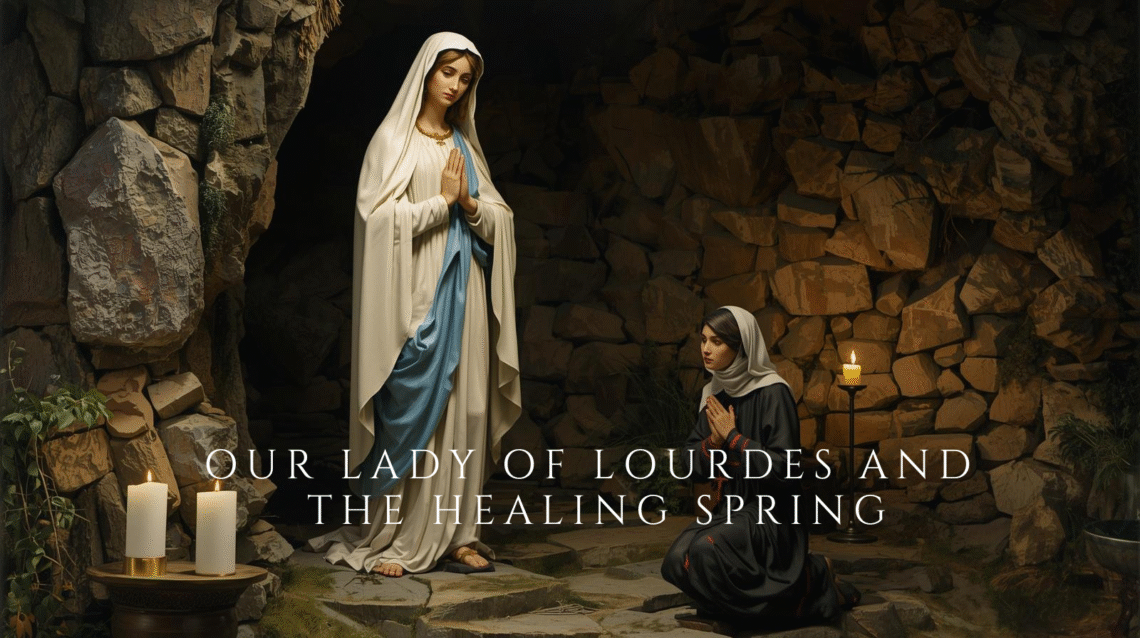
In 1858, in Lourdes, France, the Blessed Virgin Mary appeared to Bernadette Soubirous, a humble girl from a poor family. Bernadette was not powerful, educated, or socially important. She was simple, sickly, and overlooked by the world. Yet that is often how God works. Heaven does not always choose according to human importance. Sometimes God chooses the small, the hidden, and the humble so that His glory may be seen more clearly.
During the apparitions, Bernadette was led to a place in the grotto where she was told to dig in the ground. At first, what she found seemed unimpressive — mud, damp earth, and confusion. But soon a spring began to flow. That spring would become one of the most recognized signs associated with Lourdes. Over time, countless pilgrims would come to that place seeking healing, comfort, and mercy from God.
This is one of the reasons Lourdes continues to touch so many hearts.
The water is not magic. The place is not important because it offers superstition. Lourdes matters because it reminds people that God still sees suffering, and that grace can emerge from places that look hidden, muddy, and unremarkable. The spring became a sign of cleansing, healing, and hope. It told the faithful that heaven had touched the earth in a place of poverty and simplicity.
That message still speaks today.
Many people live with pain they cannot explain easily. Some carry physical illness. Others carry grief, fear, emotional exhaustion, family wounds, or spiritual dryness. Some are not looking for a miracle in the dramatic sense. They are simply praying for strength to keep going, peace to endure, and some sign that God has not forgotten them.
Our Lady of Lourdes speaks powerfully to that kind of soul.
She appeared not in luxury, but in simplicity. Not to the strong, but to the humble. Not with worldly power, but with quiet heavenly beauty. And from that place came a spring, a visible sign that God can bring living water out of the earth and hope out of sorrow.
Lourdes also reminds us that healing is deeper than the body alone.
Yes, many people go there praying for physical healing. That has always been part of Lourdes devotion. But there is another kind of healing that is just as needed — healing of the heart, healing of old grief, healing of fear, healing of bitterness, healing of a soul that has grown tired. Our Lady of Lourdes draws people toward that deeper healing too. She leads the suffering not only to relief, but to prayer, trust, repentance, and surrender to God.
That is why Lourdes remains so beloved.
It is a place for the sick, yes.
But it is also a place for the weary.
For the anxious.
For the grieving.
For those carrying private pain.
For those who need hope.
For those who need to remember that God still works gently, quietly, and mercifully.
The spring at Lourdes is a sign that grace still flows.
Not always in the way we expect.
Not always in the timing we want.
But still, grace flows.
And perhaps that is why devotion to Our Lady of Lourdes remains so powerful. She reminds us that heaven is not distant from suffering. God is not absent from the wounded. Mercy still reaches into places of poverty, weakness, and need.
Lourdes says to the suffering heart:
You are seen.
You are not forgotten.
Bring your pain to God.
Closing Prayer:
Our Lady of Lourdes, tender Mother of mercy, pray for us. Bring our needs before your Son, especially in times of sickness, sorrow, and weariness. Help us trust in God’s healing, His mercy, and His peace. Through Christ our Lord. Amen.