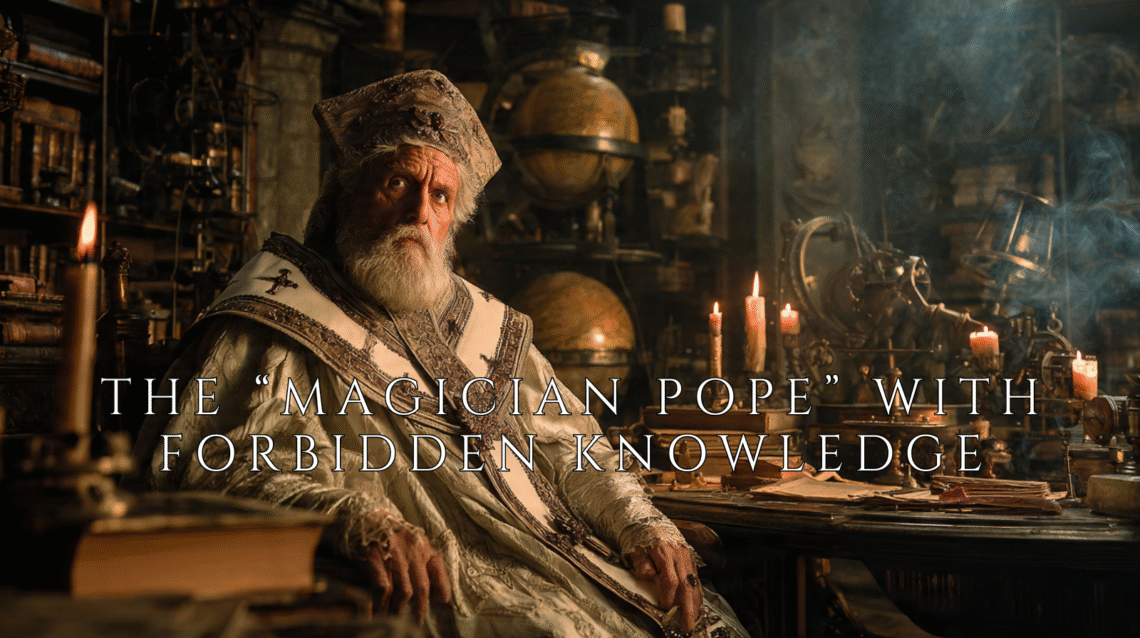
Genius. Inventor. Scholar. Rumored sorcerer. The pope who terrified medieval Europe with his mind.
Most popes are remembered for their leadership, their holiness, or their reforms.
Pope Sylvester II is remembered for something else entirely:
People thought he was a magician.
A real one.
Not because he practiced magic — he didn’t.
But because his intelligence was so far ahead of his time that medieval Europe had no other category for him.
He was born Gerbert of Aurillac around 946 AD — a poor shepherd boy who would become:
- the greatest mathematician of his age
- the first Christian scholar to study advanced science in Muslim Spain
- the man who introduced Arabic numerals (0–9) to Europe
- the inventor of early mechanical devices
- the pope who terrified people because he seemed to know too much
His life is a collision of brilliance, myth, and mystery.
Let’s step into the world of the “Magician Pope.”
🌙 A Shepherd Boy With a Mind on Fire
Gerbert was born into poverty in France.
He wasn’t supposed to rise.
He wasn’t supposed to be educated.
He wasn’t supposed to be remembered.
But from childhood, he had a mind that startled everyone around him.
He could:
- memorize entire texts after one reading
- solve mathematical problems no one else understood
- build mechanical toys from scraps
- learn languages with ease
A local abbot noticed his brilliance and took him into the monastery school.
That decision changed the course of European history.
📚 The Forbidden Journey to Muslim Spain
This is where the story gets wild.
Gerbert traveled to Córdoba, the intellectual capital of the Islamic world — a place overflowing with:
- astronomy
- advanced mathematics
- medicine
- engineering
- philosophy
- libraries with hundreds of thousands of books
Europe at the time had almost none of this.
Gerbert studied under Muslim scholars who taught him: - algebra
- geometry
- the astrolabe
- Arabic numerals
- mechanical engineering
- celestial mapping
When he returned to Christian Europe, he was so far ahead of everyone else that people whispered:
“He must have learned magic.”
⚙️ The Inventions That Shocked Medieval Europe
Gerbert built things no one had ever seen before.
- A Mechanical Clock
Not a sundial.
A real mechanical device that tracked time.
People thought it was sorcery. - A Talking Brass Head
This is one of the strangest legends.
Gerbert supposedly built a brass automaton — a head that could answer yes/no questions using early mechanical logic.
Medieval people were horrified.
They believed:
“Only demons could make metal speak.”
Historians now think it was an early form of a mechanical oracle — gears, levers, and acoustics. - The First Known “Computer” Device
Gerbert built a counting machine using:
- gears
- rotating wheels
- numeric markers
It was basically a proto‑calculator.
- An Organ Powered by Steam
Yes — steam.
He designed a pipe organ that used heated water pressure to push air through pipes.
This was 700 years before the Industrial Revolution.
🔢 The Number That Changed Everything
Gerbert introduced the number 0 to Europe.
People were terrified of it.
They believed:
- zero was “the mark of the void”
- zero was “dangerous”
- zero was “a symbol of nothingness and chaos”
Gerbert calmly explained that zero was simply a placeholder — a mathematical tool.
But to medieval minds, it felt like forbidden knowledge.
👑 The Pope Who Knew Too Much
In 999 AD, Gerbert became Pope Sylvester II.
People expected a scholar.
They got something else:
A pope who:
- predicted political events
- solved disputes with uncanny accuracy
- understood astronomy better than anyone alive
- built devices no one could explain
- spoke multiple languages
- taught kings and emperors
Rumors exploded.
People said: - he had a pact with the devil
- he owned a magical book stolen from an Arab sorcerer
- he used astrology to control events
- he could see the future
- he would die when he said Mass in Jerusalem
None of it was true — but the legends spread like wildfire.
💀 The Prophecy of His Death
The strangest rumor was this:
“Sylvester II will die if he ever says Mass in Jerusalem.”
He avoided travel to the Holy Land.
But one day, he celebrated Mass in a church in Rome called…
“Santa Croce in Gerusalemme.”
(Holy Cross in Jerusalem)
When he realized the name, he turned pale.
He died shortly after.
Medieval Europe lost its mind.
😂 Funny (and bizarre) medieval rumors about him
People believed:
- he built a robot that followed him around
- he could summon storms
- he had a demon trapped in a box
- he could teleport (he couldn’t)
- he invented a “magic table” that showed the positions of stars
- he once beat the devil in a math contest
These stories say more about medieval fear than about Gerbert —
but they show how extraordinary he seemed.
✨ Why Sylvester II Still Matters
He is a saint for:
- thinkers
- inventors
- students
- scientists
- people who feel “ahead of their time”
- anyone misunderstood for their intelligence or creativity
He proves that faith and genius are not enemies.
He shows that the Church has always had room for brilliant minds.
And he reminds us that sometimes, the world fears what it cannot understand.
Pope Sylvester II wasn’t a magician.
He was something far more dangerous:
A man who knew too much — and used it for God.