There are saints we admire from a distance, and then there are saints we instinctively turn to — almost without thinking — when something precious slips from our grasp. Saint Anthony of Padua belongs to the second kind.
For centuries, people have whispered his name in moments of urgency: when keys are missing, when words fail, when faith feels misplaced, when direction itself seems lost. Yet to reduce Saint Anthony to a helper in small crises is to miss the depth of who he was — and why the Church continues to trust his intercession.
Anthony was not a saint of coincidence.
He was a saint of clarity.
From Portugal to the World
Saint Anthony was born Fernando Martins de Bulhões in Lisbon, Portugal, in 1195, into a noble and well-educated family. From an early age, he showed a hunger for learning and prayer. He entered the Augustinian Canons as a young man, devoting himself to Scripture, theology, and disciplined religious life.
Everything changed when Fernando encountered the witness of Franciscan martyrs — friars who had been killed while preaching Christ in Morocco. Their deaths unsettled him. Their courage awakened something deeper than scholarship alone.
Fernando left his former life and joined the Franciscans, taking the name Anthony, desiring not comfort or reputation, but the Gospel lived without compromise.
A Voice That Could Not Be Hidden
Anthony did not initially seek to preach. In fact, his gifts remained hidden until a moment of necessity revealed them. When another friar failed to appear for a homily, Anthony was asked to speak — simply, without preparation.
What followed astonished those who listened.
Anthony spoke with clarity, depth, and authority. His words carried Scripture not as abstraction, but as lived truth. From that moment on, his path was set. He preached across Italy and southern France, confronting heresy, defending doctrine, and drawing people back to the heart of the faith.
Yet his preaching was never harsh. Anthony’s strength lay in his ability to unite truth with tenderness.
The Saint of the Child Jesus
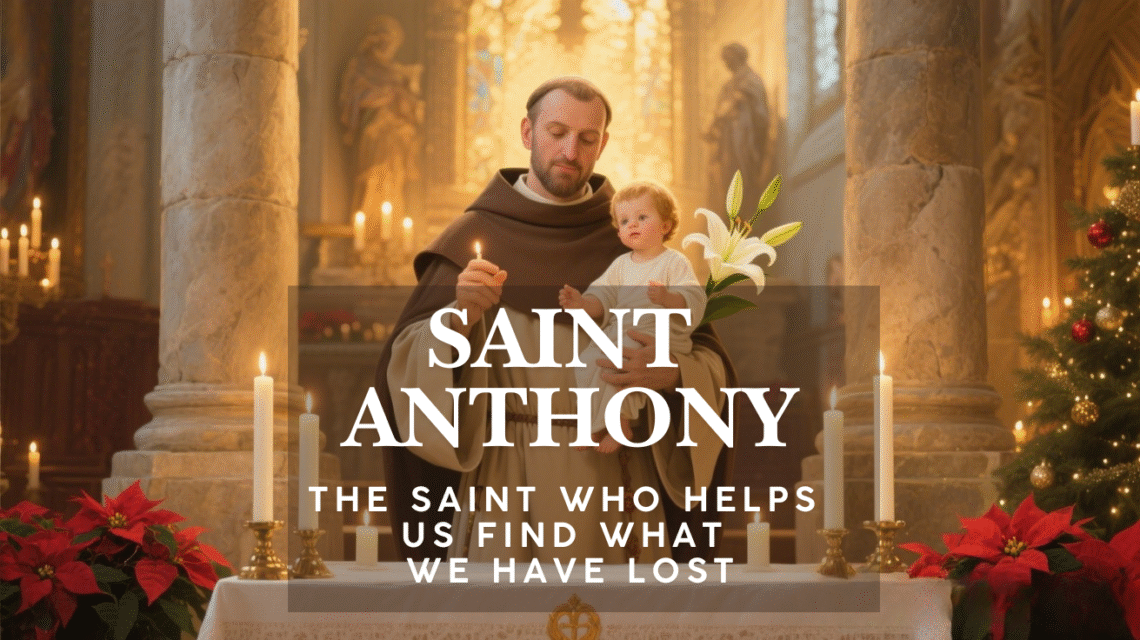
One of the most beloved traditions surrounding Saint Anthony is his association with the Child Jesus. According to early accounts, Anthony experienced a vision in which the Christ Child appeared to him, resting in his arms.
Whether understood literally or mystically, the meaning is unmistakable: Anthony’s theology was not cold or distant. It was intimate, incarnational, and rooted in love.
This is why sacred art so often depicts him holding the Child Jesus — not as decoration, but as testimony.
Relics of Saint Anthony and Their Meaning
Saint Anthony died in 1231 at the age of 36, exhausted by preaching and illness. His reputation for holiness was immediate and overwhelming. Miracles were reported at his tomb almost instantly.
The Relics of Saint Anthony: Meaning, Symbols, and Where They Are Kept
Unlike many saints whose relics are scattered, the relics of Saint Anthony of Padua are carefully preserved and deeply venerated in a single primary location: the Basilica of Saint Anthony, also known simply as Il Santo.
When Saint Anthony’s tomb was opened several years after his death, an extraordinary discovery was made. Though his body had deteriorated, his tongue was found incorrupt — preserved in a remarkable condition. For the Church, this was not viewed as spectacle, but as symbol. The tongue that had preached truth with clarity, defended the faith with charity, and proclaimed the Gospel with humility had not decayed.
Today, Saint Anthony’s tongue relic is preserved in an ornate reliquary shaped like a flame, symbolizing the fire of the Holy Spirit that animated his preaching. His jawbone and vocal apparatus are also preserved, further emphasizing his vocation as a teacher and preacher of the Word.
In sacred symbolism, Saint Anthony is closely associated with:
- Gold, representing divine truth and wisdom
- Brown, reflecting Franciscan humility and poverty
- The lily, symbolizing purity and integrity
- The Child Jesus, representing intimate union with Christ and the Incarnation
Pilgrims from around the world continue to visit Padua, not merely to see relics, but to pray — seeking clarity, restoration, and guidance. The relics of Saint Anthony stand as a quiet testimony that words spoken in love endure beyond a lifetime.
When his body was examined years later, his tongue was found incorrupt — preserved in a remarkable state. For the Church, this was not spectacle, but symbol. The tongue that proclaimed truth with charity had not decayed.
Today, Anthony’s relics are preserved and venerated at the Basilica of Saint Anthony in Padua, one of the most visited pilgrimage sites in the world. His relics are associated with gold, symbolizing divine truth; brown, reflecting Franciscan humility; and warm earth tones, echoing his grounded, pastoral approach to faith.
These relics are reminders that words spoken in love endure.
Swift Canonization — and Why
Saint Anthony was canonized less than one year after his death — one of the fastest canonizations in Church history. The Church recognized not only the miracles attributed to him, but the clarity of his witness and the immediate devotion of the faithful.
He was later declared a Doctor of the Church, honoring his theological depth and enduring teaching.
Anthony’s sanctity was not built on novelty. It was built on fidelity.
Why the World Still Turns to Saint Anthony
People turn to Saint Anthony when something has gone missing — not only objects, but peace, direction, faith, and hope. His intercession is sought because his life assures us that what is lost can be restored, and that God does not abandon what seems misplaced.
He reminds us that truth can be gentle, and clarity can be compassionate.
Anthony does not replace our search.
He steadies it.
A Prayer to Saint Anthony of Padua
Saint Anthony, faithful servant of God
and teacher of truth,
intercede for us.
Help us recover what has been lost —
not only what we hold in our hands,
but what we carry in our hearts.
Guide us back to clarity when confusion weighs heavy,
to faith when trust feels fragile,
and to hope when the path forward is unclear.
Teach us to seek Christ above all things,
and to hold Him with humility and love.
Saint Anthony of Padua,
pray for us.