
There is a reason why, for centuries, people have turned to Saint Anthony of Padua in moments of urgency, confusion, and loss. Many know him simply as “the saint who finds lost things,” but that description barely scratches the surface of who he truly was.
To understand why his intercession is so powerful, you have to begin at the start of his life.
Saint Anthony was born in 1195 in Lisbon, Portugal, and was originally named Fernando. From a young age, he showed a deep love for learning and a serious commitment to God. He entered religious life early, joining the Augustinian order, where he spent years studying Scripture and theology. He was not only intelligent but disciplined, forming a strong spiritual foundation that would later shape his mission.
Everything changed in the year 1220.
At that time, the bodies of Franciscan missionaries who had been martyred for their faith were brought back through his city. Seeing their sacrifice awakened something powerful within him. It was not fear, but conviction. He desired to give everything to God, just as they had. Moved by this encounter, he left the Augustinians and joined the Franciscan order, embracing a life of poverty, humility, and total surrender.
At first, Anthony intended to go to Morocco, hoping to preach and even die for Christ. But illness forced him to return, and what seemed like a setback became divine redirection. God was not calling him to martyrdom—but to something just as powerful.
He was called to speak.
For a time, Anthony lived quietly, almost unnoticed among the Franciscans. But during an ordination gathering, when no one else was prepared to preach, he was unexpectedly asked to speak. What happened next changed everything.
His words carried clarity, authority, and a depth of truth that immediately moved those who heard him. It became clear that this quiet friar possessed an extraordinary gift. Soon, he was sent throughout Italy and France, preaching to large crowds. People listened. Hearts softened. Lives changed. And wherever he went, reports of miracles followed.
One of the most well-known stories about Saint Anthony reveals not only his faith, but the spiritual authority he carried. In a town where people refused to listen to his preaching, Anthony turned away from them and went to the water’s edge. There, he began to preach to the fish. According to tradition, the fish rose from the water and gathered, as if listening in silence. Witnessing this, the people were moved to repentance, recognizing that they had rejected a man sent by God.
Saint Anthony’s life was marked by many miracles—healings, conversions, and moments of profound spiritual insight. But one of the most striking signs came after his death.
Anthony died in 1231 at the age of just 36. Less than a year later, in 1232, he was canonized by the Church—one of the fastest canonizations in history, a reflection of the impact he had made. Years after his burial, when his tomb was opened, it was discovered that while his body had decayed, his tongue remained intact and incorrupt. The Church recognized this as a sign of the purity and power of his preaching, a visible reminder that God had used his voice in an extraordinary way.
Today, Saint Anthony’s relics are preserved in Padua, Italy, at the Basilica dedicated to him. Pilgrims from around the world travel there, seeking his intercession in moments of need. Among the relics are his tongue, jawbone, and other remains—each one a testimony to a life completely given to God.
His feast day is celebrated on June 13, and devotion to him remains strong across the world. Tuesdays are traditionally dedicated to him, and many participate in the “13 Tuesdays” devotion, praying for specific intentions. Another long-standing tradition, known as the “Bread of Saint Anthony,” encourages acts of charity toward the poor in his honor.
So why do people continue to turn to Saint Anthony?
Yes, he is known for helping find lost items. But more deeply, people seek his intercession when something greater is missing—when peace feels out of reach, when direction is unclear, when relationships are broken, or when faith itself feels distant. Over time, countless people have testified to receiving help through his prayers, often in ways that feel immediate and personal.
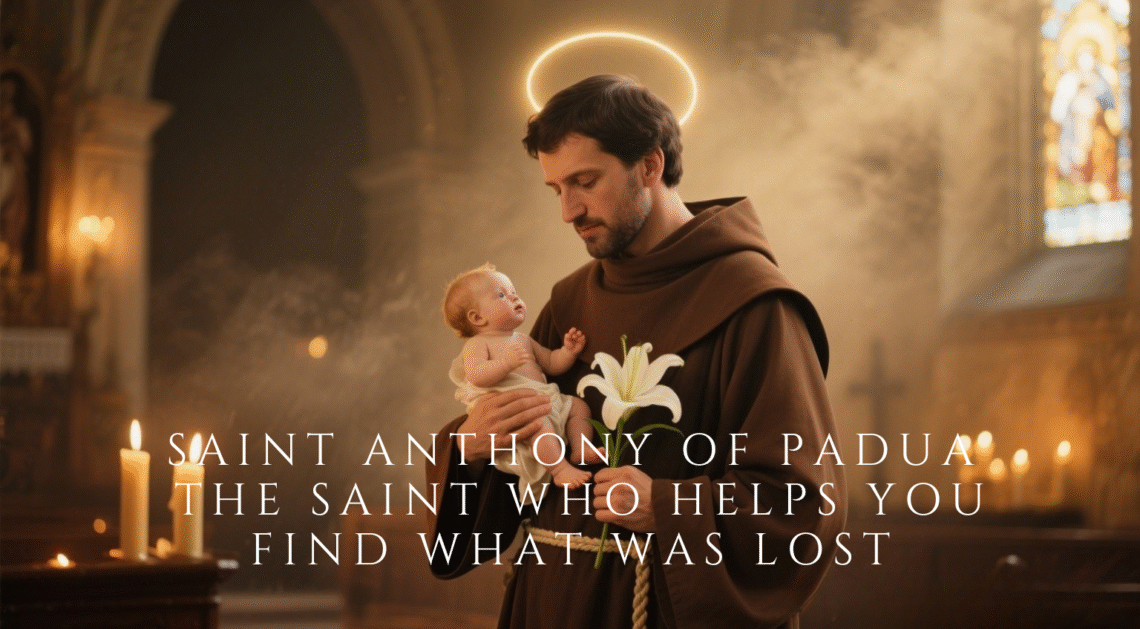
Saint Anthony is often depicted holding a lily, symbolizing purity, a book representing his knowledge of Scripture, and the Child Jesus, recalling a mystical vision he experienced. These symbols reflect the depth of his spiritual life and the closeness he shared with God.
But beyond the history, beyond the miracles, there is something important to understand.
His story is not just meant to inform you.
It is meant to reach you.
Because when something in your life feels lost—whether it is peace, stability, hope, or clarity—you are not alone in that experience. And through saints like Anthony, the Church reminds us that God does not ignore those moments.
Nothing that is placed in God’s hands is ever truly beyond recovery.
Prayer to Saint Anthony
Saint Anthony, faithful servant of God,
you who have been entrusted with helping restore what is lost,
hear my prayer.
There are things in my life that feel beyond my reach.
Things I cannot fix, cannot recover, cannot understand.
I ask for your intercession.
Pray for me before the Lord,
that what has been lost may be found,
and what is broken may be restored.
Guide me gently toward God’s will,
and help me trust that even in uncertainty,
He is working.
Through Christ our Lord, Amen.


