There are moments in life when we are forced to stop and reconsider what a “gift” truly is.
Not because we lack love,
but because circumstances remind us that love is not measured by what we can purchase.
In those moments, the teachings of Jesus Christ offer clarity that is both comforting and challenging:
the greatest gifts are not things — they are ways of giving ourselves.
Jesus never defined generosity by abundance.
He defined it by intention, presence, and love.
The Gift of Time
Time is the one resource that cannot be stored, replaced, or recovered.
Every moment given to another person is a moment of life shared.
Scripture does not treat time casually:
“So teach us to number our days, that we may gain a heart of wisdom.”
— Psalm 90:12
Jesus modeled this wisdom constantly.
He paused.
He stayed.
He listened.
He allowed interruptions, knowing that love is rarely efficient.
To give time — especially attentive, patient time — is to give something priceless.
It is a gift that teaches children, families, and communities that presence matters more than performance.
The Gift of Self-Giving Love
Jesus did not teach love as sentiment.
He taught it as self-giving.
“Greater love has no one than this, that someone lay down his life for his friends.”
— John 15:13
Most of the time, this laying down of life is quiet.
It appears as restraint, honesty, faithfulness, and choosing what is right over what is easy.
In a culture that pressures people to provide at any cost, Jesus offers a different measure of worth — one rooted in integrity, not excess.
The Gift of Faith
Faith is one of the most enduring gifts a person can receive.
Jesus repeatedly redirected attention away from possessions and toward trust in God’s care:
“Do not worry about tomorrow… your heavenly Father knows what you need.”
— Matthew 6:32–34
Faith teaches people how to navigate life when answers are unclear and circumstances feel unstable.
It offers direction when certainty is absent and hope when outcomes are unknown.
For families, faith becomes an inheritance that does not fade with time — a guide that remains long after seasons change.
The Gift of “Enough”
Jesus never promised excess.
He taught reliance on daily provision:
“Give us this day our daily bread.”
— Matthew 6:11
“Enough” is a difficult lesson in a world of comparison, but it is a freeing one.
It teaches gratitude, moderation, and compassion.
When people learn that sufficiency is not failure, they are released from shame and fear — and opened to generosity that does not harm the soul.
The Gifts That Do Not Go Under the Tree
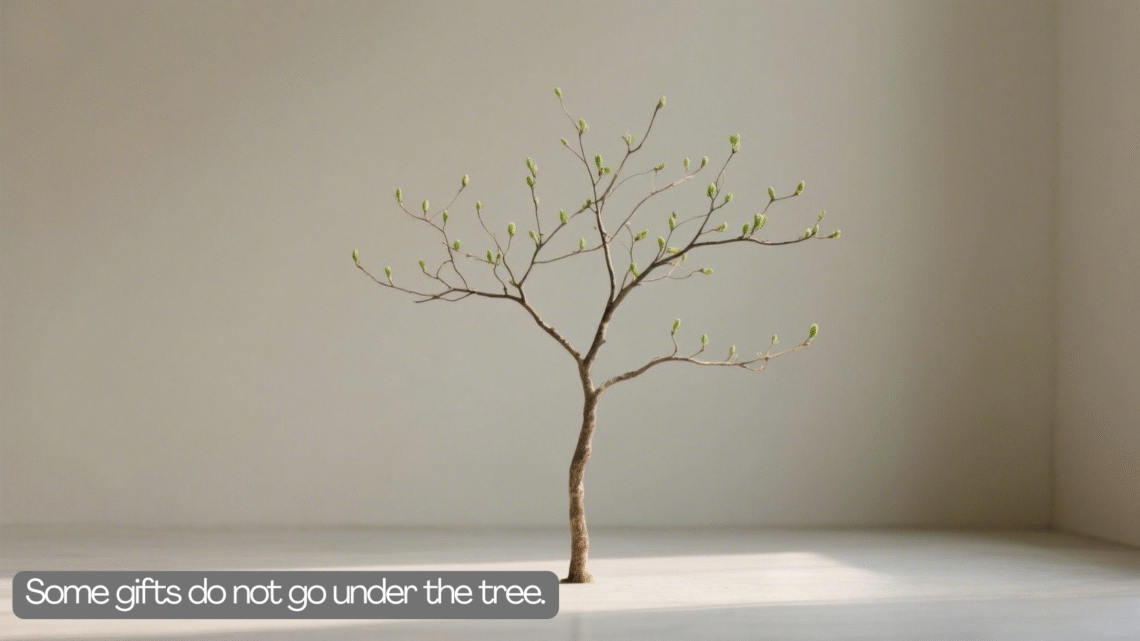
There are gifts that never sit beneath branches.
They are not wrapped, labeled, or placed where they can be counted.
Jesus never taught that the most important gifts would be visible.
Instead, He spoke of gifts that are received, carried, and lived.
“The kingdom of God is within you.”
— Luke 17:21
These are the gifts that do not go under the tree.
They grow quietly, the way life does.
They take root within a person long before anyone else can see them.
They are carried into ordinary days and difficult seasons, shaping how one loves, forgives, endures, and hopes.
A tree, even when bare, is still alive.
Its worth is not measured by what hangs from its branches, but by what flows through it.
So it is with the gifts Jesus gives.
What These Gifts Are
Jesus gives gifts that do not fade:
- Love that remains when circumstances change
- Faith that guides when answers are unclear
- Hope that endures when outcomes are uncertain
- Mercy that restores rather than condemns
- Life that continues beyond what is seen
“I came that they may have life, and have it abundantly.”
— John 10:10
These gifts are not seasonal.
They are not temporary.
They are eternal.
Why These Gifts Matter
Material gifts meet a moment.
Spiritual gifts shape a lifetime.
The gifts Jesus gives do not depend on wealth, timing, or circumstance.
They remain available in seasons of abundance and in seasons of lack.
They teach people how to live with dignity, restraint, compassion, and courage.
They form hearts that know how to stand when things are uncertain.
This is why they matter.
This is why they last.
How These Gifts Are Carried
Jesus does not place these gifts around us.
He places them within us.
“Abide in me, and I in you.”
— John 15:4
They are carried in how we give our time.
In how we choose restraint instead of excess.
In how we remain faithful when it would be easier to turn away.
These gifts are not displayed.
They are lived.
The Gift of Compassion
Jesus identified Himself with the poor, the hungry, and the unseen:
“Whatever you did for one of the least of these, you did for me.”
— Matthew 25:40
Compassion does not require wealth.
It requires attention, restraint, and willingness to see others as fully human.
These quiet acts of care shape hearts more powerfully than grand gestures ever could.
The Gift of Hope in Difficult Seasons
There are seasons when giving feels painful — not because love is absent, but because limits are real.
Jesus never dismissed hardship, yet He reminded people that grace remains sufficient:
“My grace is sufficient for you.”
— 2 Corinthians 12:9
No season defines a life or a family forever.
What endures is the love that holds people together, the faith that steadies them, and the hope that points forward.
A Closing Reflection
Jesus did not come bearing packages or promises of abundance.
He came bearing life.
The gifts He offers — time, faith, presence, compassion, restraint, hope — shape people long after material things fade.
When these gifts are given, they form something lasting, something holy.
And they remain available to all.