The Miraculous Staircase of Loretto Chapel
A Testament to Faith, Craftsmanship, and Divine Providence in Santa Fe, New Mexico
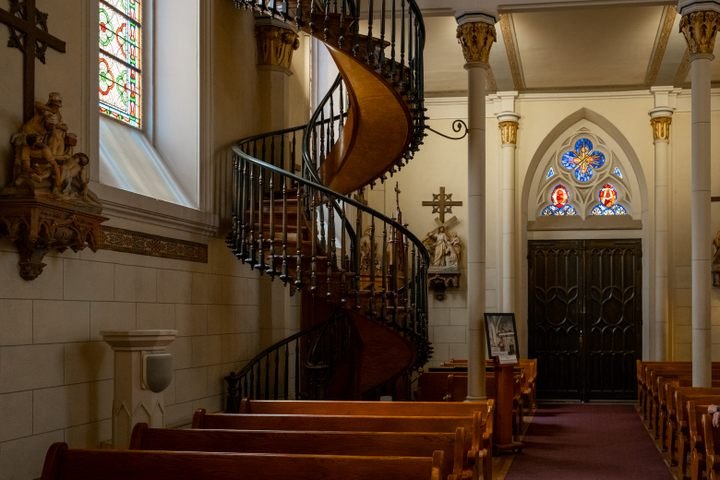
In the heart of historic Santa Fe, New Mexico, stands a small Gothic chapel that holds one of the most extraordinary faith-filled stories in American history. Within Loretto Chapel rises a spiral staircase so unusual, so precise, and so timely that it has been called both an engineering marvel and a miracle of answered prayer.
Known as the Miraculous Staircase of Loretto or St. Joseph’s Staircase, this structure continues to draw pilgrims, historians, engineers, and travelers from around the world. For believers, it is a powerful reminder that God responds when human solutions fail, and that Saint Joseph, patron saint of carpenters and workers, quietly intercedes for those who trust.
This article explores the full historical and spiritual story of the Loretto Staircase—who built it, why it was needed, how it was constructed, and why it remains one of the most astonishing structures of its kind.
The History of Loretto Chapel
The story begins in the mid-19th century, when the Sisters of Loretto arrived in the New Mexico Territory from Kentucky at the request of Bishop Jean-Baptiste Lamy. Their mission was to establish a girls’ academy and bring education to the region.
In 1873, construction began on a chapel for the academy. Designed by French architect Projectus Mouly, the chapel was inspired by the Gothic style of Sainte-Chapelle in Paris, featuring pointed arches, stained glass imported from France, and elegant vertical lines.
By 1878, the chapel was completed and consecrated—but a serious problem remained.
There was no way to access the choir loft, which stood approximately 22 feet above the floor. Due to the chapel’s narrow interior, traditional staircases would intrude into the sanctuary, and ladders were unsafe for the Sisters, who wore long habits.
Local builders were consulted. None could provide a solution that worked within the space.
The situation seemed impossible.
The Novena to Saint Joseph
With no practical answer, the Sisters did what religious communities have done for centuries when faced with impossibility: they prayed.
They began a nine-day novena to Saint Joseph, the patron saint of carpenters, workers, and families, asking for his intercession and guidance.
According to long-held tradition, on the final day of the novena, something extraordinary happened.
The Mysterious Carpenter
A stranger appeared at the chapel—described as a quiet man who arrived with simple tools and offered to build the staircase. He asked only for privacy, requesting to work alone without interruption.
The Sisters agreed.
For several months—accounts vary between three to eight months—the man worked quietly inside the chapel. No blueprints were ever seen. No helpers assisted him. He used no modern machinery, electricity, or advanced tools.
When the staircase was completed, it astonished everyone.
And then the carpenter disappeared.
He left no name, no bill, and no explanation. Despite attempts to find him and offer payment, the Sisters could not locate him. Many came to believe that Saint Joseph himself, or a carpenter sent through his intercession, had answered their prayers.
Why the Loretto Staircase Is So Incredible
The staircase is remarkable for several reasons that continue to fascinate experts today.
Extraordinary Design and Structure
- The staircase rises 20–22 feet
- It makes two full 360-degree turns
- It contains 33 steps, traditionally associated with the age of Christ at His crucifixion
- It appears to have no central support column
- It was originally built without a handrail (one was added in 1887 for safety)
Materials and Construction
- Constructed entirely of wood
- No nails or metal fasteners were used—only wooden pegs
- The wood has been identified as spruce, but a species not native to the region, with no documented local source
- The design allows for natural expansion and contraction without cracking
Engineering Significance
Modern engineers confirm that the staircase follows the laws of physics, relying on precise geometry, an inner stringer, and elastic wood properties. However, replicating it exactly, using 19th-century tools, without plans, remains extraordinarily difficult.
Yes, it could be recreated today with modern technology—but its execution in the late 1800s, under those conditions, is what makes it exceptional.
Can the Staircase Be Explained Today?
From a purely technical perspective, the staircase can be analyzed and understood. But the timing, execution, lack of documentation, and disappearance of the builder leave unanswered questions.
Later research suggests a highly skilled French carpenter named François-Jean Rochas may have been responsible. Yet no definitive proof exists, and this explanation does not diminish the faith-based interpretation held by many.
For believers, the miracle is not that physics were suspended—but that help arrived precisely when it was needed, through prayer.
Historical Timeline of Loretto Chapel and the Staircase
| Year | Event |
|---|---|
| 1852 | Sisters of Loretto arrive in Santa Fe |
| 1853 | Loretto Academy opens |
| 1873 | Construction of Loretto Chapel begins |
| 1878 | Chapel completed; choir loft inaccessible |
| ~1880–1881 | Novena to St. Joseph; staircase constructed |
| 1887 | Handrail added |
| 1968 | Loretto Academy closes |
| Today | Chapel operates as a museum and wedding venue |
Why This Story Strengthens Faith
For believers, the Loretto Staircase is more than architectural curiosity—it is a testimony to perseverance in prayer.
It reminds us that:
- God is attentive to details
- No problem is too small or too impossible
- Saint Joseph works quietly, without recognition
- Faith often meets us in silence, not spectacle
It speaks especially to those facing closed doors, unanswered questions, or situations where logic offers no solution.
Visiting Loretto Chapel and Santa Fe’s Historic Sites
Loretto Chapel is located in downtown Santa Fe, near the historic Plaza, and is open daily as a museum (admission required).
Nearby Historic and Faith-Based Sites
- Cathedral Basilica of St. Francis of Assisi
- San Miguel Chapel (often cited as the oldest church in the U.S.)
- Santa Fe Plaza
Lodging Recommendations
- Inn and Spa at Loretto (adjacent to the chapel)
- Boutique hotels and historic inns within walking distance
Santa Fe’s blend of history, art, architecture, and spirituality makes it an ideal destination for faith-based travel, cultural exploration, and reflection.
A Prayer to Saint Joseph
Saint Joseph,
faithful guardian and humble worker,
you answered the prayers of the Sisters of Loretto
when no human solution could be found.
Intercede for us in our own impossible moments.
Teach us patience, trust, and quiet obedience.
Help us believe that God is working
even when the answer arrives silently.
Saint Joseph, patron of workers and families,
pray for us.
Amen.
A Lasting Testament
The Miraculous Staircase of Loretto stands today not simply as a structure, but as a reminder:
Faith builds where fear ends.
Prayer opens what effort cannot.
And God still provides a way.