
Where Fear Ended and Mercy Began
Before Saint Francis of Assisi became known for humility, peace, and love of the poor, he lived a life shaped by comfort and ambition. He was the son of a prosperous merchant, admired for his charm and drawn to dreams of recognition and honor. Like many young men of his time, he imagined a future defined by success, not surrender.
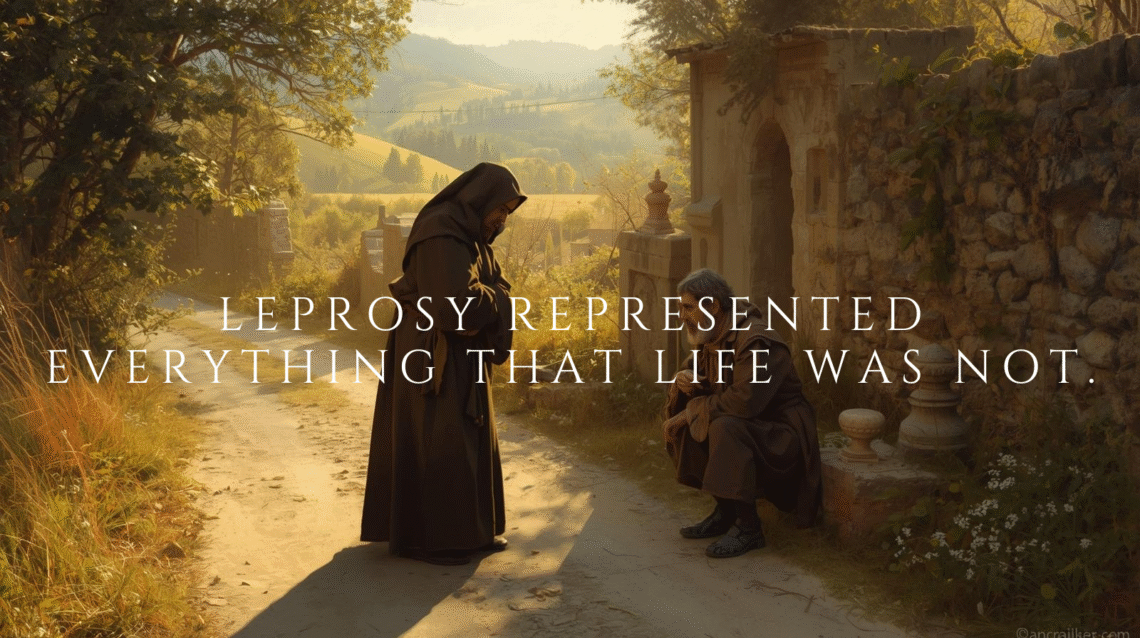
Leprosy represented everything that life was not.
In the medieval world, lepers were feared and excluded. They lived outside city walls, separated from family and community, forced to announce their presence so others could avoid them. Their illness carried stigma, isolation, and deep social rejection. To encounter a leper was to confront what society deemed untouchable.
Francis later admitted that nothing filled him with greater revulsion. In his Testament, he wrote plainly, “When I was in sin, it seemed too bitter for me to see lepers.” His fear was not unusual. It was learned, reinforced, and accepted. Avoidance was considered normal. Compassion was not expected.
At the same time, Francis was already restless. His early dreams of glory had begun to unravel. Illness, disappointment, and unanswered questions had unsettled him. He was searching for God, yet still clinging to comfort and control. Faith had entered his life, but it had not yet reshaped it.
It was during this unsettled season that Francis encountered a leper on the road near Assisi.
Nothing required him to stop. No one was watching. He could have turned away, as he always had. Instead, something within him shifted. Francis later described this moment not as courage, but as obedience to grace. He dismounted from his horse, approached the man he feared, embraced him, and kissed him.
The act was physical and deliberate. It crossed social, emotional, and instinctive boundaries. Francis wrote that when he left the lepers, “what had seemed bitter to me was turned into sweetness of soul and body.” The encounter did not remove suffering, but it transformed the one who dared to draw near.
In that moment, Francis lived the Gospel rather than reflecting on it. The words Christ spoke — “Whatever you did for one of these least brothers of mine, you did for me” (Matthew 25:40) — took flesh. The leper was no longer a symbol of fear, but a place of encounter with Christ.
This moment did not stand alone. It reordered Francis’s life.
Before, he was admired for ambition and ease. After, he was increasingly seen as impractical, even foolish. He relinquished wealth, embraced poverty, and chose proximity to those on the margins. What once brought him approval, he willingly surrendered. What once repelled him, he now served.
Francis did not become holy because he kissed a leper. He kissed the leper because he allowed grace to lead him where fear once ruled. That single act clarified the direction of his life. From then on, he consistently chose mercy over safety, presence over avoidance, and love over reputation.
This story continues to matter because the world still teaches distance.
Today’s “lepers” may not live outside city walls, but many live outside attention and care. They are the chronically ill, the grieving, the exhausted, the displaced, the lonely. Some wounds are visible. Others are carried quietly. Society may no longer require bells or warnings, but it still encourages turning away.
The story of Saint Francis does not demand heroic gestures or dramatic sacrifice. It offers a quieter invitation: to notice where fear has shaped our habits, and to consider where grace might be asking us to step closer.
Francis did not heal the leper’s body. But something more enduring was healed — the division between fear and compassion. And in that healing, a life was redirected, a witness was formed, and a legacy of mercy began.
That is why this moment still speaks.
Not because it was extraordinary,
but because it was faithful.