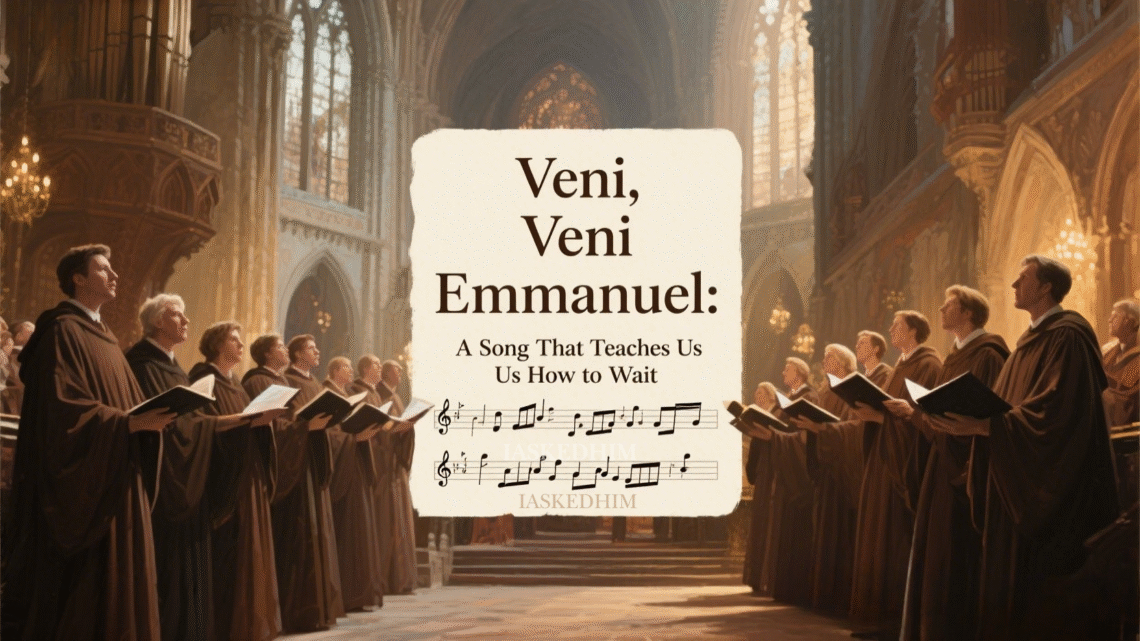
As the days grow shorter and the air turns crisp, a haunting melody often emerges from churches, playlists, and quiet reflections: “O Come, O Come, Emmanuel.” Known in its original Latin as Veni, Veni Emmanuel, this hymn carries a depth that sets it apart from the cheerful jingles of the holiday season. It is not a song of triumphant celebration but one of profound yearning—a cry from the soul for God to break into our world. In an age of instant gratification, singing this hymn invites us to rediscover the true spirit of Christmas: the patient, hopeful waiting for “God with us.”
Ancient Origins in Monastic Prayer
The roots of Veni, Veni Emmanuel stretch back over 1,200 years to the early medieval Church. Its foundation lies in the “O Antiphons,” seven ancient chants sung during Vespers (evening prayer) in monastic communities from December 17 to 23—the final week of Advent.
These antiphons, dating to at least the 8th or 9th century (with possible origins as early as the 6th century in Italy), each begin with “O” and address the coming Messiah by a biblical title drawn from Old Testament prophecies:
- O Sapientia (O Wisdom)
- O Adonai (O Lord)
- O Radix Jesse (O Root of Jesse)
- O Clavis David (O Key of David)
- O Oriens (O Dayspring or Rising Sun)
- O Rex Gentium (O King of the Nations)
- O Emmanuel (O God With Us)
By the 12th century, these antiphons were paraphrased into a metrical Latin hymn, Veni, Veni Emmanuel. The earliest documented version appears in a 1710 German hymnal, Psalteriolum Cantionum Catholicarum. The hymn synthesizes the antiphons into verses, each pleading “Veni” (“Come”) and ending with a refrain: “Gaude! Gaude! Emmanuel nascetur pro te, Israel” (“Rejoice! Rejoice! Emmanuel shall be born for thee, O Israel”).
A Hidden Message from the Messiah
One of the most captivating lesser-known facts about the O Antiphons is their ingenious acrostic. Take the first letter of each title in reverse order (starting from the last antiphon on December 23):
Emmanuel Rex Gentium Oriens Clavis David Radix Jesse Adonai Sapientia
This spells ERO CRAS in Latin, meaning “I will be [there] tomorrow.” Sung over seven days, the antiphons build to Christmas Eve, as if Christ Himself is responding from the future: “Tomorrow, I will come.” This subtle promise underscores the hymn’s theme of divine faithfulness—God answering centuries of longing with His presence on Christmas Day.
The Melody: From Funeral Procession to Advent Hope
The haunting tune we associate with the hymn today originated separately in 15th-century France. For centuries, its source was a mystery—early publishers claimed it came from a “French missal in Lisbon.” In 1966, musicologist Mary Berry (also known as Sister Thomas More) solved the puzzle: she discovered it in a manuscript used by Franciscan nuns as a processional chant for funerals, paired with the responsory Libera me (“Deliver me”).
A melody born in mourning now carries a message of hope. This transformation—from death to expectant life—mirrors the hymn’s theology: Christ comes to conquer death’s shadows and ransom captives from exile.
Revival in the 19th Century: John Mason Neale’s Translation
The modern English version owes its popularity to Anglican priest and scholar John Mason Neale (1818–1866). A passionate reviver of ancient hymns, Neale translated the Latin in 1851, initially as “Draw nigh, draw nigh, Emmanuel.” His collaborator, Thomas Helmore, paired it with the now-iconic tune in The Hymnal Noted (1854). By 1861, a revised version appeared in the influential Hymns Ancient and Modern, cementing “O Come, O Come, Emmanuel” in English-speaking worship.
Neale, despite chronic illness and controversy (he faced opposition for his “high church” leanings), gifted the Church timeless translations like “Good King Wenceslas” and “Of the Father’s Love Begotten.”
The Lyrics: Latin Original and English Translation
The original Latin (common version with refrain):
Veni, veni Emmanuel! Captivum solve Israel, Qui gemit in exilio, Privatus Dei Filio.
Gaude! Gaude! Emmanuel Nascetur pro te, Israel.
Neale’s enduring English translation (common verses):
O come, O come, Emmanuel, And ransom captive Israel, That mourns in lonely exile here, Until the Son of God appear.
Rejoice! Rejoice! Emmanuel Shall come to thee, O Israel.
Other verses invoke Wisdom, the Root of Jesse, the Key of David, the Dayspring, and the King of Nations—each rooted in Isaiah’s prophecies, pleading for deliverance from sin, darkness, and tyranny.
The Meaning: Longing for “God With Us”
At its core, Veni, Veni Emmanuel expresses humanity’s exile—spiritual separation from God—and the desperate hope for redemption. “Emmanuel” (from Isaiah 7:14, fulfilled in Matthew 1:23) means “God with us.” Unlike joyful Christmas carols celebrating the Nativity, this is an Advent hymn: it captures Israel’s centuries-long wait for the Messiah and echoes our own anticipation of Christ’s return.
It reminds us that Christmas is not just about a baby in a manger but about God entering our broken world to ransom, heal, and reign.
Why Isn’t It as Famous as “Jingle Bells” or “Silent Night”?
Despite its depth, Veni, Veni Emmanuel is less ubiquitous than brighter carols. It’s primarily an Advent hymn, sung in the penitential weeks before Christmas, not during the festive 12 days. Its minor-key melody is somber and reflective, evoking longing rather than merriment. Archaic language (“ransom captive Israel,” “disperse the gloomy clouds of night”) can feel distant in modern settings. Yet, in churches and classical recordings, it remains beloved—and has found new life in versions by artists like Enya, Kelly Clarkson, and choral ensembles.
Lesser-Known Gems and Enduring Legacy
- Zoltán Kodály composed a choral version in 1943, blending Latin and Hungarian.
- The hymn’s double meaning: it prays not only for Christ’s first coming but His second advent.
- Its funeral origins add poignant irony—now it heralds victory over the grave.
As you listen to or sing Veni, Veni Emmanuel this season, let its ancient plea stir your heart. In a world of hurried holidays, it draws us back to the quiet ache of waiting—and the profound joy of knowing Emmanuel has come, is with us, and will come again. May it deepen your Christmas, reminding you that the true meaning is not in the lights or gifts, but in God drawing near to ransom His people.
Rejoice! Rejoice! Emmanuel shall come to thee.