
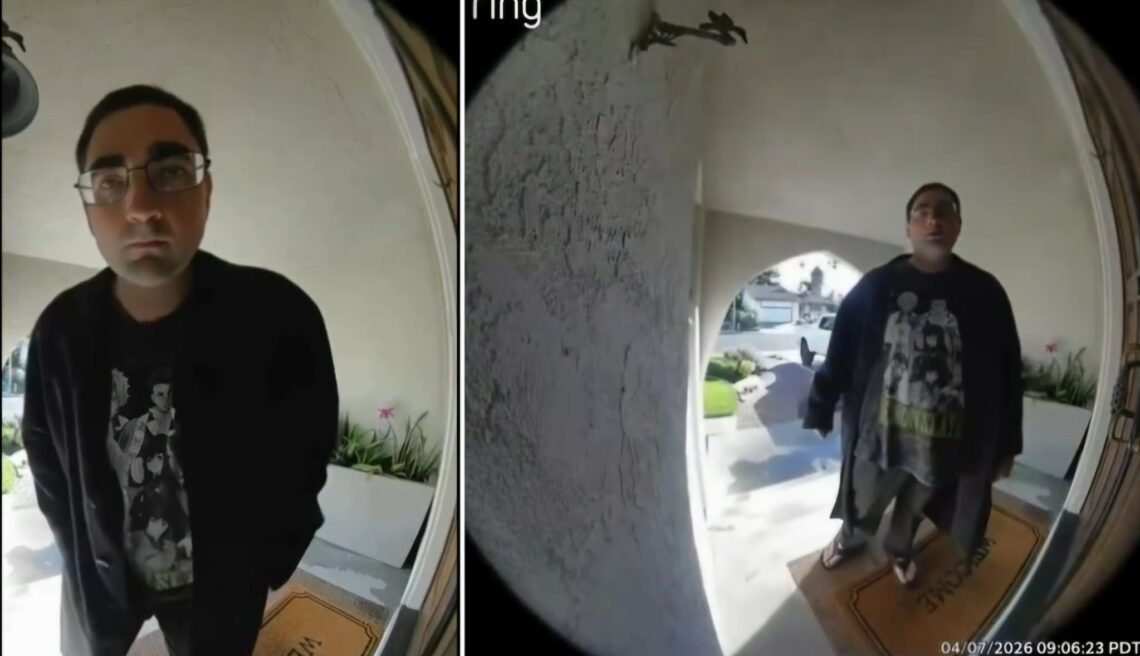
A disturbing viral Ring-camera incident is making the rounds online, and it is hitting parents for one reason above all: it forces a terrifying question to the surface. If a child had been the one standing closest to that door, would that child have known exactly what to do?
Widely shared follow-ups identify the incident as happening in Fairfield, California, and a Solano County inmate-search result shows a Jason Thomas Nichols in custody after the incident. Even with that update, public details remain limited, which is exactly why this moment should be treated first as a family safety warning, not as a social-media guessing game.
That is the real reason this story matters.
Not because it is shocking.
Not because it is viral.
But because it reminds every parent, grandparent, and caregiver that children need a plan before fear ever reaches the front door.
Why this video unsettles people so deeply
There is something especially chilling about a stranger at the door acting erratically, aggressively, or unpredictably. Adults may recognize the danger immediately. Children may not.
A child can hear a raised voice, feel pressure, panic, freeze, or respond out of fear. That is why this kind of incident cannot be brushed off as just another strange internet clip. It is a vivid reminder that families should never assume a child will “just know” what to do in a frightening moment.
The safest response is not panic. It is preparation.
This is not the time for internet diagnosis
When a video like this spreads, people rush to label what they think they are seeing. Some say possession. Some say drugs. Some say mental illness. Some say evil.
But a clip is not a diagnosis.
What the footage does show is behavior that appears frightening and unsafe. That alone is enough reason to take it seriously. Families do not need to know exactly what was happening in that man’s mind to understand the lesson in front of them: if someone shows up at your door behaving in a threatening or unstable way, the door stays closed.
That is the message parents need to hear most clearly.
Children should be taught one simple rule
Children should never open the door to strangers.
That rule is not outdated. It is not excessive. It is still basic home safety.
The American Academy of Pediatrics includes “never open the door to strangers” in its safety guidance, and Children’s Hospital of Pittsburgh likewise advises families to teach children and babysitters never to open the door to strangers and never tell a stranger that parents are not home. The same guidance recommends rehearsing emergency situations ahead of time so a child knows how to respond before fear takes over.
That matters because a frightened child does not rise to the level of a parent’s hopes. A frightened child falls to the level of what has been practiced.
What children need to know before something happens
A child does not need a long lecture. A child needs a simple script.
Do not open the door.
Do not say you are home alone.
Go get a trusted adult.
If you are scared and no adult is there, call 911.
Children’s Hospital of Pittsburgh notes that children age 4 and older can begin learning how to take an active role in an emergency, including alerting a nearby adult and learning key information like their address and emergency numbers.
That is why this conversation should happen now, not later.
Not after a scare.
Not after a near miss.
Not after a viral video.
Now.
Why video doorbells matter
This incident is also a powerful reminder that video doorbells are not just trendy gadgets. They can be a real layer of protection.
The FTC notes that connected cameras such as doorbell smart cameras let homeowners watch or listen to live video and audio feeds from a phone or computer. In a moment of uncertainty, that can mean the difference between opening the door blindly and staying safely behind it while you assess what is happening.
A camera cannot replace wisdom.
It cannot replace a locked door.
It cannot replace a safety plan.
But it can help a family see what is outside, record what happened, and buy precious seconds in a dangerous moment.
That matters.
A warning families should not ignore
If you have children in your home, even occasionally, this is a good reason to check your front-door safety tonight.
Is the camera working?
Can you see clearly who is outside?
Does your child know not to answer the door?
Does your child know what to do if someone begins shouting, knocking hard, or demanding information?
Those are not dramatic questions. They are responsible ones.
The same FTC guidance that explains how these cameras work also warns families to secure them properly with strong passwords, current software, and built-in security features so the system that protects your home does not become a privacy risk itself.
So yes, a video doorbell can help. But it should be paired with common sense, a locked door, and a family plan.
What parents and grandparents should teach tonight
Tell children this clearly:
You do not open the door because someone knocks loudly.
You do not open the door because someone sounds urgent.
You do not open the door because someone demands answers.
You do not tell strangers who is home.
You go get help.
That may sound simple, but simple is what works under stress.
Children do not need complicated instructions in a frightening moment. They need words they can remember and repeat.
Final thought
The viral Ring camera incident out of Fairfield is terrifying to watch. But if families use it as a reason to strengthen home safety, then it can still serve a purpose.
Lock the door.
Teach the plan.
Check the camera.
Practice the script.
And make sure every child in your care knows this truth:
You never open the door just because someone demands it.