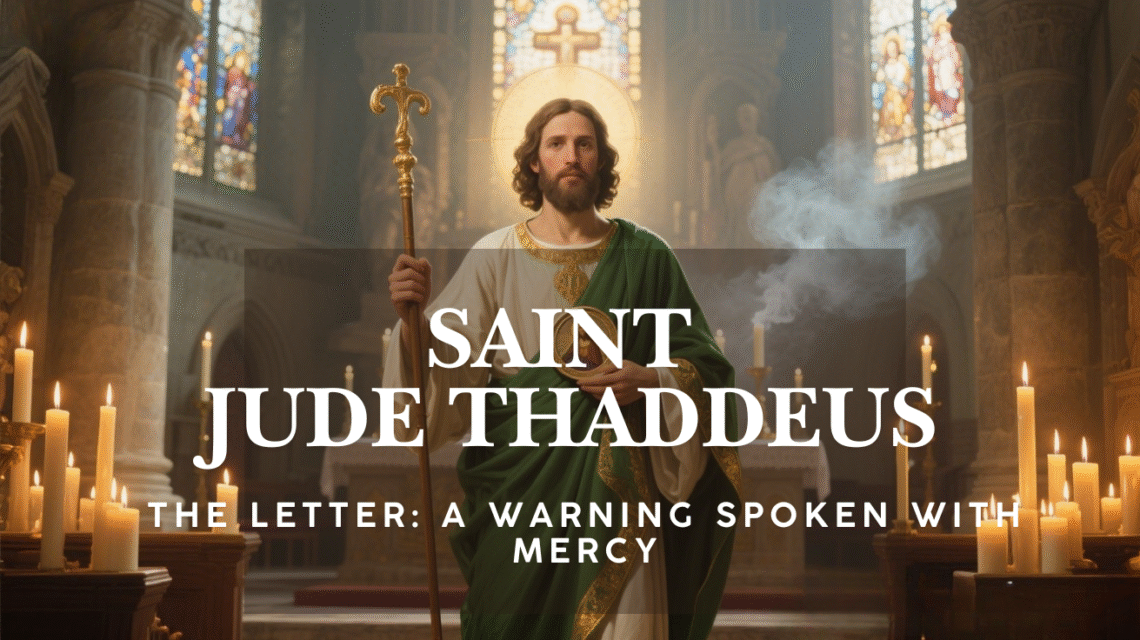
The Letter of Saint Jude is one of the shortest writings in the New Testament, yet it carries a gravity that has unsettled readers for centuries. It does not ease the conscience or flatter the listener. It interrupts. It warns. And yet, when read carefully, it does so not with cruelty, but with a fierce desire to protect what is fragile.
Saint Jude did not set out to write a severe letter. He tells us himself that he originally intended to write about the joy of shared salvation. But something changed. A danger had entered the Christian community — not from persecution outside the Church, but from distortion within it. And Jude understood that this kind of danger required clarity, not softness.
Who Saint Jude Was — and Why His Voice Matters
Saint Jude, also known as Jude Thaddeus, was one of the Twelve Apostles. In the Gospels he is identified carefully as “Jude, not Iscariot,” a distinction that quietly tells us something important: Jude lived in the shadow of misunderstanding. He was close to Jesus — tradition holds that he was a relative — yet he never assumed authority by proximity. His faith matured through humility, patience, and obedience.
After the Resurrection and Pentecost, Jude traveled widely to preach the Gospel, particularly in regions marked by instability and resistance to Christianity. He preached alongside Saint Simon the Zealot and eventually suffered martyrdom for his faith. His life was not dramatic in the way history often remembers heroes. It was steady. And it was faithful.
That same steadiness marks his letter.
Why the Letter Was Written
Jude writes because false teachers had begun to infiltrate Christian communities. These were not obvious enemies. They participated in worship, shared meals, spoke confidently — and yet quietly distorted the Gospel. They reframed grace as permission, freedom as self-indulgence, and faith as something malleable to personal desire.
Jude recognized what was happening immediately: truth was being hollowed out while maintaining its outer form.
This is why his language feels sharp. He is not addressing confused believers. He is addressing those who mislead others while appearing spiritually secure.
“Contend for the Faith”
One of the most cited lines in the letter is Jude’s exhortation to “contend for the faith that was once for all delivered to the saints.” This is not a call to aggression or argument. In the original sense, it means to stand firmly, to guard something entrusted, to refuse erosion.
Jude is reminding the Church that faith is not endlessly reinvented. It is received, protected, and lived — even when that fidelity is inconvenient.
The Language That Feels Harsh — and What It Actually Means
Some of Jude’s imagery is among the strongest in Scripture, particularly when he describes false teachers as “waterless clouds” and “twice dead, uprooted.”
In the original Greek, Jude calls them νεφέλαι ἄνυδροι (nephelai anydroi) — clouds without water. In the ancient world, clouds were not decorative. They were promises. A cloud that carried no rain was dangerous because it raised false hope.
Jude is not insulting people for their sake. He is warning that leaders who promise nourishment but cannot give it cause real harm.
He continues with agricultural language, describing fruitless trees as “twice dead, uprooted.” Again, this is not final condemnation. It is diagnosis. A tree pulled from its roots cannot restore itself. Without intervention, it will wither.
What Jude never says is that God cannot heal or restore. He does not issue judgment. He describes spiritual conditions, not eternal outcomes.
Why the Tone Is Severe — but Not Cruel
Jude’s severity is reserved for those who exploit the community from within. Scripture consistently treats internal corruption more seriously than external opposition because it disguises itself as nourishment.
And yet — this is crucial — Jude immediately balances warning with mercy.
He instructs believers to show compassion to those who doubt, to rescue others gently, and to remain vigilant over their own hearts. The letter is not about superiority. It is about responsibility.
Jude knows how easily confidence can masquerade as truth, and how easily zeal can slide into pride.
The Letter’s Final Word: Hope
After all the warnings, Jude does something remarkable. He lifts the reader’s eyes away from danger and toward God.
He closes with one of the most beautiful doxologies in Scripture, praising the God who is able to keep His people from falling and to present them blameless with joy.
Jude does not leave the Church anxious.
He leaves the Church anchored.
The message is clear: vigilance is necessary, but fear is not the foundation. God is.
Why the Letter Still Matters
The Letter of Saint Jude speaks powerfully to times of confusion, when truth feels diluted and conviction feels costly. It reminds us that faith requires both clarity and compassion — and that mercy without truth collapses, just as truth without mercy hardens.
This is why Saint Jude became the saint people turn to in desperate times. Not because he promises easy solutions, but because his life and letter testify that faith can endure without immediate answers.
A Prayer Inspired by the Letter of Saint Jude
Saint Jude, faithful apostle and guardian of truth,
you who warned the Church with courage and care,
intercede for us.
Help us remain rooted in the faith we have received,
to contend without bitterness,
and to love without compromise.
Grant us discernment without pride,
mercy without confusion,
and perseverance when clarity feels distant.
Entrust us always to the God
who is able to keep us from falling
and to lead us into lasting joy.
Saint Jude,
pray for us.