A Reflection on Saint Thomas Aquinas and the Wisdom That Comes from God
In the halls of learning, Saint Thomas Aquinas was once dismissed before he was ever understood.
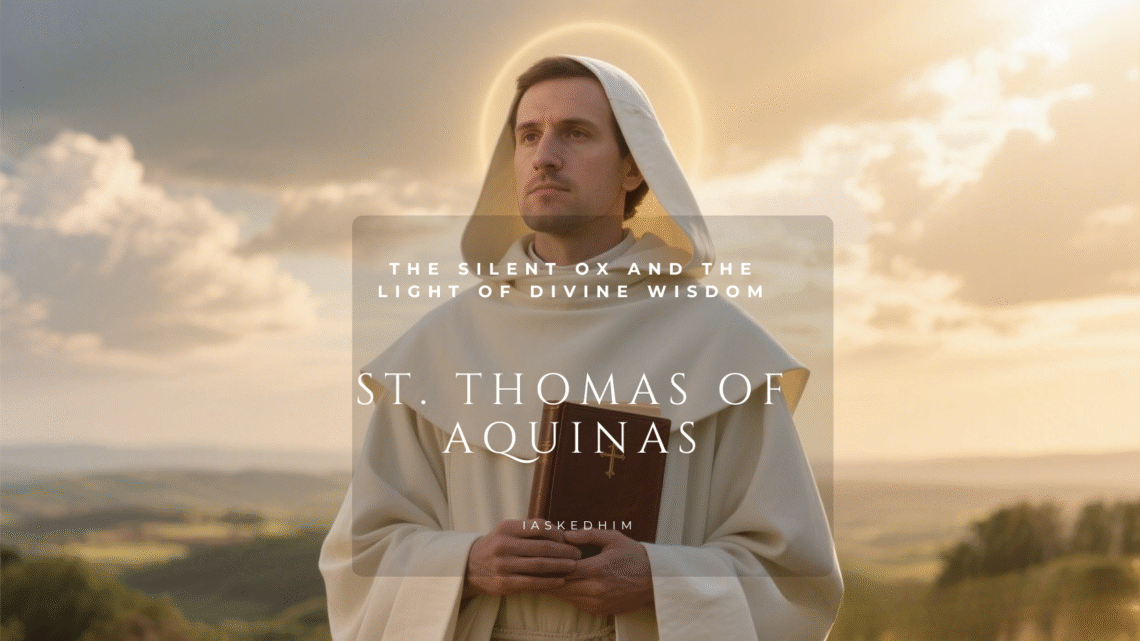
He was large in stature, quiet in speech, slow to respond. His fellow students mocked him and gave him a nickname meant to belittle: “The Silent Ox.” They mistook silence for emptiness and humility for lack of brilliance.
But God was doing something unseen.
Thomas was not silent because he had nothing to say. He was silent because he was listening.
Born into a noble family in 13th-century Italy, Saint Thomas Aquinas was expected to pursue power, prestige, and influence. Instead, he chose the life of a Dominican friar—poverty, obedience, study, and prayer. His decision was so radical that his own family imprisoned him, hoping to force him to abandon his vocation.
Even then, Thomas did not argue. He waited.
That pattern would mark his entire life.
Thomas believed that truth was not something humans invented, but something received. He studied tirelessly, not to dominate debate, but to understand God more deeply. Scripture was his foundation. Prayer was his breath. Reason was his servant, never his master.
He lived by the conviction echoed in Scripture:
“The fear of the Lord is the beginning of wisdom.”
— Proverbs 9:10
For Thomas, faith and reason were not enemies. They were companions on the same road, both leading toward God when rightly ordered. He taught that human intellect, when humble, could explore the mysteries of creation without threatening the mystery of the Creator.
This belief shaped centuries of Christian thought.
Yet for all his brilliance, Thomas remained deeply aware of the limits of human understanding. Near the end of his life, after a profound mystical encounter during Mass, he stopped writing altogether. When pressed by those who admired his work, he responded with words that still echo through time:
“All that I have written seems like straw compared to what has now been revealed to me.”
This was not rejection of truth, but reverence for something greater.
Thomas understood what Scripture teaches again and again: that God is not fully grasped by words, however carefully chosen.
“Now we see in a mirror dimly, but then face to face.”
— 1 Corinthians 13:12
His silence at the end was not failure. It was fulfillment.
Saint Thomas Aquinas reminds us that wisdom does not shout. It does not rush. It does not need applause. True wisdom is formed slowly—in prayer, in study, in surrender. It grows when we accept that knowing God matters more than being admired for knowing things.
In a world that rewards speed, certainty, and noise, Thomas offers a different path. He invites us to slow down, to think deeply, to pray honestly, and to trust that truth unfolds in God’s time.
If you have ever felt overlooked because you were quiet, underestimated because you were thoughtful, or dismissed because you chose depth over display, Saint Thomas Aquinas stands as a witness for you. God often works most powerfully through those who wait, listen, and remain humble.
The Silent Ox was not silent forever.
His voice still teaches the Church.
His humility still instructs the world.
And his life still points us toward the God who is Truth itself.
Closing Prayer
Saint Thomas Aquinas,
humble seeker of truth and faithful servant of God,
pray for us.
Teach us to love wisdom without pride,
to seek knowledge without fear,
and to trust that faith leads reason safely home.
Help us to listen more than speak,
to study without arrogance,
and to remember that all understanding
finds its fulfillment in God alone.
May our words never replace prayer,
and may our learning always lead us closer
to the mystery of divine love.
Saint Thomas Aquinas,
pray for us.
Amen.