Long before calendars were printed and years were counted down by clocks, people marked new beginnings with something far more intimate: fruit. Not as decoration, not as superstition, but as a sign — a living reminder that God’s design for renewal was already written into creation itself.
Fruit appears throughout Scripture not as excess, but as promise. From the garden to the wilderness, from harvest fields to temple imagery, fruit is never random. It carries meaning because it carries seed, and seed is God’s language of continuity. What is planted does not end where it begins.
Among the fruits most closely tied to beginnings, two stand out across both biblical lands and ancient faith traditions: the pomegranate and the grape.
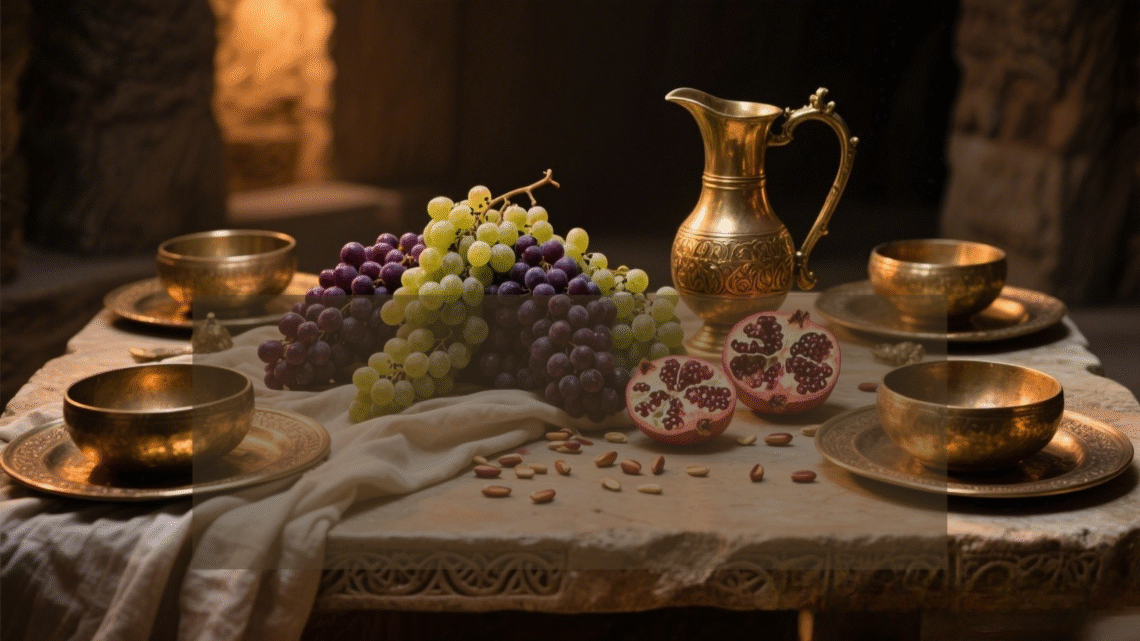
The pomegranate, heavy with hundreds of hidden seeds, was woven into the very fabric of sacred life. God instructed that pomegranates be embroidered on the hem of the priestly garments (Exodus 28:33–34), not for beauty alone, but as a visible symbol of abundance, holiness, and life multiplied. Each fruit held more than could be seen at first glance — a quiet testimony that God’s blessings often exceed what the eye can count.
In Jewish tradition, the pomegranate came to represent the fullness of God’s commandments, a reminder that obedience bears fruit beyond understanding. In Christian reflection, it has long symbolized resurrection and eternal life — many seeds held within one body, life emerging where the shell is broken.
Grapes, too, carry sacred weight. Scripture returns to them again and again — from the promised land described as overflowing with fruit, to Christ Himself declaring, “I am the vine; you are the branches.” Grapes are not instant. They require tending, pruning, patience, and time. Yet when they mature, they bring both sweetness and sustenance.
In ancient cultures surrounding the biblical world, grapes were eaten at the threshold of the New Year as an act of trust — one grape for each coming season, one prayer for each month yet unseen. It was not magic. It was hope practiced aloud.
Even today, these rituals linger not because people remember their origins, but because the soul remembers their meaning. We still long for renewal that is rooted, not rushed. We still desire a future that grows from faith rather than fear.
Fruit reminds us that God does not create in haste. He plants, He waits, He brings forth in season. New beginnings are rarely loud in Scripture; they are quiet, intentional, and often hidden beneath the surface before they are revealed.
As we stand at the edge of another turning — another chapter, another season — perhaps the ancient wisdom still speaks. What we consume, what we meditate on, what we plant in our hearts matters. Seeds sown in faith will bear fruit, even when the timing is not yet visible.
The New Year does not begin with noise. It begins with trust — and with the quiet confidence that God is already at work beneath the surface.