
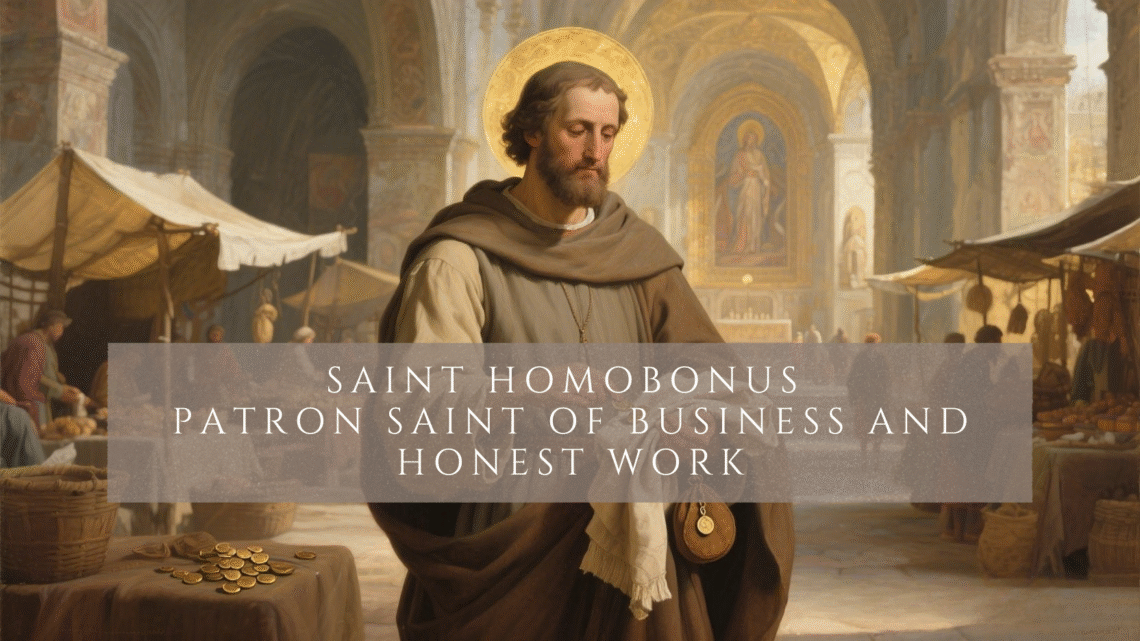
Saint Homobonus, known in Italian as San Omobono, was born around 1117 in Cremona, Italy, a thriving commercial city shaped by trade, craftsmanship, and daily labor. He was not a monk, a priest, or a scholar. He was a husband, father, and merchant—a man whose sanctity was forged not in monasteries, but in marketplaces.
From an early age, Homobonus learned the family trade as a cloth merchant. He was skilled, diligent, and successful, yet never driven by greed. His business was known for fairness, honest weights, and just prices. For Homobonus, profit was never the goal—charity was.
🌿 A Life Ordered by God
Homobonus rose early each morning to attend Mass before opening his shop. Prayer was not something he fit into his schedule; it shaped it. He believed that work done without God at its center quickly lost its soul.
His wife shared his devotion, and together they lived simply, giving generously to the poor. Homobonus was known to distribute food, clothing, and money to those in need—sometimes giving away the very goods he was meant to sell.
When questioned about his generosity, he answered not with words, but with peace.
🕊️ Charity That Cost Something
Homobonus did not give from excess. He gave until it was uncomfortable. He trusted that God would provide—and time and again, his business prospered enough to continue his works of mercy.
He saw Christ in the poor.
He saw worship in honest labor.
He saw salvation in fidelity to daily duty.
In a city driven by commerce, Homobonus quietly preached a radical message: holiness belongs in the ordinary rhythms of life.
✨ A Saint in the Moment of Prayer
On November 13, 1197, Homobonus went to church as he always did. During the Eucharistic Prayer, he collapsed and died suddenly at the altar. He died as he lived—in prayer, in God’s presence.
The people of Cremona immediately recognized his holiness. Miracles were reported almost at once, and devotion spread rapidly among merchants and laborers who saw in him a saint who understood their lives.
👑 Canonization and Legacy
Saint Homobonus was canonized in 1199 by Pope Innocent III, only two years after his death—one of the fastest canonizations in Church history. His sanctity was undeniable, not because of dramatic visions or martyrdom, but because of faithfulness lived daily.
His relics are venerated in Cremona, and his feast day is celebrated on November 13.
🧵 Patron of Honest Work and Business
Saint Homobonus is honored as the patron saint of business people, merchants, tailors, cloth workers, and ethical labor. In a world where success is often measured by profit alone, he stands as a witness that integrity is wealth.
People pray to Saint Homobonus for:
- Honesty and fairness in business
- Ethical decision-making
- Financial stability without compromise
- Charity toward the poor
- Balance between work, faith, and family
🙏 Traditional Prayer to Saint Homobonus
Saint Homobonus, faithful servant of God,
you who honored the Lord through honest work,teach us to conduct our business with integrity,
our labor with humility,
and our success with generosity.Help us to see Christ in those we serve
and to place God above all profit.Saint Homobonus, patron of honest work,
pray for us. Amen.
Saint Homobonus reminds us that holiness is not reserved for the cloister—
it is found in shops, homes, contracts, and choices made with a faithful heart.





One comment on “Saint Homobonus — Holiness in Honest Work”