Who He Was
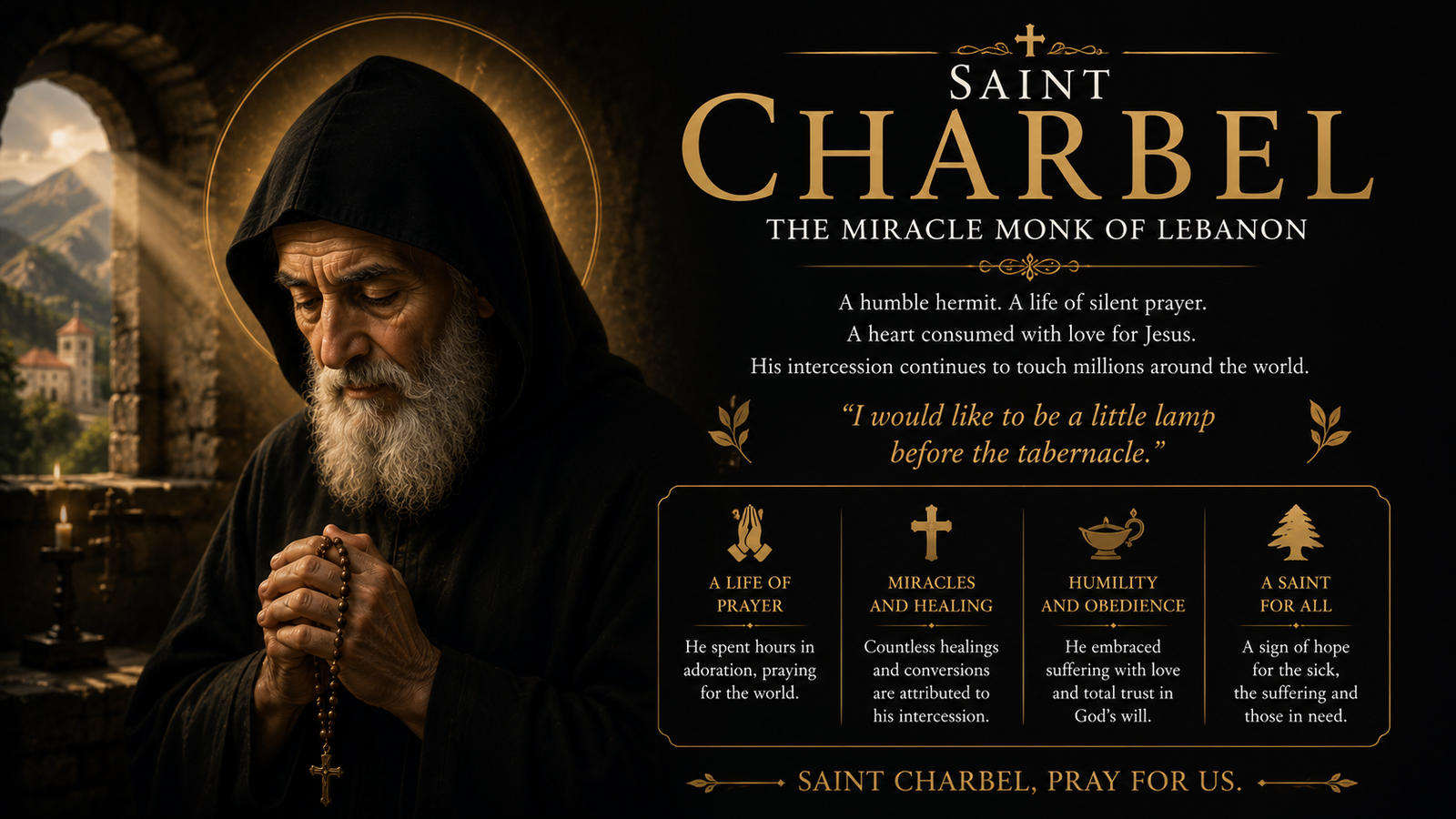
Saint Charbel was born Youssef Antoun Makhlouf on May 8, 1828, in Bekaa Kafra — the highest village in Lebanon, tucked into the mountains near the famous Cedars. He was the youngest of five children in a poor, devoutly Maronite farming family. His father, a mule driver conscripted into forced labor under Ottoman rule, died of fever when Youssef was only three, leaving him to be raised by his mother and, later, his stepfather, who became a priest and served as both a father figure and spiritual guide to the boy.
Two of Youssef’s uncles lived as hermits, and from an early age, he wanted nothing more than to follow them. While tending his family’s small flock of sheep and goats, he found a secluded grotto in the hills and turned it into his own private chapel, spending long hours there in prayer before an icon of the Virgin Mary he had placed inside — what he would later call his first hermitage.
What His Life Looked Like
At twenty-three, Youssef left home in secret, walking to a monastery to begin religious life — over his family’s objections. He entered the Lebanese Maronite Order, took the name Charbel after a second-century martyr from Antioch, and made his final profession as a monk in 1853. He was ordained a priest in 1859 and spent the next sixteen years in community at the Monastery of Saint Maron in Annaya, living a life marked by intense prayer, humility, and quiet care for the sick and the weak.
He was famous — even then — for his devotion to the Eucharist, spending hours preparing to say Mass and hours afterward in thanksgiving. One evening, a tired novice was asked to refill Charbel’s oil lamp for night prayer and mistakenly filled it with water instead. The lamp burned through the entire night anyway. His superior witnessed it and took it as confirmation that Charbel’s calling was moving toward something even more solitary.
In 1875, at age forty-six, he finally received permission to live as a hermit at the Hermitage of Saints Peter and Paul, 1,400 meters above sea level. He lived there for the last twenty-three years of his life: fasting, praying, working the land with his hands, and living in near-total silence, sleeping on a straw mat with a wooden plank for a pillow.
Why He’s Called the Miracle Monk
Charbel’s reputation for holiness reached beyond his own faith during his lifetime — he was known and respected among Christians, Muslims, and the Druze alike, a rare unifying figure in a region often divided along religious lines. But what happened after his death is what made him famous across the world.
On December 16, 1898, while celebrating Mass and reciting the words “Father of Truth, behold Your Son, a sacrifice pleasing to You,” Charbel suffered a stroke. He died eight days later, on Christmas Eve, at seventy years old. That same night, a monk visiting the tabernacle at midnight reported seeing a light circling Charbel’s body — even though it had already been moved for burial.
When his tomb was opened months later, his body was found completely incorrupt — flexible, warm to the touch, and exuding a fragrant, blood-like oil that continued for decades. His grave was reopened multiple times over the following years, and witnesses, including a 1950 filmed exhumation, documented the same phenomenon each time. It wasn’t until the mid-1970s that his body was finally found to have decomposed naturally, leaving only the skeleton.
When the Church Recognized Him
Charbel was beatified by Pope Paul VI on December 5, 1965, at the close of the Second Vatican Council, and canonized by the same pope on October 9, 1977. The Church confirmed three separate miracles attributed to his intercession for these causes: the healing of Sister Mary Abel Kamari, who had suffered fourteen years of an incurable digestive condition; the healing of Iskandar Naim Obeid; and the healing of Rached Salim Zoorob.
Devotion to Charbel has never slowed. The Church estimates well over 30,000 documented healings attributed to his intercession, and pilgrims — including many non-Christians — continue to travel to Annaya by the millions every year. On December 1, 2025, Pope Leo XIV became the first pope in history to visit Charbel’s tomb in person, entrusting Lebanon and its people to the saint’s protection.
Hardly Known Facts
- One of the most striking modern healings happened in a dream. In 1993, a paralyzed woman named Nohad El Shami reported that two monks appeared to her in a dream, operated on her neck, and healed her completely. She woke with two real wounds on either side of her neck — and full use of her body restored. The next night, she said, Charbel appeared again and asked her to visit his hermitage on the 22nd of every month for the rest of her life. People still gather there on the 22nd because of it.
- He reportedly protected a village’s crops from a locust swarm simply by sprinkling them with water he had blessed — one of several quieter miracles attributed to him during his own lifetime, alongside healing a man suffering from mental illness by reading him the Gospel.
- A 2016 healing crossed an ocean. A woman in Phoenix, Arizona, declared legally blind, reportedly had her sight fully restored after being blessed with a relic of Saint Charbel at her local Maronite parish.
- His incorrupt body lasted an extraordinary sixty-seven years before finally decomposing — placing him among a small handful of saints, alongside Saint Bernadette, whose bodily preservation is considered among the best-documented in the modern era.
The Traditional Prayer to Saint Charbel
O miraculous Saint Charbel, from whose body radiates the scent of heaven, come to my rescue and grant me from God the grace I need. I trust in your intercession, you who lived a life of silence, poverty, and total surrender to the will of the Father. Pray for me, that I may find strength in my struggles and peace in my heart. Help me to follow your example of humility, obedience, and devotion. Amen.
Where His Relics Rest
Saint Charbel’s remains are enshrined at the Monastery of Saint Maron in Annaya, Lebanon, still the primary site of pilgrimage and the location of the “surgery” reported by Nohad El Shami. Beyond Lebanon, relics have traveled widely: a shrine with a mosaic and relic was installed at Saint Patrick’s Cathedral in New York City in 2017, and in 2017 his relics were also translated to Saint Elisabeth Cathedral in Košice, Slovakia, where a monthly pilgrimage draws faithful from across Central Europe. Devotional medals bearing his image — the Medal of Saint Charbel — are worn by the faithful worldwide as a point of personal connection to his intercession.


A reliable notation reference should make the same symbol usable across writing contexts without treating every platform as identical. The approximately equal symbol can be copied for plain text, but technical work benefits from checking the matching Unicode value and the syntax required by markup, scripts, or typeset equations. A short comparison with related relation signs is especially helpful when readers need to express an estimate precisely rather than simply decorate a number.
Usernames are often constrained by character limits and availability, so small visual distinctions can be more useful than longer descriptions. username symbols let people create a memorable look while keeping the core name legible. A good rule is to place decoration at the beginning or end rather than interrupting every word, and to keep a plain-text version available for forms or platforms with stricter character support.