
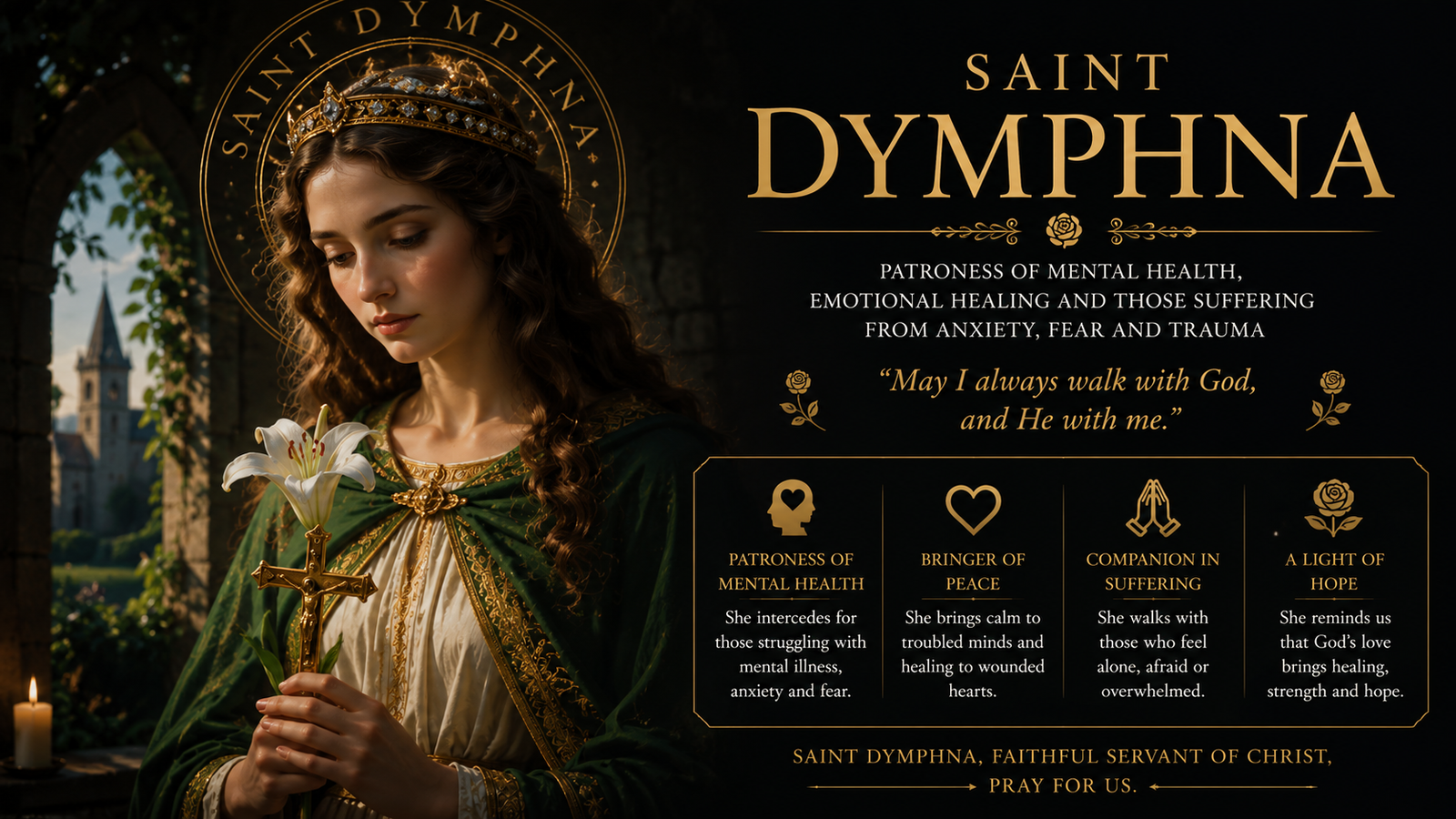
Who She Was
Saint Dymphna was born in Ireland, most traditions say in the seventh century, the only daughter of a pagan Celtic chieftain named Damon and his Christian wife. Dymphna’s name comes from the old Irish damh, meaning poet, with a suffix meaning “little” — she is sometimes called by her original Irish name, Damhnait. Her mother had her secretly baptized, and Dymphna grew into her Christian faith with real conviction. At fourteen, she consecrated herself to Christ and took a vow of chastity.
She looked remarkably like her mother. That resemblance would upend her entire life.
What Happened to Her Family
Not long after Dymphna took her vow, her mother died. Damon, who had loved his wife deeply, did not simply grieve — his mental health collapsed. His advisors, worried about a kingdom without an heir secured, pressed him to remarry, and he agreed on one condition: his new wife had to be as beautiful as the one he’d lost. His envoys searched far and wide and found no one. Eventually, in the fog of his grief and instability, his attention turned to the one person who bore his late wife’s face — his own daughter.
Dymphna refused, absolutely and immediately. She fled her father’s court by ship with four companions: her confessor and priest, Father Gerebernus; two trusted servants; and, in one of the story’s stranger and more human details, the king’s own court fool. They crossed to the Continent and eventually settled in a small town in what is now Belgium — Geel — where they believed themselves safe.
Why She Was Discovered
Tradition holds that Dymphna didn’t spend her time in Geel simply hiding. She used her own dowry to build a hospice for the poor and the sick of the region, continuing the charitable life she’d begun back in Ireland. But it was this same generosity that gave her away. The coins she spent to fund the hospice were distinctly Irish currency — unusual on the Continent — and when her father’s spies eventually traced those coins to Geel, they found her.
Damon arrived in Geel himself. He first tried persuasion, offering wealth and status if she would return with him. When Dymphna refused, he turned to threats. She held firm, insisting she would rather die than break her vow or enter into an incestuous marriage. Enraged, Damon ordered his men to kill Father Gerebernus, who was beheaded on the spot. When Dymphna still would not yield, her own father drew his sword and beheaded her himself. She was fifteen years old.
When Her Story Became Known
The residents of Geel buried Dymphna and Gerebernus in a nearby cave. It would be centuries before her story was formally written down — the earliest surviving account dates to the mid-1200s, composed by a church canon named Pierre at the request of the Bishop of Cambrai, drawn entirely from oral tradition that had been passed through the town for over six hundred years.
But local devotion had started almost immediately. Legend holds that the night after her death, a small group of people suffering from mental afflictions slept at the site where she died — and woke the next morning healed. Word spread. Pilgrims suffering from epilepsy, mental illness, and nervous disorders began traveling to Geel in growing numbers, and by the time Dymphna’s remains were formally exhumed and enshrined in the thirteenth century, the town had already become known as a place of healing for exactly these conditions.
How Geel Responded — and Still Does
What makes Dymphna’s story remarkable isn’t only her martyrdom — it’s what her death built. As pilgrims kept arriving, the church in Geel added sick rooms to house them. When those overflowed, something unusual happened: the townspeople began taking the afflicted into their own homes. Not as patients, but as boarders — full members of the household, given work on the farm or a trade to learn, treated with ordinary family life rather than confinement.
That practice, which began in the medieval period, never stopped. Geel is still known today, eight centuries later, as one of the earliest and most humane community-based models of mental health care in the world — studied by psychiatrists and psychologists as a genuine alternative to institutionalization, all traced back to a teenage girl killed by her own father.
Hardly Known Facts
- When her tomb was opened generations after her death, villagers found two finely carved stone tombs — so well made that locals believed angels had built them — along with a red tile resting on her chest, inscribed simply with her name.
- She’s traditionally depicted holding a sword and wearing a crown and ermine robes, and is known by the title “the Lily of Éire” for her purity.
- Her feast day has actually changed in modern times. For centuries, her primary feast was celebrated on May 15, marking the transfer of her relics. In the 2004 Roman Martyrology, the Church moved her official feast to May 30, the actual anniversary of her martyrdom.
- The court fool who fled with her is almost always left out of retellings — yet nearly every early account includes him among her small band of companions, a strange and very human detail in an otherwise formal hagiography.
- The National Shrine of Saint Dymphna in Massillon, Ohio, burned down in 2015 and was rebuilt and reopened by December 2016 — still standing today as the primary U.S. pilgrimage site for her intercession.
The Traditional Prayer to Saint Dymphna
Hear us, O God our Savior, as we honor Saint Dymphna, patron of those afflicted with mental and emotional illness. Filled with the Spirit of God, she suffered death rather than sin. Give us strength in our weakness and help us to be inspired by her example and comforted by her merciful help. We ask this through Christ our Lord. Amen.
Where Her Relics Rest
Saint Dymphna’s remains are held in a silver reliquary inside the Church of Saint Dymphna in Geel, Belgium — consecrated in 1532 and still standing on the site where her body was first buried. The relics of Father Gerebernus were moved to Xanten, Germany, where a shrine honored him until it was destroyed during World War II. In the United States, the National Shrine of Saint Dymphna inside Saint Mary’s Catholic Church in Massillon, Ohio, holds a first-class relic and remains open to pilgrims seeking her intercession for themselves or loved ones struggling with mental and emotional illness.



Thank you for your prayers and thank you St Dymphna for hearing my novena and your intercession. Please continue to intercede for my daughter and bring her peace and joy, healing, a soulmate, perfect fit job, good friends . Thank you
A printable project is most useful when it makes the next step clear for both the learner and the adult guiding it. Folder layouts, assembly directions, reading prompts, and answer materials turn hands-on learning into something easier to prepare and revisit. Well-organized homeschool printables can also help keep creative activities tied to a specific topic rather than becoming disconnected craft time.
Custom tattoo design is easier to discuss when the brief identifies the subject, style boundaries, intended placement, and the mood the piece should carry. Rather than arriving with a single fixed image, preparing two or three variations can show which composition feels most balanced. An AI tattoo generator is useful for this exploration stage because it creates a shared visual starting point, while the tattoo artist can adapt it into a design that fits the body and their technical approach.