
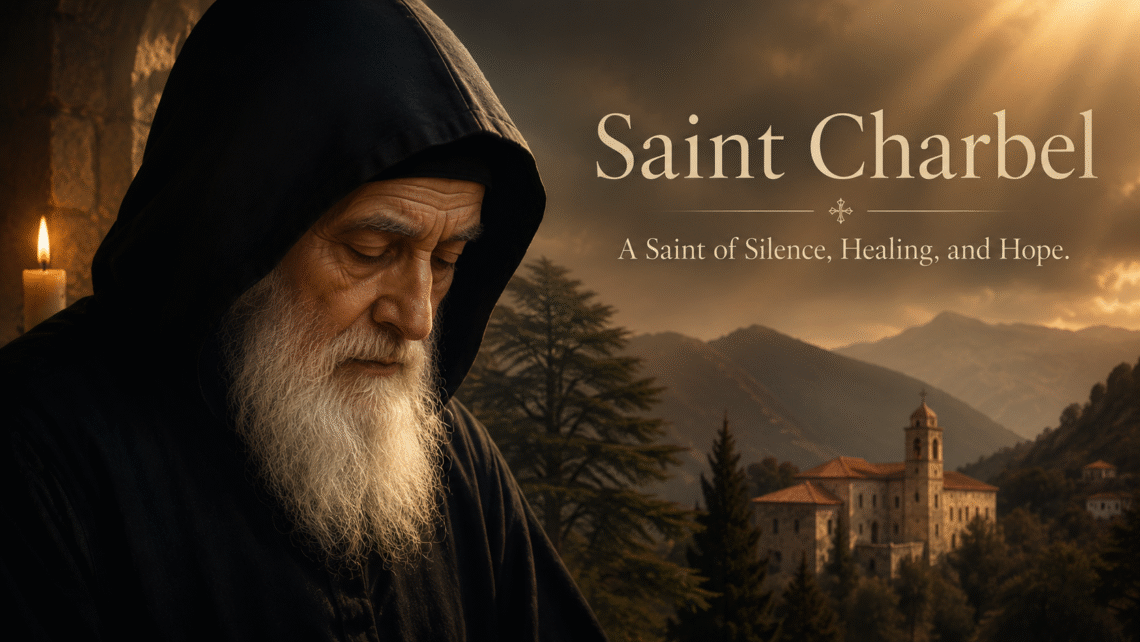
Saint Charbel: The Hidden Hermit Whose Silence Still Speaks to the World
There are saints remembered for their preaching, their writing, or the institutions they founded.
Saint Charbel Makhlouf is remembered for something far quieter.
He withdrew from attention. He sought no audience, wrote no celebrated theological work, and built no public ministry around himself. He chose prayer, obedience, poverty, silence, and the hidden life of a hermit.
Yet the man who spent much of his life trying to disappear from the world eventually became one of Lebanon’s most recognizable saints. Pilgrims of different Christian traditions—and even people outside Christianity—continue to travel to Annaya, Lebanon, to pray at his tomb and ask for healing, peace, and renewed faith.
That may be the first great paradox of Saint Charbel:
The more completely he hid himself in God, the farther his witness traveled.
When Is the Feast Day of Saint Charbel?
Saint Charbel is commemorated on July 24 in the Roman Catholic calendar, where Vatican News lists him as the saint of the day.
Maronite communities may also hold major celebrations in July according to their own liturgical traditions and local calendars. In 2026, some Maronite observances and parish celebrations are taking place around Sunday, July 19, before the July 24 Roman memorial. Because parish dates can vary, readers attending a local celebration should confirm the schedule with their nearest Maronite Catholic church.
The feast does not celebrate one dramatic public achievement. It honors the holiness of a life surrendered almost entirely in secret.
Who Was Saint Charbel?
Saint Charbel was born Youssef Antoun Makhlouf on May 8, 1828, in the mountain village of Bkaakafra in northern Lebanon. The village lies high in the Lebanese mountains, near the region traditionally associated with the ancient Cedars of Lebanon.
His father died while Youssef was still young. He grew up in a deeply religious Maronite Catholic family and was drawn early toward prayer and solitude. Accounts of his youth describe him withdrawing to a grotto dedicated to the Blessed Virgin Mary, where he would pray away from the noise of village life.
At approximately twenty-three years old, he left home and entered the Lebanese Maronite Order. During his religious formation, he took the name Charbel, after an early Christian martyr. He was ordained a priest in 1858 and lived for sixteen years in the monastic community at Saint Maron Monastery in Annaya.
In 1875, with the permission of his superiors, Father Charbel entered the Hermitage of Saints Peter and Paul. He remained there for the final twenty-three years of his life, devoting himself to prayer, fasting, manual labor, Eucharistic worship, and strict asceticism.
He died on December 24, 1898.
The Saint Who Did Not Seek to Be Seen
Saint Charbel was not famous during his earthly life in the way many modern religious figures become famous.
He did not travel widely. He did not preach to enormous crowds. He did not leave behind a large collection of books or letters. A Maronite account describes him plainly: he was not primarily known as a writer, public preacher, charismatic personality, or missionary apostle. He was a monk and hermit whose evangelization came through union with God.
That is what makes his life so challenging to the modern imagination.
We live in an age that often confuses visibility with importance. Saint Charbel lived as though God’s attention were enough.
His days were marked by ordinary acts that remained unseen:
prayer in a stone cell,
labor carried out in obedience,
long hours before the Eucharist,
fasting,
silence,
and surrender.
His life reminds us that spiritual fruit does not always grow where people can watch it.
Sometimes the holiest work is happening beneath the surface.
A Lesser-Known Detail: He Was Formed by Another Future Saint
One of the most meaningful details of Saint Charbel’s formation is his connection to Saint Nimatullah Kassab Al-Hardini, another great Maronite monk.
During his theological studies, Charbel was instructed by Father Nimatullah, who was known for his learning, disciplined monastic life, and devotion to prayer. The future Saint Charbel therefore did not emerge in isolation; he was formed within a living spiritual tradition and guided by holy teachers.
This gives us an important insight into sainthood:
Even the saints usually receive help from someone.
Behind a hidden saint there may be a patient teacher, a faithful confessor, a praying mother, a disciplined community, or a spiritual example that history barely notices.
His Religious Name Carried an Ancient Memory
Youssef Makhlouf did not receive the name Charbel at birth.
He adopted it when he entered monastic life. The name is associated with an early Christian martyr, and Maronite sources connect it with an Aramaic meaning often rendered as “God’s story.”
Whether contemplated linguistically or spiritually, the name suits him.
Saint Charbel allowed his own ambitions to become quiet so that his life could tell God’s story instead.
His Hermitage Was Not Romantic
Images of hermits can make solitude look peaceful and picturesque. Saint Charbel’s hermitage was not a spiritual retreat in the modern sense.
It was austere.
The life demanded limited food, physical labor, cold nights, harsh weather, prolonged prayer, little comfort, and obedience to a strict monastic rule. The room traditionally associated with his hermitage reflects that simplicity: stone walls, a basic bed, devotional objects, and only what was necessary for prayer and survival.
He did not enter solitude because he disliked people. He entered it to belong more completely to God.
Authentic Christian solitude is not an escape from love. It is meant to deepen love.
He Died During the Season of the Nativity
Saint Charbel died on Christmas Eve in 1898.
That detail is easily overlooked, but it carries profound symbolism.
The monk who spent his life becoming hidden died as the Church prepared to celebrate the hidden arrival of Christ: God entering the world not through earthly spectacle, but through humility, poverty, and silence.
The Nativity and Saint Charbel’s life seem to echo one another:
Bethlehem was quiet.
The manger was poor.
Christ was hidden from the powerful.
Yet heaven was at work.
The Light Reported Near His Tomb
After Saint Charbel’s burial, reports began to circulate of an unusual light appearing near his grave. These accounts drew attention to the burial place and contributed to the growing conviction among local people that the quiet hermit had lived a life of extraordinary holiness. Maronite historical sources preserve the tradition that a great light was seen near his tomb after his burial.
Such reports should be approached with reverence rather than sensationalism. Catholic faith does not require every devotional story to be treated as an article of doctrine.
What is undeniable is that Saint Charbel’s death did not end devotion to him. It intensified it.
The man who avoided attention in life became a source of hope after death.
Why Is Saint Charbel Associated With Healing?
Saint Charbel is especially loved by those praying through illness, chronic pain, frightening diagnoses, unsuccessful treatments, and situations that appear humanly impossible.
Numerous healings have been attributed to his intercession, and his shrine at Annaya has become a destination for pilgrims seeking both physical and spiritual help. Vatican sources describe him as a saint widely known for reported miraculous healings, with devotion extending beyond Catholics to Muslims and people of other faiths.
Catholic teaching is important here: saints do not replace God, and they do not perform miracles independently.
We ask saints to pray with us and for us.
Any healing comes from God.
Saint Charbel’s life directs attention away from the saint as a personality and toward Christ—the Divine Physician.
His Appeal Crosses Religious Boundaries
Another remarkable fact is that devotion to Saint Charbel is not limited neatly by religious identity.
Christians of different traditions visit his shrine, but so do Muslims and others who come with petitions, gratitude, grief, and hope. Vatican News has described Saint Charbel as a figure of coexistence in Lebanon and noted the broad devotion surrounding his tomb.
This does not erase theological differences. It reveals something about suffering.
Pain makes people search for mercy.
Illness, fear, loss, and desperation speak a language recognized in every community. Saint Charbel’s silent witness has become a meeting place for people who may disagree about many things but still understand the need to pray.
Beatified as the Second Vatican Council Was Ending
Saint Charbel was beatified by Pope Paul VI on December 5, 1965, at the conclusion of the Second Vatican Council. Pope Paul VI presented him as an outstanding witness to monastic holiness whose example belonged not only to Lebanon, but to the whole Church.
The timing was striking.
The Catholic Church was reflecting deeply on its relationship with the modern world. At that historic moment, the Church elevated a man whose life had been marked by silence, penance, poverty, and withdrawal from worldly recognition.
It was almost a prophetic reminder:
The Church must speak to the world, but she must never lose the interior life from which her words receive power.
Canonized by Pope Paul VI
Pope Paul VI canonized Saint Charbel on October 9, 1977, formally declaring the Lebanese hermit a saint of the universal Catholic Church.
His canonization was significant not only for Lebanon and the Maronite Catholic Church, but also for the wider Church. It brought greater awareness of the spiritual riches of Eastern Catholicism and the ancient monastic traditions of the Christian East.
Saint Charbel belongs deeply to Lebanon.
But he does not belong only to Lebanon.
Pope Leo XIV at the Tomb of Saint Charbel
In December 2025, Pope Leo XIV became the first pope to visit Saint Charbel’s tomb in Annaya. He prayed there and reflected upon what the hidden hermit continues to teach the modern world: prayer amid godlessness, silence amid noise, modesty amid appearances, and poverty amid the pursuit of wealth.
That papal visit gave fresh meaning to Saint Charbel’s message.
He lived without broadcasting himself.
Yet a pope eventually came as a pilgrim to the place where the hermit had once disappeared into prayer.
What Saint Charbel Teaches Us Today
Saint Charbel’s life is not an invitation for everyone to abandon ordinary responsibilities and enter a mountain hermitage.
It is an invitation to ask harder questions.
What noise keeps me from hearing God?
What comfort has become more important to me than obedience?
What am I doing only because someone may notice?
Can I remain faithful when no immediate result is visible?
Do I still believe that prayer is productive when nothing appears to be happening?
Saint Charbel teaches that a hidden life can still carry enormous spiritual power.
He teaches us that silence is not emptiness when it is filled with God.
He teaches us that faithfulness is not wasted merely because it is unseen.
And he teaches us that healing may begin before circumstances visibly change—when fear gives way to trust, bitterness loosens its hold, and the soul remembers that it is not abandoned.
A Feast-Day Prayer to Saint Charbel for Healing and Hope
Saint Charbel, faithful monk and humble servant of God,
you surrendered your life in silence, prayer, obedience, and love.
You knew the hidden places where only God could see you.
You trusted Him through sacrifice, solitude, and suffering.
Today, I ask you to pray for me.
Carry before the Lord the illness that frightens me,
the pain that has exhausted me,
the diagnosis I cannot understand,
and the prayer that has remained unanswered for so long.
Saint Charbel, pray that Christ, the Divine Physician,
will touch every part of my body, mind, and soul in need of healing.
Ask Him to guide my doctors,
strengthen those who care for me,
restore what can be restored,
and give me courage for each step ahead.
Where there is fear, ask God to give me peace.
Where there is discouragement, ask Him to renew my hope.
Where there is pain, ask Him to remain close.
Where healing seems impossible, help me trust that nothing is beyond His power.
I do not place my faith in signs alone.
I place my faith in Jesus Christ.
Through your intercession, Saint Charbel,
may I receive the grace I need—
whether through healing, endurance, guidance, reconciliation, or deeper faith.
Teach me to pray when God feels silent.
Teach me to remain faithful when I cannot see the answer.
Teach me to believe that hidden prayer is never wasted.
Saint Charbel, pray for me.
Pray for my family.
Pray for all who are suffering tonight.
And may every grace received lead us closer to Christ.
Amen.
A Short Prayer for an Urgent Need
Saint Charbel, servant of God and friend of those who suffer, pray for me in this urgent need. Ask Jesus to bring healing where there is illness, peace where there is fear, and hope where the way forward feels impossible. May God’s will be done with mercy, and may I never feel abandoned in this trial. Amen.
Final Reflection
Saint Charbel’s story is not compelling because he chased miracles.
It is compelling because he chased God.
The healings associated with his intercession should never distract us from the deeper miracle of his life: a human being became so surrendered, so quiet, and so faithful that generations afterward still sense an invitation to pray.
Perhaps that is what many hearts need most today.
Not more noise.
Not more performance.
Not another promise of instant relief.
But a quiet place in which to remember:
God is still present.
Prayer is still heard.
Hope is still holy.
And no suffering offered to Christ is ever truly hidden.


A focused countdown tool is most useful when it removes friction: no account setup, no distracting interface, and clear controls for starting, pausing, resuming, and resetting. A browser-based タイマー with an audible finish can suit short study blocks, cooking steps, exercise intervals, or a quick return-to-work reminder. Keeping hours, minutes, and seconds available also makes it flexible enough for both small tasks and longer sessions.