
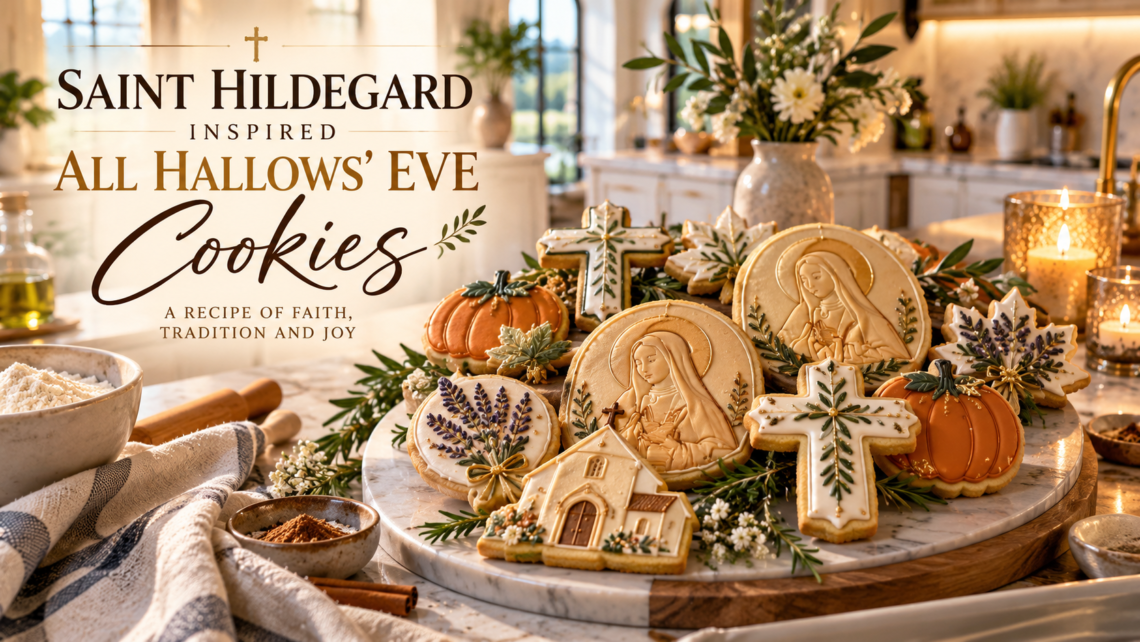
An elegant autumn baking tradition inspired by a medieval saint, bringing together Catholic heritage, family, and the comforting aroma of homemade spelt cookies.
Where Faith Meets the Warmth of an Autumn Kitchen
There is something extraordinary about an autumn kitchen. The fragrance of cinnamon, the gentle warmth of the oven, and the simple pleasure of preparing something beautiful for the people we love.
As October draws to a close, many families prepare for Halloween with pumpkins, costumes, and sweet treats. Yet behind the name Halloween lies an older Christian tradition: All Hallows’ Eve, the evening preceding All Saints’ Day on November 1.
This season offers an opportunity to bring faith, history, and creativity together through something wonderfully familiar: baking cookies.
Inspired by the writings and culinary traditions associated with Saint Hildegard of Bingen, these All Hallows’ Eve Cookies of Joy transform a simple spiced recipe into an elegant celebration of faith.
Who Was Saint Hildegard of Bingen?
Saint Hildegard of Bingen (1098–1179) was a German Benedictine abbess, composer, writer, and visionary. She studied the natural world, wrote about plants and foods, and became one of the most remarkable intellectual and spiritual figures of medieval Christianity.
In 2012, Pope Benedict XVI declared her a Doctor of the Church.
Among the food traditions associated with Hildegard are spiced cookies often called Cookies of Joy. They are commonly prepared with spelt flour, nutmeg, cinnamon, and cloves.
Modern versions vary considerably, and not every recipe circulated under her name can be verified as an original medieval preparation.
Our version honors that inspiration while making a delicious, approachable cookie suitable for a contemporary home kitchen.
Why Cookies of Joy Belong in an All Hallows’ Eve Celebration
Halloween and All Saints’ Day share a historical connection through the Christian calendar.
All Hallows’ Eve falls on October 31, followed by All Saints’ Day on November 1 and All Souls’ Day on November 2.
Rather than viewing the season only through costumes and decorations, families can also use it to remember the saints, celebrate meaningful traditions, and create lasting memories.
Imagine a platter of fragrant spelt cookies decorated with:
- Delicate ivory and gold crosses representing Christian faith.
- Saint-inspired embossed portraits honoring holy men and women.
- Deep red roses recalling Saint Rita of Cascia.
- Botanical designs celebrating Saint Hildegard’s interest in the natural world.
- Autumn pumpkins and leaves reflecting the beauty of the season.
- Small chapels and stained-glass patterns inspired by sacred architecture.
Each design becomes part of a beautiful, edible story.
Saint Hildegard-Inspired Spelt Cookies: The Full Recipe
Recipe overview
- Yield: Approximately 24–30 cookies, depending on cutter size.
- Preparation: 20 minutes.
- Chilling: 60 minutes.
- Baking: 10–14 minutes per batch.
- Oven temperature: 350°F (175°C).
- Difficulty: Easy to moderate.
Ingredients
- 2½ cups spelt flour, approximately 300 grams.
- ¾ cup unsalted butter, softened.
- ¾ cup light brown sugar, packed.
- 1 large egg.
- 1 teaspoon ground cinnamon.
- 1 teaspoon ground nutmeg.
- ¼ teaspoon ground cloves.
- ¼ teaspoon fine salt.
Step-by-Step Instructions
1. Prepare the dough.
In a large mixing bowl, cream the softened butter and brown sugar until smooth. Add the egg and mix until combined.
2. Add the aromatic spices.
In a separate bowl, whisk together the spelt flour, cinnamon, nutmeg, cloves, and salt.
Gradually incorporate the dry ingredients into the butter mixture until a soft dough forms.
3. Chill before shaping.
Flatten the dough into a disk, wrap it, and refrigerate for approximately one hour. Chilling helps preserve the details of decorative cookie stamps.
4. Roll and cut.
Preheat the oven to 350°F. Roll the chilled dough to approximately ¼ inch thickness on a lightly floured surface.
Use round cutters, cross-shaped cutters, leaf cutters, or religious cookie stamps to create your designs.
5. Bake until lightly golden.
Arrange cookies on parchment-lined baking sheets, leaving a little space between them.
Bake for approximately 10–14 minutes, checking earlier for smaller cookies. The edges should be lightly golden and the centers set.
6. Cool completely.
Allow cookies to rest briefly on the baking sheet before transferring them to a wire rack.
Do not decorate warm cookies, as icing may melt or lose its shape.
Decorating the Cookies: An Elegant All Hallows’ Eve Collection
The beauty of this recipe is its versatility.
For a refined presentation inspired by the I ASKED HIM collection, choose a restrained palette of ivory, champagne gold, muted pumpkin orange, sage green, and deep rose red.
Decorating Supplies
- Prepared royal icing in ivory, black, green, and muted orange.
- Food-safe edible gold detailing.
- Religious and autumn-themed cookie cutters or stamps.
- Fine piping bags and small decorating tips.
- Food-safe brushes for delicate details.
- Optional edible rose decorations.
Creating the Designs
- Saint Rita: Use a religious portrait-style stamp or an oval cookie and decorate with a black-and-white habit, small red roses, and a crucifix.
- Saint Charbel: Create a monk-inspired design with a dark hood, white beard, and simple gold halo.
- Saint Hildegard: Feature botanical motifs, herbs, leaves, and a traditional Benedictine-inspired design.
- Crosses: Pipe ivory icing with delicate botanical borders.
- Autumn pumpkins: Use muted orange icing with sage-green leaves.
- Chapel windows: Create simple stained-glass patterns using contrasting icing colors.
For intricate saint portraits, an edible printed image or professionally made food-safe transfer may be more practical than hand-piping.
The photographed designs accompanying this article are artistic visualizations. Actual decorating results will depend on the cutters, icing techniques, and supplies used.
How to Create an Elegant Cookie Platter
Presentation can turn a homemade recipe into a memorable centerpiece.
Begin with a large white marble platter, porcelain serving tray, or natural wood board.
Arrange the larger saint-inspired cookies toward the center, then surround them with crosses, botanical cookies, and autumn shapes.
Add small seasonal decorations around the serving platter, keeping non-edible objects separate from the cookies.
A few roses, a linen napkin, and soft natural lighting can create a welcoming atmosphere without overwhelming the food.
The goal is not extravagance. It is warmth, beauty, and thoughtful detail.
Can These Cookies Be Prepared Ahead of Time?
Yes. These cookies are suitable for preparing in advance.
- Dough: Refrigerate tightly wrapped for up to two days.
- Freezing: Freeze unbaked dough for up to two months.
- Undecorated cookies: Store in an airtight container at room temperature for approximately five to seven days.
- Decorated cookies: Allow royal icing to dry completely before stacking with parchment between layers.
For the best texture, protect the cookies from excess moisture and heat.
Frequently Asked Questions
What are Saint Hildegard’s Cookies of Joy?
They are spiced cookies associated with Saint Hildegard of Bingen’s food traditions, commonly made with spelt flour, nutmeg, cinnamon, and cloves. Many modern recipes are adaptations rather than verified medieval originals.
Can I use regular flour instead of spelt flour?
Yes. All-purpose flour can be substituted, although the texture and flavor may differ. Begin with a similar weight and adjust if necessary.
Can I make these cookies without royal icing?
Absolutely. Embossed cookies can be served plain, lightly dusted with powdered sugar, or decorated with a minimal glaze.
Are these cookies suitable for Halloween?
Yes. Their autumn spices and decorative possibilities make them a lovely seasonal treat, especially for families who wish to incorporate All Hallows’ Eve and All Saints’ Day traditions.
Are these cookies medicinal?
No. Although Hildegard wrote about food and the natural world, these cookies should be enjoyed as food, not presented as a treatment for medical conditions.
A Sweet Tradition Worth Remembering
Not every meaningful family tradition requires an elaborate celebration.
Sometimes it begins with flour on the counter, a familiar fragrance filling the kitchen, and a little time spent creating something together.
Saint Hildegard’s legacy invites us to appreciate the natural world, creativity, music, and the spiritual dimensions of everyday life.
And perhaps that is what makes these cookies special.
They offer a simple way to bring beauty, gratitude, and faith into an ordinary afternoon.
As All Hallows’ Eve approaches, may your home be filled with warmth, your table with joy, and your heart with gratitude for the blessings found in everyday moments.
Faith can be celebrated not only in grand gestures, but also in the quiet beauty of the life we share.
I ASKED HIM

