In the winter of 1577, a group of Carmelite friars broke down the door of a small friary in Ávila, Spain, seized a thirty-five-year-old priest, blindfolded him, and carried him across the country in the dark. When they arrived in Toledo, they threw him into a cell that was six feet wide and ten feet long — barely enough room to lie down — with a single slit near the ceiling for light. They fed him bread, sardines, and water. They brought him out regularly to be flogged in front of the assembled community. Then they put him back in the dark and locked the door. His name was Juan de Yepes Álvarez. The world would come to know him as Saint John of the Cross. And what happened inside that prison cell would become one of the most astonishing stories in the history of the Catholic Church.
A Child Born Into Nothing
To understand why Saint John of the Cross could endure a prison cell without being destroyed by it, you have to understand where he came from. He was born in 1542 in Fontiveros, a small town in the Castile region of Spain. His father, Gonzalo de Yepes, came from a wealthy silk merchant family but was disowned when he married a poor weaver named Catalina Álvarez — a woman his family considered far beneath their station. That decision cost Gonzalo everything. He was cut off from his inheritance, fell into poverty, and died when John was only three years old, leaving Catalina alone with three young sons and no means of support. The family moved from town to town searching for work. One of John’s brothers died from the deprivation. John himself spent years in an orphanage, where he received a basic education and, from an early age, showed an unusual interior depth and a draw toward prayer that stayed with him for the rest of his life. When he entered the Carmelite order in 1563 at the age of twenty-one, it was not an escape from hardship. It was a deliberate movement toward God.
The Woman Who Changed Everything
In 1567, a meeting took place that would alter the course of John’s life and, in many ways, Catholic history. He was introduced to Sister Teresa of Ávila, a Carmelite nun already deep in her effort to reform the order. Teresa was fifty-two. John was twenty-five. She recognized something in him immediately. At the time, John was considering leaving the Carmelites for the stricter life of the Carthusians, frustrated by what he saw as growing laxity in religious observance. Teresa persuaded him to stay and join her reform movement instead, giving birth to what became known as the Discalced Carmelites — a return to the order’s original austerity, marked by poverty, silence, deep contemplative prayer, and a literal going without shoes as a sign of humility and dependence on God. Together they opened the first reformed Carmelite friary for men in Duruelo in 1568. John lived the austerity he taught — sleeping on the floor, fasting regularly, spending long hours in silent prayer. His fellow friars described him as joyful rather than grim. The discipline did not make him harsh. It made him free in a way that the people around him could feel.
Saint John of the Cross was declared a Doctor of the Church in 1926 by Pope Pius XI — not for miracles alone, but specifically because of the profound depth and authority of his writings on prayer, suffering, and union with God. Only 37 individuals in the entire history of the Catholic Church have ever received this designation. His works, many of them composed in secret while he was imprisoned, are still required reading in seminaries and theological universities around the world more than four centuries after his death.
The Night They Came for Him
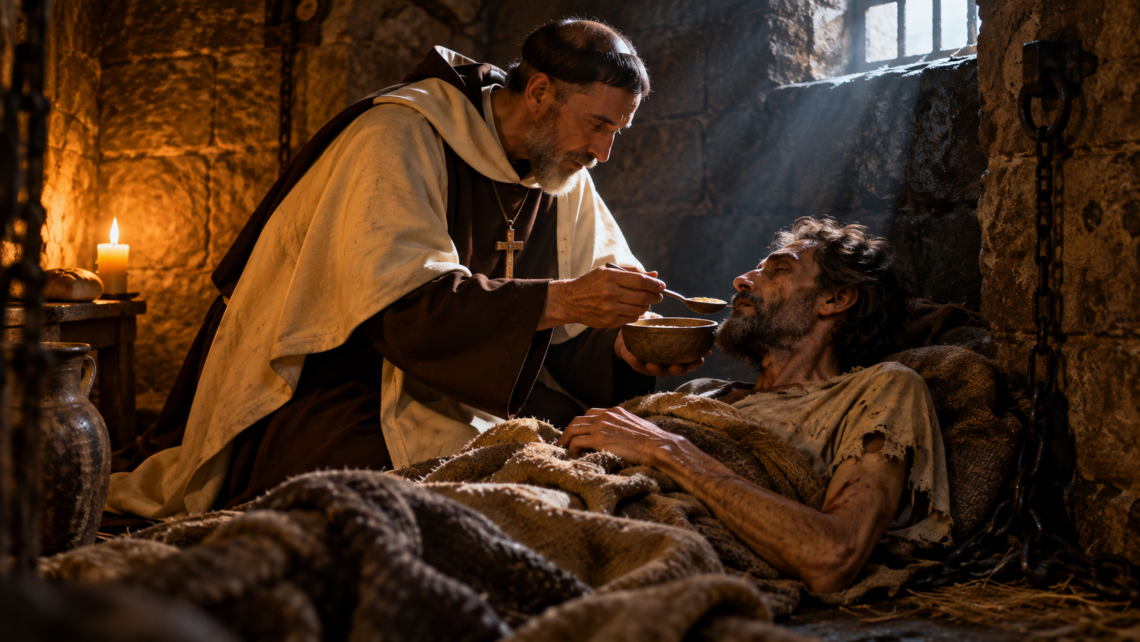
Not everyone welcomed the reform. The unreformed Carmelites viewed Teresa and John’s work as a direct challenge to their authority and way of life, and tensions had been escalating for years. On the night of December 2nd, 1577, a group of friars from the unreformed faction arrived at the Incarnation convent in Ávila where John served as confessor. They seized him without warning, gave him no trial or hearing, and transported him to the Carmelite priory in Toledo, where he was locked in that infamous cell — six feet wide, ten feet long, a single ventilation slit near the ceiling. The floggings were not casual. They were formal, administered in the refectory in front of the assembled community, designed to humiliate as much as to hurt, and repeated regularly throughout his nine months of captivity. The goal was clear: break him, and make him renounce the reform. He never did. And in the darkness of that cell — in what should have been the most defeating season of his life — he began composing poetry. He had no pen and no paper, so he memorized the lines in the dark, turning them over in his mind each day, refining them, carrying them like a lamp. When a sympathetic guard finally brought him scraps of paper, he wrote down what he had already been holding inside him for months. It was the beginning of what would become “The Dark Night of the Soul.”
What Is the Dark Night of the Soul — Really?
People use this phrase today sometimes loosely, sometimes with real pain, to describe a season when God feels absent and faith feels like it is barely holding. Saint John of the Cross wrote about this experience with a precision that five centuries have not made outdated. He described two distinct phases. The first he called the “night of the senses” — a season in which God gradually withdraws the spiritual consolations that once made prayer feel warm and emotionally satisfying. The closeness, the warmth, the sense of being held — it begins to fade. Prayer becomes dry. The things that once moved the soul no longer seem to reach it. This phase, John taught, is actually a sign of spiritual progress, not failure. God is weaning the soul off its dependence on feelings so that it learns to seek Him, rather than the feeling of Him. The second phase, the “night of the spirit,” is deeper and more disorienting. In this stage, even the soul’s understanding of God seems to dissolve. Everything it thought it knew — about who God is, how He works, and what He wants — becomes uncertain. By every external measure it looks like a crisis of faith. But John insisted, with the authority of someone who had lived it, that this darkness is not abandonment. It is the most intimate thing God can do. He is burning away every substitute, every lesser comfort, every false foundation the soul has been standing on instead of standing on Him alone.
The Teaching That Still Unsettles Us
What made Saint John of the Cross so radical — and what still makes him uncomfortable reading for modern audiences — is his teaching on attachments. He argued that it is not only sinful things that block the soul’s path to God. Any attachment, including attachment to good things, beautiful things, and even spiritual things, becomes an obstacle when it is held more tightly than God Himself. He used a striking image to make his point: a bird tied to the ground by a thin thread is just as unable to fly as a bird tied by a heavy chain. The size of what holds you does not matter. What matters is the grip. Most of us are not attached to obviously destructive things. We are attached to our plans, our timelines, our vision of how our lives should unfold. We are attached to comfort — not just physical comfort, but the comfort of certainty, of answered prayers that arrive on our schedule, of a God who behaves predictably. Saint John of the Cross would say gently but without apology that every one of those attachments, however understandable, is a thread that keeps us grounded when God designed us to fly. His life was the lived demonstration of what becomes possible when you cut them — not in despair, but in love.
The Escape and the Years That Followed
After nine months of imprisonment, John managed a daring escape in August of 1578. He had been quietly working at the screws of his cell door lock over a period of weeks. On the night he finally moved, he lowered himself from a high window using a makeshift rope sewn from strips of his blanket, dropped into an inner courtyard, scaled a wall in the dark, and fled into the city of Toledo. He was weak, malnourished, and disoriented, but he reached safety and was eventually reunited with Teresa and the reform community. He spent the remaining thirteen years of his life writing, directing souls in prayer, founding new monasteries, and continuing the work that had been born in that cell. He died in December of 1591 at the age of forty-nine, asking those with him to read the Psalms aloud at the end. He was beatified in 1675 and canonized in 1726 by Pope Benedict XIII. In 1926, Pope Pius XI declared him a Doctor of the Church — one of only thirty-seven individuals in Catholic history to receive that title — recognizing that his writings carry a teaching authority for the universal Church across every generation. Today his works are read not only by Catholics but by spiritual seekers across traditions who find in them the most honest and rigorous map ever drawn of what it costs, and what it means, to pursue God without reservation.
What His Life Is Saying to Yours
Most of us will never sleep on a hard floor by choice, or be locked in a cell, or be taken in the night. That is not the point. The point is that Saint John of the Cross had already surrendered his grip on comfort long before his captors tried to use it against him — and that is precisely why they failed. They had nothing to threaten him with. The thing they took — physical ease, warmth, a decent bed — he had already decided was not the most important thing in his life. By the time suffering found him by force, he had been practicing detachment willingly for years, and the practice held. For today’s reader, the practical question his life raises is not about sleeping arrangements. It is about what you are unwilling to release. It might be comfort itself — the expectation that faith should always feel warm and emotionally close. It might be a plan you are holding so tightly you cannot hear whether God is asking you to lay it down. It might be the need for prayer to always feel like something. Saint John of the Cross would say: notice what you cannot let go of. Then ask yourself honestly whether God is in that grip — or whether the grip itself is the obstacle. The dark night, whenever it comes, is not the end of your story. It is the part of the story where God is doing His deepest, most irreversible work.
A Prayer to Saint John of the Cross
🕯 Prayer to Saint John of the Cross
Saint John of the Cross,
mystic, poet, and Doctor of the Church,
you who found God not in spite of the darkness
but within it —
pray for us.
You understood something most of us spend our lives avoiding:
that the things we hold onto for comfort
can become the very walls that keep us from more of God.
Pray that we would have the courage to open our hands,
to loosen our grip on what is temporary,
and to trust the One who is asking us to let go.
When the night comes — and it will come —
remind us that darkness is not the same as absence.
Remind us that God does not leave when we stop feeling Him.
Remind us that every dark night in the life of a soul
who is truly seeking God
has a dawn waiting on the other side of it.
Saint John of the Cross, pray for us.
Through Christ our Lord.
Amen.
Final Reflection
Saint John of the Cross did not choose the floor, the cold cell, or the dark night because he was indifferent to suffering or because he hated the world. He chose them — first in small daily ways, then in the larger suffering that arrived uninvited — because he had already discovered something that made everything else feel small by comparison. He had found God. Not a feeling, not a theology, not a set of religious practices, but the living Person at the center of everything. And having found that Person, the floor was not really a sacrifice. It was just a floor. The question he leaves behind for every one of us is quiet, but it does not let go easily: What is the thing you are not willing to release — and could that very thing be the door God is waiting for you to walk through?