Some saints are remembered for one image that says everything.
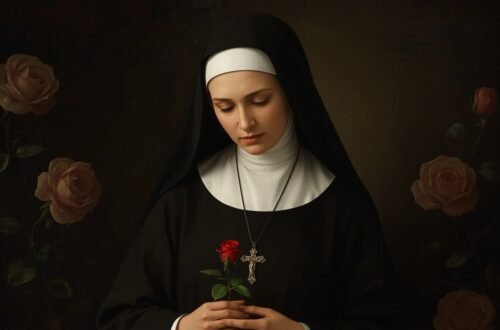
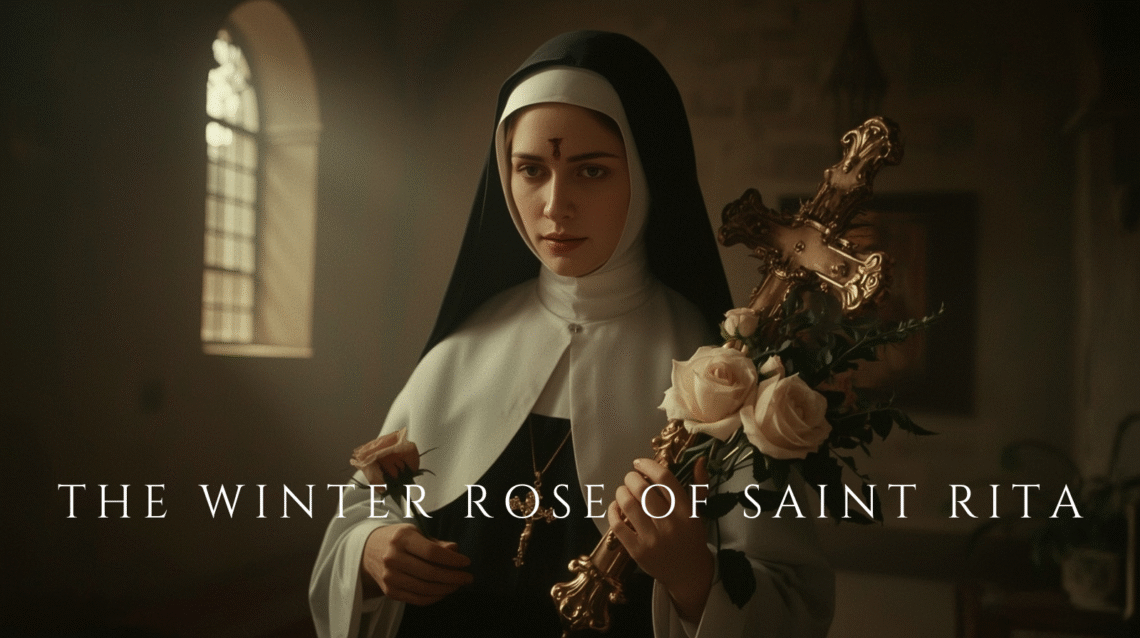
For Saint Rita of Cascia, that image is often a rose.
It is not merely because roses are beautiful, and not simply because they look lovely in devotional art. The rose connected to Saint Rita carries a meaning that reaches directly into sorrow, endurance, and the mystery of how God can bring life out of seasons that look completely barren. That is one reason Saint Rita has become so beloved by people living through impossible situations. The winter rose is not only part of her story. It has become a sign of her spiritual message. Devotion to her is closely linked to the rose, and Augustinian and Catholic devotional sources continue to preserve that association.
Saint Rita lived a life marked by suffering long before she entered the convent. Born near Cascia in Italy, she desired religious life from an early age, but she was married instead. Her husband is traditionally described as harsh and difficult, and Rita became known for responding not with revenge or bitterness but with patience, prayer, and perseverance. After years of hardship, her husband was killed in a violent feud. Her two sons then grew tempted toward vengeance, and Rita feared not only the destruction of their lives, but also the danger to their souls. In the traditions surrounding her life, she is remembered as a woman who pleaded for peace rather than revenge, and who eventually entered the Augustinian religious community after deep personal loss.
Even that alone would make her a powerful saint for wounded families.
But her story did not stop there.
Later in life, while meditating on the Passion of Christ before a crucifix, Rita received a wound on her forehead associated in tradition with a thorn from Christ’s crown. This wound became one of her best-known symbols, reflecting her deep union with the suffering of Jesus. It is one reason she is often shown with a forehead mark, a crucifix, or roses. Catholic sources continue to connect her iconography with the thorn wound and with the rose that later became so central to devotion to her.
Then comes the detail that has touched generations of the faithful.
Near the end of her life, when Rita was ill, she asked for a rose from the garden of her old home. It was winter. By every natural expectation, such a request would have seemed impossible. Yet tradition says that a rose was found blooming there and was brought to her. That image has never left the hearts of the faithful. It is why roses are blessed on her feast day in some places and why so many people see the rose of Saint Rita as a sign that God can still act even when everything appears spiritually dead, out of season, or beyond repair.
This is where Saint Rita’s story becomes more than history.
So many people live in a kind of winter.
There are winters of marriage, when love feels cold and strained. There are winters of grief, when the heart feels numb. There are winters of waiting, when prayers seem to go unanswered. There are winters of finances, family conflict, loneliness, illness, regret, and silent heartbreak. Saint Rita speaks to all of that because she did not become holy by escaping suffering. She became holy by remaining faithful in it.
That is why she is often called the saint of impossible causes.
Not because she offers sentimental comfort, but because her life itself looked impossible. A painful marriage. Violence. Widowhood. sorrow. The fear of losing her sons to revenge. The struggle to enter religious life. Long years of penance and prayer. And still, out of that life, God brought sanctity, healing, and a witness so powerful that the whole Church continues to remember her. She is widely invoked in situations that seem humanly hopeless, especially family pain, marital difficulties, wounds, and desperate needs.
The winter rose tells us something precious:
God is not limited by the season we are in.
What looks finished to us may not be finished to Him.
What looks barren to us may still carry hidden life.
What looks impossible may still be the very place where grace will bloom.
Saint Rita does not promise that every pain disappears quickly. Her life would never support that shallow idea. But she does stand as a witness that God can bring holiness out of heartbreak, peace out of violence, and beauty out of places we thought would never bloom again.
That is why her rose matters.
It is a sign for the person who feels forgotten.
It is a sign for the woman carrying pain in silence.
It is a sign for the family praying through what seems beyond repair.
It is a sign for anyone living through a long winter and asking whether God still sees them.
Yes, He does.
And Saint Rita, with her rose and her wound, reminds us that suffering offered to God is never wasted. In His hands, even winter can become a place of grace.
Closing prayer
Saint Rita, faithful servant of Christ and patroness of impossible causes, pray for us in our trials. Ask the Lord to bring peace where there is conflict, hope where there is despair, and grace where our lives feel barren. Through Christ our Lord. Amen