
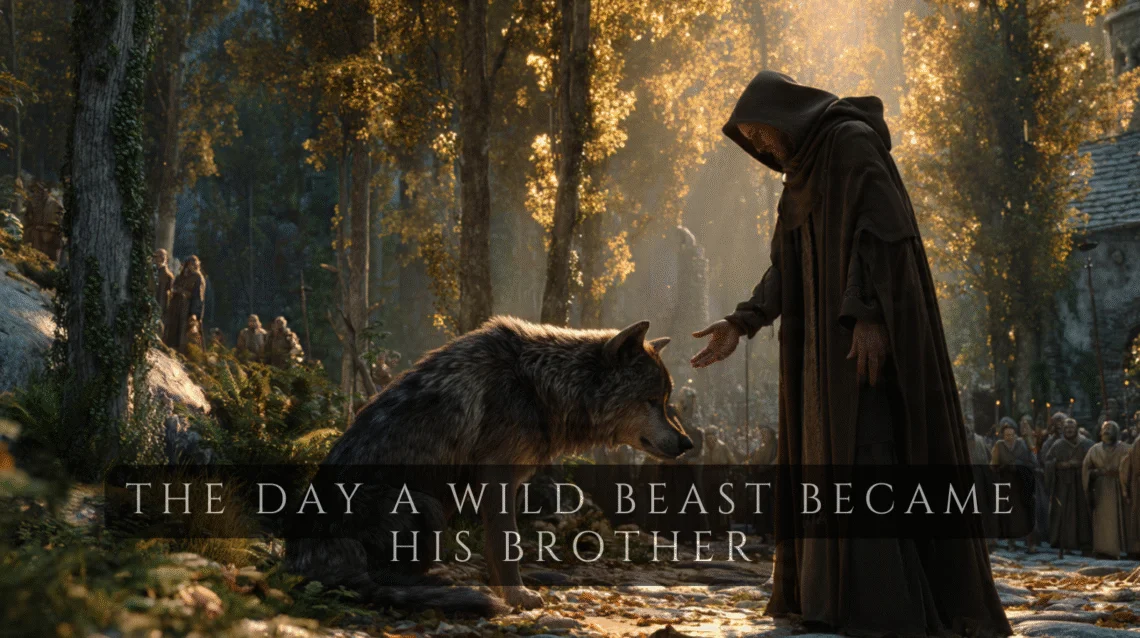
The astonishing true story of the saint who tamed a murderous wolf with nothing but gentleness and the sign of the Cross.
Among the many legends surrounding Saint Francis of Assisi, none is more beloved or more surprising than the story of the Wolf of Gubbio. In a time when fear ruled the countryside and a vicious wolf terrorized an entire town, Francis did something no one else dared to attempt: he walked straight into the forest, unarmed, to meet the beast face‑to‑face. What happened next became one of the most iconic moments in Christian storytelling — a tale of courage, compassion, and the mysterious harmony Francis carried with all of creation. This article explores the unforgettable encounter between Saint Francis and the wolf, the deeper meaning behind the miracle, and why this story continues to inspire believers and animal lovers alike.
A Town Living in Fear
The town of Gubbio was paralyzed.
A massive wolf had been attacking livestock, travelers, and even townspeople.
No one could stop it.
Hunters failed.
Armed men failed.
The people barricaded themselves indoors.
The wolf had become a symbol of terror — a reminder that nature, when wounded or wild, can turn deadly.
When Francis arrived in Gubbio, the townspeople begged him to stay inside the walls.
But Francis had a different instinct.
He walked toward the danger.
Francis Walks Into the Forest
With nothing but his brown habit, his sandals, and his unwavering trust in God, Francis stepped into the woods where the wolf lived.
Witnesses watched from a distance, trembling.
Suddenly, the wolf appeared —
huge, snarling, teeth bared, ready to attack.
Francis did not run.
He did not flinch.
He simply made the sign of the Cross and said:
“Brother Wolf, in the name of Christ, I command you: do no harm.”
The wolf froze.
Then something impossible happened.
The Wolf Becomes Gentle
Instead of lunging, the wolf lowered its head.
It approached Francis slowly, like a frightened animal rather than a monster.
Francis spoke to it as if speaking to a wounded friend:
“Brother Wolf, you have done great harm.
But I know it is hunger and fear that drove you.
If you will make peace, the people of Gubbio will forgive you.”
The wolf placed its paw in Francis’s hand —
a gesture of submission, trust, and peace.
The witnesses gasped.
Some wept.
The miracle had begun.
The Peace Treaty
Francis led the wolf back into the town.
Imagine the scene:
- doors opening
- people peeking out
- children hiding behind their mothers
- grown men trembling
And there was Francis, walking calmly with the wolf at his side.
In the town square, Francis announced a pact: - the wolf would stop attacking
- the townspeople would feed the wolf daily
- both sides would live in peace
The wolf bowed its head in agreement.
From that day on, the wolf lived peacefully in Gubbio —
visiting homes, receiving food, and harming no one.
When the wolf eventually died of old age, the entire town mourned.
They had lost not a monster, but a friend.
Why This Story Still Matters
The Wolf of Gubbio is not just a charming legend.
It is a lesson in:
- compassion
- courage
- reconciliation
- the healing of what is feared
- the dignity of all creation
- the power of gentleness over violence
Francis saw what others could not:
a creature acting out of hunger, fear, and pain — not evil.
He met violence with peace.
He met terror with tenderness.
He met a beast… and found a brother