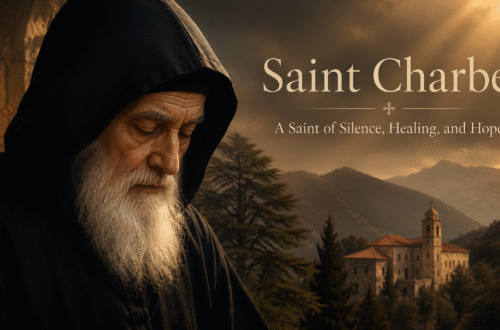
Saint Charbel did not become holy by chasing attention.
He stepped away from noise, comfort, and excess, and he entered a life so hidden that many today would find it almost unbearable. That is part of what makes him so compelling. In a world full of constant talking, constant scrolling, and constant distraction, Saint Charbel stands before us as a man who chose silence, darkness, hunger, and prayer so that nothing would come between his soul and God.
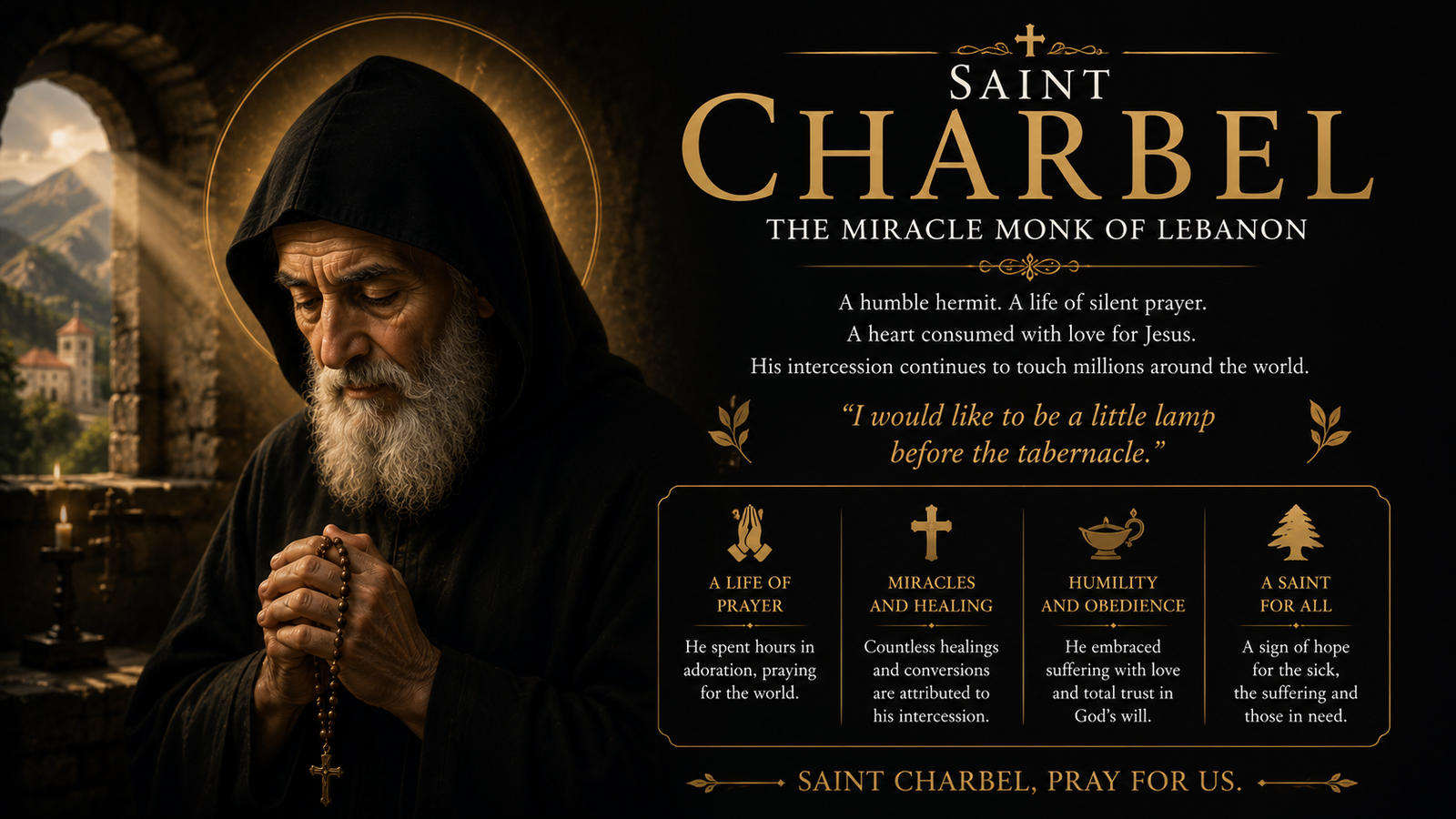
Born Youssef Antoun Makhlouf in 1828 in Beka-Kafra, Lebanon, he entered the Lebanese Maronite Order in 1851, was ordained a priest in 1859, and later received permission to live as a hermit at the Hermitage of Saints Peter and Paul near Annaya, where he spent the last decades of his life in intense prayer and ascetic discipline.
What draws many people to Saint Charbel is not only the miracles associated with him after death. It is the hidden severity of the life he embraced before the world knew his name. The hermit rule under which he lived called for frequent prayer in chapel night and day, strict poverty, silence, one meal a day, no meat or wine, stricter fasting in Lent, and very limited sleep. Accounts of his life also describe him sleeping on the ground and accepting leftovers rather than seeking comfort.
That kind of life sounds almost impossible to modern ears.
Why would a man choose so much deprivation?
Not because Saint Charbel hated life. Not because he despised the body. And not because suffering itself was his goal. Rather, the shape of his life suggests something deeper: he wanted God without distraction. He wanted prayer that was not diluted by comfort, speech, appetite, or self-indulgence. The silence he kept was not empty silence. It was guarded silence. The rule he lived required strict silence and allowed speech only when necessary, and even then briefly and quietly.
There is something piercing about that.
Most of us live as if peace will come after we finally satisfy every craving, answer every message, solve every worry, and arrange every detail of life exactly the way we want it. Saint Charbel lived the opposite way. He stripped life down. He accepted fewer words, less food, less sleep, less comfort, and less recognition. And in that hidden life, he became a man whose very silence still speaks.
This also helps explain why darkness appears so strongly in the way people speak about him.
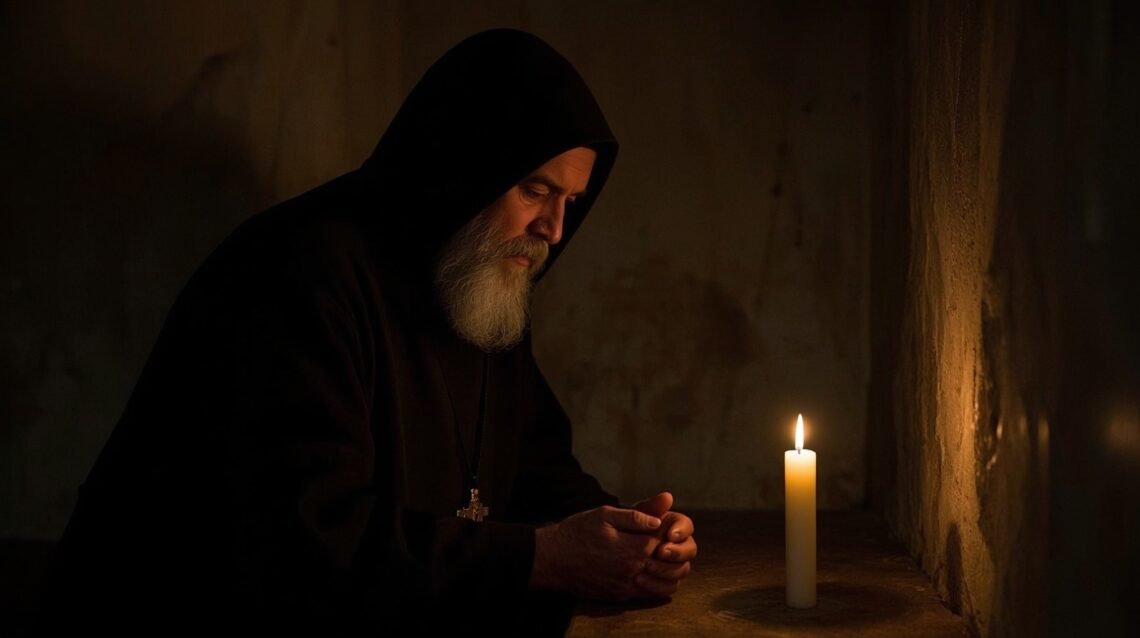
Saint Charbel’s life as a hermit involved prayer at night as well as by day. He entered literal darkness in chapel and solitude, but also the spiritual darkness of detachment, surrender, and self-denial. A later Vatican reflection on his life spoke of “the darkness into which Saint Charbel chose to withdraw,” and described him as one whose eyes were closed “in order to see God more clearly.” That does not give us a direct quote from the saint himself, but it beautifully captures the witness of his life.
So did Saint Charbel pray in the dark because he loved what people fear?
It is safer to say this: he accepted darkness as part of a life entirely centered on God. He did not build his spirituality around comfort or visibility. He entered quiet places, hard disciplines, and hidden hours because he believed God was worth that kind of surrender. The dark was not the point. God was.
The same is true of his fasting.
Saint Charbel’s fasting was not casual. It was shaped by the discipline of his monastic and hermit vocation. One meal a day. No meat. No wine. Greater austerity during Lent. Such practices were not spiritual theater. They were acts of obedience and self-emptying. They trained the heart to depend less on earthly satisfaction and to hunger more deeply for God.
That is one reason his life feels so striking even now.
He thanked God not because hunger was pleasant, but because even deprivation could become an offering. While I could not verify a direct quote from Saint Charbel saying those exact words, the witness of his life makes the idea understandable. This was a man who did not run from sacrifice. He accepted it, disciplined it, and offered it. Hunger, silence, fatigue, obscurity — all of it became a language of love in the presence of God.
There is also a lesser-known devotional story told about Saint Charbel and the crops near Annaya. According to a devotional account preserved by Saint Charbel sources, when locusts threatened the farmers’ fields, Father Charbel came, prayed, blessed the land with holy water, and the locusts left the blessed fields. Whether one approaches that story devotionally or cautiously, it reveals how the faithful came to see him: as a man whose hidden union with God reached into ordinary human need.
That may be one of the most moving parts of his witness.
Saint Charbel lived hidden from the world, but he was not useless to the world. His silence did not make him distant from suffering. His fasting did not make him indifferent to human need. If anything, his withdrawal seems to have made him more available to God, and therefore more fruitful for others. The Church later recognized miracles attributed to his intercession in the causes for his beatification and canonization, and devotion to him spread far beyond Lebanon.
For us, perhaps the lesson is not that every Christian must live exactly as Saint Charbel lived.
But perhaps we do need to ask what all our noise is doing to the soul.
What might happen if we spoke less?
What might happen if we accepted discipline more willingly?
What might happen if we stopped treating every discomfort as an emergency?
What might happen if we entered prayer not only when it felt easy, but also when it felt dark?
Saint Charbel’s life answers with quiet force.
God is still found in silence.
The soul is still strengthened by sacrifice.
Hiddenness is not failure.
And the person who belongs wholly to God can become a light even from the shadows.
Closing prayer
Saint Charbel, faithful monk and hermit of Lebanon, pray for us. Teach us to love silence, accept holy discipline, and seek God more than comfort. Help us trust the Lord in hidden seasons, in hunger, in darkness, and in prayer. Through Christ our Lord. Amen.