Most people know St. Jude as the saint you call when everything feels lost.
But few know who he really was, why he became the patron of impossible causes, or how a centuries‑old misunderstanding nearly erased his devotion from the Church.
His story is one of identity, confusion, courage, and a mission that continues to touch millions of desperate souls today.
This is the real Saint Jude Thaddeus — Apostle, martyr, miracle worker, and friend of the hopeless.
🌿 1. His Beginnings: A Man Hidden in the Shadows of Scripture
Saint Jude Thaddeus was one of the Twelve Apostles, chosen personally by Jesus.
He was the son of Mary of Clopas, a relative of the Virgin Mary, which makes Jude part of the extended Holy Family.
His names in Scripture include:
- Jude
- Thaddeus
- Judas of James
The name “Jude” means “praise” or “thanksgiving.”
“Thaddeus” means “courageous heart.”
He lived up to both.
⚠️ 2. The Great Misunderstanding: Why People Feared to Pray to Him
For centuries, Christians avoided praying to St. Jude because his name sounded too close to Judas Iscariot, the betrayer of Christ.
This tragic confusion caused Jude to be forgotten, overlooked, and rarely invoked.
But the saints say something remarkable:
Because he was so neglected, God granted him the special privilege of helping in the most desperate, impossible situations — the ones no one else could fix.
This is why devotion to him exploded in the last 150 years.
People discovered that the saint who had been ignored… never ignored anyone.
✨ 3. His Mission: The Apostle Who Carried Christ’s Face
One of the most beautiful traditions about St. Jude is the Image of Edessa — the cloth bearing the miraculous face of Jesus.
According to ancient accounts, Jude carried this image to King Abgar of Edessa, who was gravely ill.
When the king touched the cloth, he was healed.
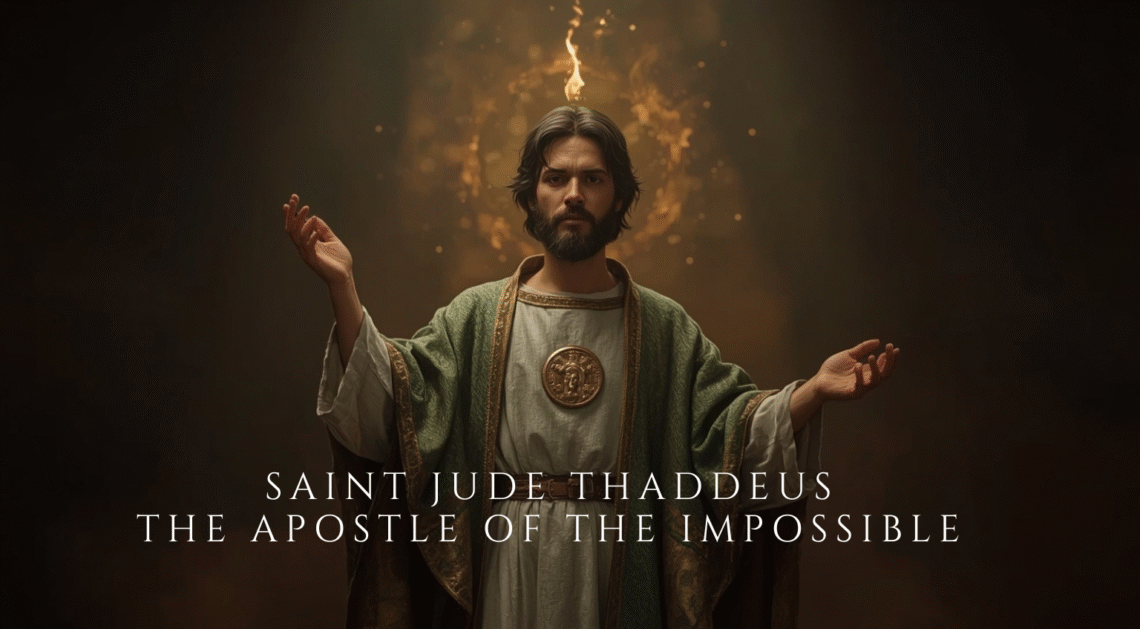
This is why St. Jude is almost always depicted holding:
- A medallion or cloth with the face of Christ
- A staff or club (symbol of his martyrdom)
- A flame above his head (the Holy Spirit at Pentecost)
Each symbol tells a story.
🔥 4. The Meaning of His Symbols and Colors
- The Flame Above His Head
Represents the moment the Holy Spirit descended on the Apostles at Pentecost.
It symbolizes: - divine courage
- clarity
- spiritual authority
- the power to intercede
- The Green Garment
Green is the color of hope, renewal, and new life.
It reflects Jude’s mission to bring hope to the hopeless. - The White Tunic
Purity, truth, and his closeness to Christ. - The Medallion of Christ’s Face
A reminder that Jude brings us directly to Jesus — he does not act alone. - The Staff or Club
The instrument of his martyrdom, symbolizing his unwavering faith.
🌍 5. His Apostolic Work: A Mission Across Nations
After Pentecost, St. Jude traveled across:
- Judea
- Samaria
- Mesopotamia
- Armenia
- Persia
He preached to pagan nations, healed the sick, cast out demons, and converted entire communities.
He died a martyr around 65 AD, alongside St. Simon the Zealot.
His body rests in St. Peter’s Basilica in Rome, where countless pilgrims still visit his tomb.
🙏 6. Why People Seek St. Jude Today
St. Jude is the patron of:
- Impossible causes
- Desperate situations
- Urgent needs
- Legal battles
- Financial crises
- Family healing
- Health emergencies
- Protection from injustice
- Emotional and spiritual despair
People turn to him when: - doctors have no answers
- courts seem unfair
- relationships are breaking
- bills are overwhelming
- hope feels gone
And time after time, testimonies pour in of sudden breakthroughs, unexpected reversals, and peace in impossible situations.
🌟 7. Hardly Known Facts About St. Jude
- He wrote one of the shortest but strongest books of the New Testament
The Epistle of Jude — a fiery defense of truth. - He was Jesus’ relative
Through Mary of Clopas. - His devotion grew massively during the Great Depression
Because people needed hope when everything collapsed. - His shrine in Chicago receives over 100,000 prayer requests a month
A sign of how deeply he is loved. - He is often called “The Saint Who Shows Up”
Because his intercession is known for being fast, clear, and powerful.
🕊️ 8. The Traditional Prayer to St. Jude
Most holy Apostle, St. Jude,
faithful servant and friend of Jesus,
the Church honors and invokes you
as the patron of hopeless cases
and of things almost despaired of.
Pray for me, who am so helpless.
Bring visible and speedy help where help is almost despaired of.
Come to my assistance in this great need,
that I may receive the consolation and help of heaven
in all my necessities, tribulations, and sufferings.
Amen.
🌄 9. His Legacy: The Apostle Who Never Abandons the Broken
St. Jude’s story is not about fame or recognition.
It is about a man who was forgotten — and because of that, became the saint who helps those who feel forgotten.
His life teaches us:
- No situation is too far gone.
- No prayer is too small.
- No person is too lost.
- No darkness is too deep for God to break through.
St. Jude is the saint of the last door — the one that opens when all others close.
And for millions around the world, he remains a living reminder that God still works miracles in impossible places.