Saint Jude is often remembered for one thing above all: impossible causes.
When life feels delayed, blocked, or painfully uncertain, many Catholics turn to him with deep trust. But there is another detail about Saint Jude that deserves more attention. In sacred art, he is often shown wearing or holding an image of Christ on his chest. That detail is not random. It points to one of the most meaningful parts of how the Church has remembered him.
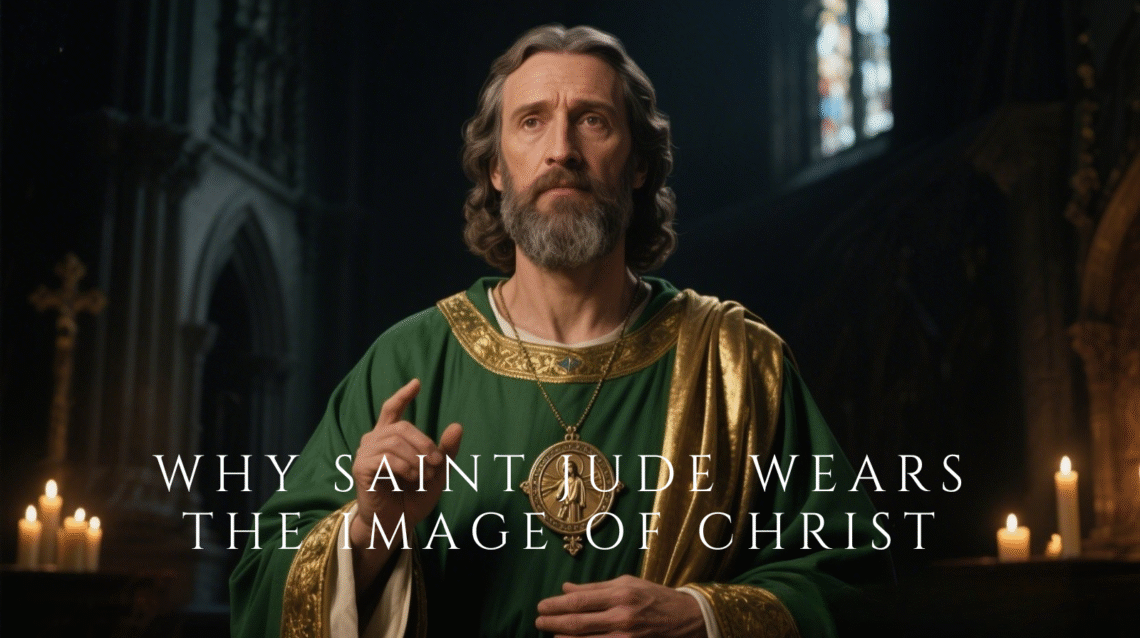
According to long-standing Christian tradition, the image on Saint Jude’s chest is connected to the Image of Edessa, a revered account in which King Abgar of Edessa received an image of Jesus associated with healing and faith. The National Shrine of St. Jude explains that this is why Saint Jude is often depicted with a medallion-like image of Christ. In iconography, he is also commonly shown in green, a color linked with hope, and with a flame above his head, recalling Pentecost and the coming of the Holy Spirit.
That matters because Saint Jude’s devotion is not only about desperate prayer. It is about keeping Christ close.
The image on his chest says something powerful without words: Saint Jude points beyond himself. He does not draw attention to his own strength. He carries the image of the Lord. That is one reason his devotion has endured so strongly. In difficult moments, people do not turn to Saint Jude because he is a substitute for Christ, but because he leads the troubled heart back to Christ with hope. The Shrine of St. Jude presents him precisely as a faithful apostle whose symbols direct people toward Jesus, even as millions seek his intercession in hardship.
Over time, Saint Jude became especially known in Roman Catholic devotion as the patron saint of impossible or desperate causes. Britannica notes that this devotion developed strongly in France and Germany in the late eighteenth century and has continued ever since. That history helps explain why Saint Jude’s name is so often spoken in moments when a person feels out of options, emotionally worn down, or desperate for God to move.
But perhaps what makes Saint Jude so beloved is not only that people bring him impossible cases.
It is that his very image teaches hope.
He wears green, the color of hope.
He bears the flame of Pentecost, the fire of the Holy Spirit.
He carries the image of Christ near his heart.
That combination is deeply moving. Saint Jude is not simply “the saint for emergencies.” He is a witness that even in the hardest moments, the Christian response is not surrender to despair, but renewed closeness to Christ.
There is something beautiful in that for those living through uncertainty.
Many people come to Saint Jude when they are carrying situations that seem humanly stuck: family conflict, financial pressure, illness, long waiting, broken relationships, unanswered prayer, emotional exhaustion, or fear about the future. His devotion has become especially strong because he is associated with the kinds of burdens people often struggle to speak about openly. To pray to Saint Jude is, in many cases, to admit, “I do not know what to do next, but I still want to hope.”
And that is not weakness.
That is faith refusing to die.
Saint Jude’s witness reminds us that hope is not naive optimism. Hope is a decision to remain turned toward Christ even when the path is unclear. His symbols make that visible. The image on his chest says: keep Christ before you. The flame says: do not forget the Spirit. The green says: hope is still alive, even here. Those details are why his iconography has remained so recognizable in Catholic devotion.
So perhaps the deeper meaning of Saint Jude’s devotion is this:
When everything feels impossible, do not let go of Christ.
That is why people still pray to Saint Jude.
Not only because they are desperate,
but because they are trying to remain faithful inside the desperation.
And maybe that is what makes his intercession feel so strong.
He is the apostle people call on when the road narrows, when the burden feels too heavy, and when the heart needs a reason to keep trusting. Yet even then, he does not keep the soul fixed on the problem. He turns it, again and again, toward the face of Christ.
Closing prayer
Saint Jude, faithful apostle and friend of the suffering, pray for us. In difficult moments, keep our hearts close to Christ, strengthen our hope, and help us trust God when the way seems impossible. Through Christ our Lord. Amen.