
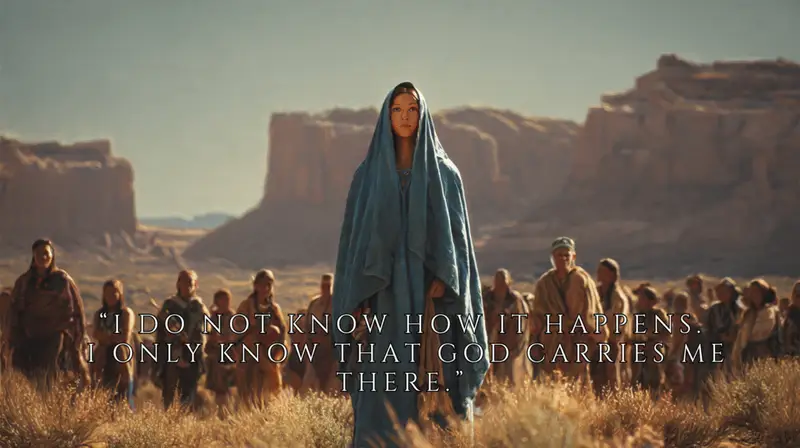
One of the most extraordinary and mysterious miracles in Catholic history involves a cloistered nun who never left her convent in Spain — yet appeared more than 5,000 miles away in the deserts of the American Southwest. Known as the “Lady in Blue,” Sister María de Ágreda was said to have bilocated dozens, even hundreds of times, teaching the Gospel to Native American tribes long before missionaries ever arrived. Her appearances were so vivid and so consistent that entire communities sought baptism the moment the first friars reached them. This article explores the astonishing story of the Blue Nun, the miracle of her bilocation, and the profound impact she left on a people she never met in the flesh.
A Cloistered Nun With a Burning Heart
María de Ágreda entered the convent at age 17.
She lived:
- behind walls
- in silence
- in prayer
- in deep mystical union with God
She never traveled.
She never sailed.
She never left Spain.
And yet… something extraordinary began happening.
During prayer, she felt herself “carried” to a distant land — a place of deserts, mesas, and people she had never seen.
She didn’t understand it at first.
But the people she visited did.
The First Reports From the New World
In the early 1600s, Franciscan missionaries in what is now Texas and New Mexico encountered something shocking.
Entire tribes — especially the Jumano people — approached them saying:
“A woman dressed in blue has been teaching us about the God of the Christians.”
The friars were stunned.
No woman had ever been there.
No missionary had reached them.
No one knew their language.
Yet the tribes described:
- a young woman
- wearing a blue mantle
- speaking their language perfectly
- teaching them about Jesus
- urging them to seek baptism
The missionaries asked:
“Who is she?”
The people answered:
“The Lady in Blue.”
The Investigation
Word reached Spain.
The Church launched an inquiry.
They questioned María de Ágreda.
She was humble, hesitant, and deeply obedient.
She said:
“I do not know how it happens.
I only know that God carries me there.”
She described:
- the land
- the people
- their clothing
- their customs
- their villages
All with perfect accuracy —
despite never leaving her convent.
The missionaries confirmed every detail.
The Jumano Testimony
The Jumano people insisted:
- she appeared physically
- she walked among them
- she taught them
- she comforted the sick
- she prepared them for baptism
They said she spoke their language fluently.
María, meanwhile, said she spoke to them in Spanish —
and God handled the rest.
The consistency of the testimonies was overwhelming.
The Miracle of Bilocation
Bilocation is a rare mystical gift where a person appears in two places at once.
Saints known for it include:
- Padre Pio
- Saint Anthony of Padua
- Saint Alphonsus Liguori
But María de Ágreda’s bilocations were unique because:
- they were frequent
- they were missionary
- they were documented by entire communities
- they changed history
Her appearances prepared the ground for evangelization in a way no human planning ever could.
A Legacy That Still Echoes
María de Ágreda became known as:
- The Lady in Blue
- The Blue Nun
- The Woman Who Came From the Sky
Her story is still told among Native communities today.
She left behind:
- a spiritual bridge between cultures
- a legacy of peace
- a testimony of God’s creativity
- a reminder that grace is not limited by geography
She died in 1665, but her impact lives on.
Why This Story Still Matters
The Blue Nun’s bilocation is not just a miracle story.
It is a reminder that:
- God reaches people where they are
- the Holy Spirit crosses every border
- evangelization is ultimately God’s work
- the cloistered life has global impact
- prayer can move across continents
María de Ágreda never left her convent —
yet she changed the history of a people she never met with her physical eyes.




Do you have recommended primary sources on this—missionary reports, inquiry notes, or biographies of Sister María de Ágreda? I’d love to read further.
The account is compelling because it asks readers to hold together history, faith, and the limits of what can be independently verified. The reported appearances of Sister María de Ágreda and the communities’ interest in baptism give the story its emotional force, while the extraordinary claim of bilocation invites careful reflection rather than easy certainty. That tension may be why the Lady in Blue remains so memorable.
The account is striking because it places a claimed mystical event alongside the later arrival of friars and the reported requests for baptism. That sequence is worth handling carefully: it explains why the story has endured within Catholic tradition while also inviting readers to distinguish devotional testimony from independently documented history. The detail that Sister María remained cloistered in Spain gives the narrative its central tension and makes its historical reception especially interesting.
The account is most compelling when read as a tradition that joins spiritual belief, missionary history, and the testimony attributed to different communities. The reported bilocation of Sister María de Ágreda raises questions that cannot be settled simply by repeating the story: what sources preserve the claims, how were they recorded, and how did later retellings shape them? That distinction matters because a miracle narrative can carry religious meaning while still inviting careful historical context.
Editing is easier when basic text signals are visible before a draft feels finished. Word and character counts help with format limits, while sentence analysis and readability cues can reveal dense passages that need simplifying. Contador de Palabras also keeps attention on keyword repetition and rhythm, which are easy to overlook during a quick proofread. Used as a review aid, these checks can support a clearer Spanish text without replacing the writer’s judgment.
For Japanese writing, a count is rarely just one number. Character, line, paragraph, manuscript-page, and encoding-byte totals can each matter depending on the submission rules or publishing destination. A tool such as 文字数カウント is especially useful when it shows these measures together and keeps the text in the browser, making quick revisions easier without adding unnecessary handling concerns.
A useful academic resource should make the next decision clear: what to study, which material applies to a subject, and how current performance affects the term. That is why SRMIST study resources are most valuable when browsing is structured around semesters and courses rather than a long, unfiltered list. Combining reference material with GPA and attendance tools also helps students turn preparation into a realistic weekly plan.
The account is compelling because it places a cloistered life alongside a claim of appearances far from Spain. For readers, it would help to separate devotional tradition, the historical records associated with Sister María de Ágreda, and the meaning believers attach to bilocation. The reported connection with Indigenous communities also deserves careful context, including how their own histories and voices are represented. That approach can preserve the spiritual significance of the story while making its historical framing clearer.
When equations begin as screenshots or notes, the real priority is retaining symbols, structure, and editability instead of merely producing an image-like result. An image to latex workflow is especially useful when it lets people review the generated expression before reusing it in coursework, documentation, or a report. Support for both equations and tables also matters, since conversion problems often appear in layouts rather than in individual characters.
Choosing a converter involves more than extracting selectable text. The useful test is whether the resulting Markdown preserves document structure well enough to search, revise, quote, or place under version control. Clear scans may be suitable for OCR, but dense tables and multi-column layouts still deserve a line-by-line review. A local pdf to md option is particularly worth considering when document handling requirements discourage transferring files to a remote application server.