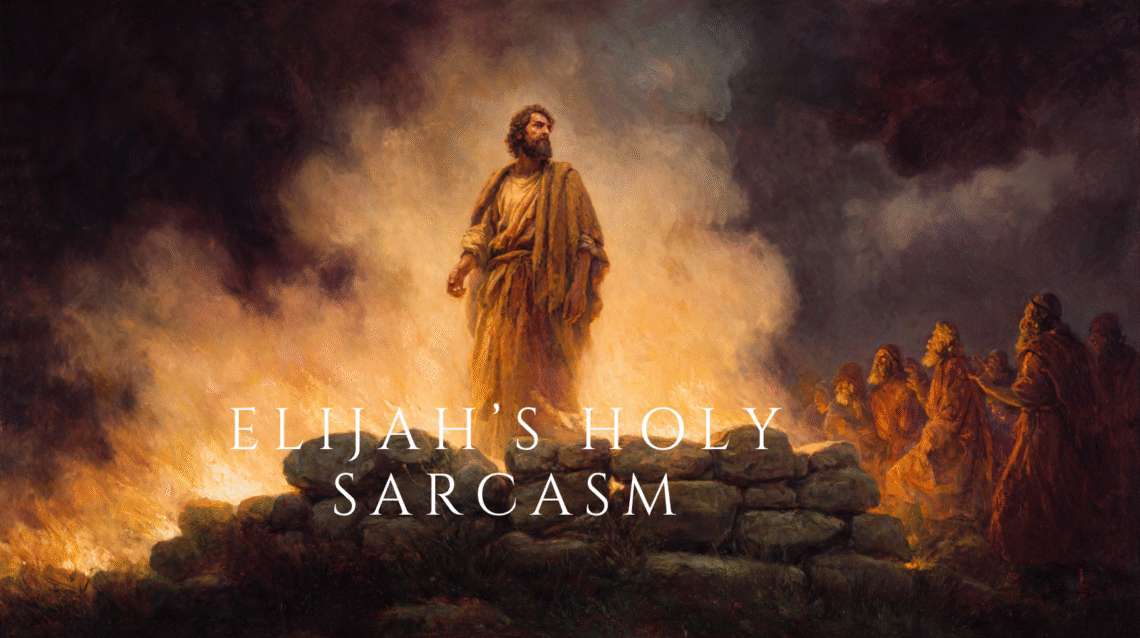
The showdown on Mount Carmel is one of the most dramatic scenes in the Old Testament—but it also contains one of the sharpest and funniest lines in Scripture.
The prophets of Baal spend hours shouting, dancing, and pleading with their god to send fire.
Nothing happens.
No voice.
No fire.
No answer.
Elijah watches them for hours—and then he starts roasting them.
A Nation Divided Between Two Gods
Israel had not completely rejected the Lord. Instead, the people were attempting to divide their loyalty between God and Baal.
Elijah confronts them with a question:
“How long will you go limping between two different opinions? If the Lord is God, follow him; but if Baal, then follow him.”
—1 Kings 18:21
The people say nothing.
They want the protection of the Lord while still holding on to the false worship encouraged by King Ahab and Queen Jezebel. Elijah refuses to let them remain comfortably undecided.
Either the Lord is God—or Baal is.
The challenge is simple: two altars, two sacrifices, and no human-made fire. The God who answers by fire will prove that He is the true God.
The Prophets of Baal Put on a Show
The prophets of Baal prepare their sacrifice and begin calling upon him early in the morning:
“O Baal, answer us!”
They continue until noon.
They shout.
They dance around the altar.
They repeat themselves.
They become increasingly frantic.
But Scripture gives the devastating result:
“There was no voice, and no one answered.”
Baal’s prophets are making all the noise, but heaven remains completely silent.
And that is when Elijah decides he has seen enough.
Elijah Starts Roasting Them
At noon, Elijah begins to mock them:
“Shout louder!”
Perhaps Baal is deep in thought. Perhaps he is busy. Perhaps he has gone traveling. Maybe he has fallen asleep and needs someone to wake him.
The NIV describes Baal as possibly being “busy,” while the ESV renders the possible euphemism much more bluntly: perhaps he is “relieving himself.” The exact Hebrew expression is debated, but Elijah’s meaning is unmistakable: What kind of god becomes distracted, disappears, falls asleep, or cannot hear his own worshippers?
In modern language, Elijah is essentially saying:
“Keep shouting. Maybe your god stepped away.”
It is holy sarcasm with a serious purpose.
Elijah is not merely trying to be funny. He is exposing the absurdity of worshipping a powerless idol.
A god who must be awakened is not God.
A god who cannot hear is not God.
A god who requires hours of screaming but still does nothing is not God.
More Noise, More Desperation—and Still Nothing
The prophets respond by shouting even louder.
They cut themselves with swords and spears until blood pours from their bodies. They continue for hours, working themselves into a frenzy.
Yet Scripture repeats the same terrible truth:
“There was no voice. No one answered; no one paid attention.”
Their false god demanded everything from them and gave them nothing in return.
Baal did not comfort them.
Baal did not speak to them.
Baal did not send fire.
Baal was not there.
That is what idols always do. They promise power, security, pleasure, approval, or control—but they can never give the soul what only God can provide.
Elijah Repairs What Had Been Broken
When the prophets of Baal finally finish, Elijah does not begin with a performance.
He begins by repairing the altar of the Lord that had been torn down.
He takes twelve stones, representing the twelve tribes of Israel, and rebuilds the altar. Then he places the sacrifice upon it and orders water to be poured over everything—not once, but three times.
The sacrifice is soaked.
The wood is soaked.
The trench surrounding the altar is filled with water.
Elijah removes every possible human explanation for what is about to happen.
No one will be able to claim that he secretly started the fire himself.
Elijah Does Not Shout
After hours of chaos from the prophets of Baal, Elijah steps forward and offers a simple prayer:
“Answer me, O Lord, answer me, that this people may know that you, O Lord, are God, and that you have turned their hearts back.”
—1 Kings 18:37
That is the heart of Elijah’s prayer.
He is not asking God to send fire so that Elijah will appear powerful. He wants the people to know that the Lord is God—and he wants their hearts to return to Him.
Then the fire falls.
It consumes the sacrifice, the wood, the stones, and even the dust. It also consumes the water that had filled the trench.
The prophets of Baal shouted for hours and received silence.
Elijah prayed—and the living God answered.
“The Lord, He Is God”
When the people witness the fire, they fall upon their faces and cry out:
“The Lord, he is God; the Lord, he is God.”
The same people who had remained silent when Elijah challenged their divided loyalty can no longer deny the truth.
The fire did more than consume an offering.
It exposed a lie.
It shattered their indecision.
It turned their attention back toward the Lord.
God did not answer because Elijah performed perfectly. God answered so that a wandering people might return to Him.
What Are We Shouting at Today?
Most people today are not dancing around an altar dedicated to Baal, but idols still exist.
Anything we expect to save us, define us, complete us, or give us the security that belongs to God can become an idol.
Money can become an idol.
Success can become an idol.
Public approval can become an idol.
A relationship can become an idol.
Control can become an idol.
We may sacrifice our peace, our time, our health, and even our integrity trying to make these things answer us.
Yet they cannot hear our prayers.
They cannot forgive sin.
They cannot heal the soul.
They cannot love us with the eternal and faithful love of God.
Like Baal, they demand more and more while remaining silent when we need them most.
Holy Sarcasm Is Not Permission to Be Cruel
Elijah’s words were sharp, but this passage should not become an excuse to humiliate people or mock someone who is sincerely searching for God.
Elijah was confronting public idolatry that had drawn an entire nation away from the Lord. His sarcasm exposed the false claim that Baal possessed divine power.
The point is not that Christians should become rude.
The point is that lies do not become sacred merely because many people believe them.
Sometimes truth comforts.
Sometimes truth heals.
And sometimes truth exposes something so clearly that the falsehood can no longer pretend to be powerful.
The Question Still Remains
Elijah’s first question may be the most important part of the entire story:
“How long will you go limping between two different opinions?”
We cannot give God part of our hearts while expecting the world to satisfy the rest.
We cannot call Him Lord while treating Him as one option among many.
The Lord does not ask us to shout louder, injure ourselves, or perform until we earn His attention. He calls us to come near, turn our hearts back to Him, and trust that He hears us.
The false gods remain silent.
The Lord still answers.
A Prayer Inspired by Mount Carmel
Lord God of Elijah, reveal every false thing in which I have placed my trust. Forgive me for the times I have allowed fear, success, money, approval, or control to occupy the place that belongs to You.
Repair the altar of my heart and turn me back toward You completely. Help me stop wavering between faith and the promises of the world.
When I feel unheard, remind me that You are not absent. When I feel discouraged, strengthen my faith. When I am tempted to place my hope in something powerless, remind me that You alone are God.
May my life declare what the people proclaimed on Mount Carmel:
The Lord, He is God.
Through Christ our Lord. Amen.